By. Scott Jackson
08/21/2025
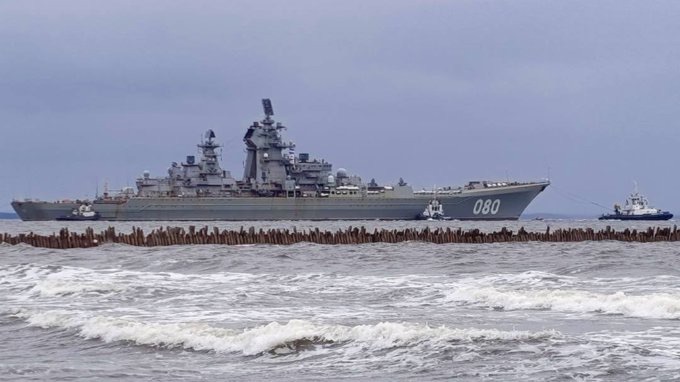
The Project 1144 Orlan Admiral Nakhimov last sailed in 1997. It was brought into the Sevmash shipyard in the port city of Severodvinsk with the intent for a major refit and modernization. The refit took almost 30 years but the time has come and this week the RFS Admiral Nakhimov was seen sailing under her own power as she undergoes sea trials to test its new and old systems. The large cruiser has seen a modernization to its weapons systems and sensors which the Russian leadership hopes will put fear into the enemies of the Russian navy.
The Project 1144 battlecruiser (referred to as the Kirov-class by NATO), is a powerhouse of a ship. Called a nuclear-powered guided missile heavy cruiser by the Soviets, and besides aircraft carriers, it is today, the largest surface combatant in the world. At 827 ft long it is as large as some of the dreadnoughts and battleships of the early 20th century. During World War 2, the battleships were the dominant force until aircraft carriers were developed which could sink a battleship without it ever having fired a shot. Battleships spent the rest of the war far away from most combat. The reason battleships are no longer used is simple: big ships are easier to sink and the larger the ship, the larger the loss when they are destroyed, taking with them more men, and more weapons than their smaller peers. A country’s navy could build one large ship or several smaller ships that can do mostly same task and be less of a liability if sunk. The last of the battleships were used by the U.S. as glorified missile platforms and artillery pieces, with 2 modernized Iowa-classes being used in the gulf war. The Kirovs were built around this time during the Cold War as a direct counter to the Benjamin Franklin-class nuclear submarine. For all its anti-sea and air based weaponry the original primary job of this battleship sized cruiser was that of ASW: anti submarine warfare, sometimes called awful slow warfare by its practitioners. The Kirovs all came with ten torpedo tubes which launched torpedoes or anti-submarine missiles. They also had advanced sensors for detecting them and 3 helicopters which could carry ASW weapons.
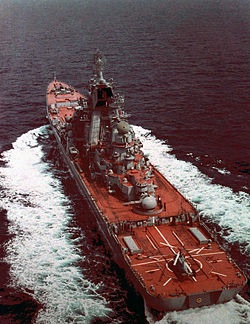
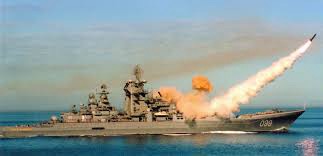
The Admiral Nakhimov other weapons before the modernization included the main weapon, 20 of the P-700 Granit (Shipwreck) anti-ship missiles which could destroy a ship out to 300 miles.This missiles was designed to sink American carriers these missiles outrange the newest American Anti-Ship missiles, the AGM-84H/K SLAM-ER (Standoff Land Attack Missile-Expanded Response) by 100 miles, according to the publicly available data. It’s been claimed that the missile, when fired in a swarm (group of 4–8) has a unique guidance mode. One of the weapons climbs to a higher altitude and designates targets to the group while the others fly low to the sea and keep their onboard sensors in a passive mode, only flipping on active guidance in the final seconds before launch. If the targeting missile is destroyed another will rise to take its place. The missile responsible for target designation climbs in short pop-ups, so as to be harder to intercept. The missiles are linked by data connections, forming a network. The missile’s predecessors, the P-500 and the Bazalt and the P-1000 Vulkan were capable of this guidance technique as well. Now those P-700 missiles have been removed giving space for some of the 176 Vertical Launch Cells 80 of which can hold the subsonic Kalibr cruise missile, the supersonic Oniks anti-ship missile, and the hypersonic Tsirkon cruise missiles. That leaves 96 cells reserved for surface to air missiles. The original Kirov-class ships came with the S-300F systems in rotary tubes below deck however there are some reports that these were replaced with the S-400F system giving them around 250 miles of air defense protection. It layers that protection with the more medium range abilities of 6 Pantsir-M air defense systems as well as a number of AK-630 close-in weapon systems. Additionally, the 130mm AK-130 dual purpose naval gun has been replaced by a modern 130mm AK-192M naval gun.
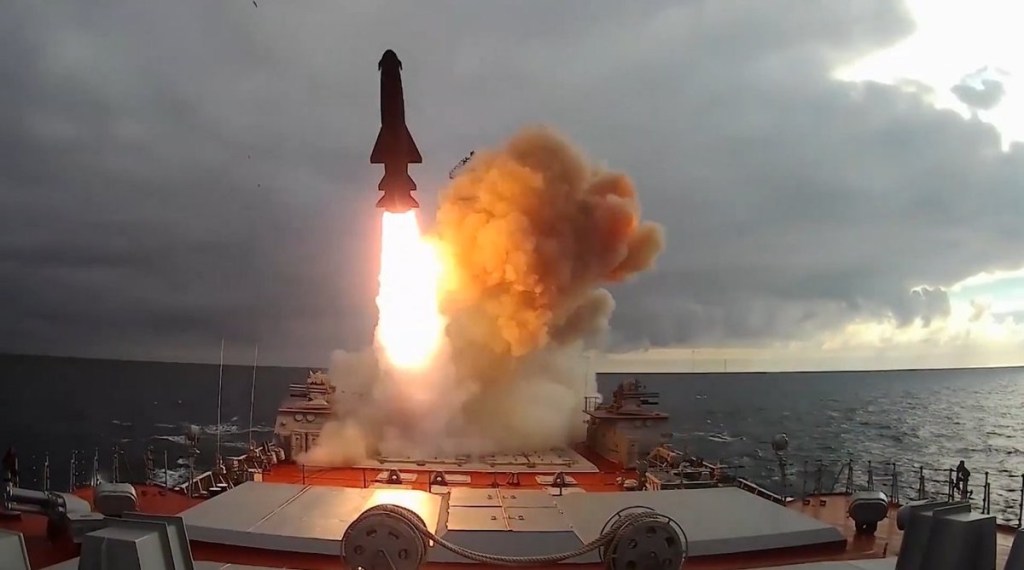
The 176 launch cells make this ship the most heavily armed capital ship on the planet currently, surpassing the 122 cells on the American Ticonderoga-Class cruisers or the 96 on the Arleigh Burke destroyers. The Chinese Type 055 Renhai-class cruisers carry 112.

The Admiral Nakhimov’s sea trials will take several months at least, with the first stages testing the ships safety, navigation, and propulsion systems and later the weapons and combat effectiveness. After that the vessel will be taken back into the service of the Russian Navy. The earliest estimates for the end of the sea trials put it at the end of the year before the ships return to active service, taking the flagship role with the Northern Fleet and the Russian Navy. At this The RFS Pyotr Velikiy, the current Kirov-class flagship of the Russian Navy is not likely to undergo the same modernization of the Admiral Nakhimov and is more likely to be decommissioned as the cost is simply too great for Russia to foot at this time. The Pyotr Velikiy has also been in service for a good while longer than her sistership, making her more worn down after decades of operation.
When RFS Admiral Nakhimov replaces the RFS Pyotr Velikiy the Russian navy will only have three cruisers left in their navy, the RFS Marshal Ustanov in the Northern Fleet, and the RFS Varyag in the Pacific Fleet. Both cruisers are part of the Slava-class missile cruisers which are also coming to the end of their service life. It’s possible in the near future the Admiral Nakhimov could become Russia’s only capital warship in the fleet. Russian shipyards are unable to build new large ships for the time being and even repair work is becoming an impossible task. Recently, plans for the repair and refit of Russia’s sole aircraft carrier, the RFS Admiral Kuznetsov, were canceled.
The Admiral Nakhimov will likely take an important role in the Russian surface fleet, with its numerous long range weapons systems, the ship can be used to interdict a large area at sea and provide protection for a Russian fleet during their operations.


Leave a Reply