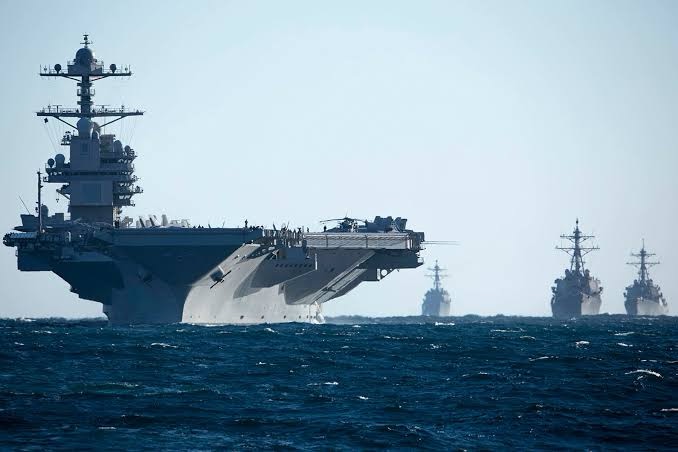
The Pentagon has announced that the USS Gerald R. Ford (CVN- 78) and its Carrier Strike Group (CSG) is being redeployed to the Caribbean in an effort to bolster the forces currently involved in counter-narcotic operations in the region. This comes a day after the announcement that the White House was going to Congress with notice that the president was planning to conduct ground operations in Venezuela. These operations will likely target suspected drug production operations and other assets under the control of the cartels operating in the country. That being said, the Venezuelan military is unlikely to just watch as US forces carry out strikes in their country, meaning the U.S. will likely preemptively target assets under the control of Venezuelan President Maduro’s forces. Radar, air defense and any air units are to be a high priority for suppression or destruction.
At last report the Ford CSG was operating in the Adriatic Sea off the coast of Italy and various parts of the Mediterranean. It will take the CSG at least several days to assume a position within range of Venezuela.
The USS Gerald R. Ford Carrier Strike Group includes the carrier along with three Areleigh Burke-class guided missile destroyers acting as escorts.
USS Bainbridge DDG-96
USS Mahan DDG-72
The USS Winston Churchill DDG-81 is acting as the CSG’s Air Defense Commander.
Making up the air power of the CSG is Carrier Wing 8, made up of the following.
The “Tomcatters” of Strike Fighter Squadron (VFA) 31 F/A-18E
The “Ragin Bulls” of VFA 37 – F/A-18E
The “Golden Warriors” of VFA 87 – F/A-18E
.The “Black Lions” of VFA 213 – F/A-18F
The “Gray Wolves” of Electronic Attack Squadron (VAQ) 142 – EA-18G
The “Bear Aces” of Airborne Command and Control Squadron (VAW) 124 – E-2D
The “Rawhides” of Fleet Logistics Squadron (VRC) 40 Det. – C-2A
The “Spartans” of Helicopter Maritime Strike Squadron (HSM) 70 – MH-60R
The “Tridents” of Helicopter Sea Combat Squadron (HSC) 9 – MH-60S
Fleet info pulled from various public sources as well as the GCR database.
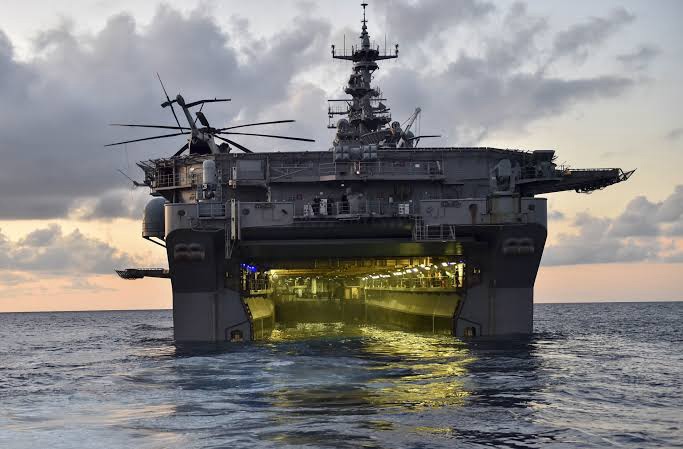
A look inside the well deck of the USS Iwo Jima (LHD-7)
By.Scott Jackson
10.19.2025
The United States Department of Defense and White House released footage showing the destruction of a Venezuelan submarine reported to be involved in cartel drug trafficking operations and the transportation of fentanyl, a powerful synthetic opiate. The sub was destroyed on Thursday.
While all the media and even this article calls the vessel a submarine it’s more like a semi- submersible. Most of the vessel is underwater but it doesn’t have the capability to fully submerge itself. If this vessel is anything like others that have been stopped trying to smuggle drugs into America in the past, it was made with fiberglass and plywood.
Video of the strike on the Venezuelan semi-submersible.
The submarine had two survivors who were rescued by a US helicopter and taken to a Navy ship in the area. The men will eventually be repatriated to their home countries according to the US. The men are from Ecuador and Colombia. The bombing of the sub killed two other men, both alleged to be Narco terrorists. Sending the men back to their home countries helps the US avoid any turbulent legal issues of detaining the men whose drug trafficking crimes don’t exactly fit under the laws of war.
Neither the pentagon or the White House offered any other comments when asked by GCR or other media outlets.
Moving on to today, it was just several hours ago reported that the US said they had carried out a strike on a vessel associated with a Colombian leftist rebel group,National Liberation Army.
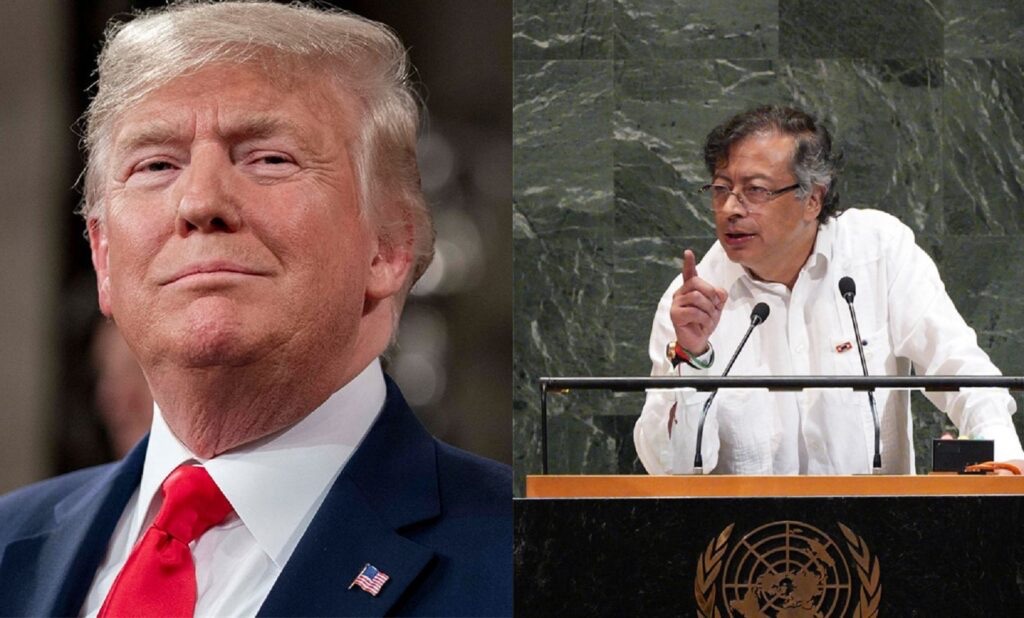
This strike has led to a falling out between US president Trump and Columbian President Gustavo Petro as the Colombian President accused the US of murder. “US government officials have committed a murder and violated our sovereignty in territorial waters. Fisherman Alejandro Carranza had no ties to the drug trade and his daily activity was fishing,” said Gustavo Petro on a post on social media. He added “The Colombian boat was adrift and had its distress signal up due to an engine failure. We await explanations from the US government.”
Trump and Colombian President Gustavo Petro
That US response was swift, with Trump and the White House cutting off all subsidies. Trump said the Columbian president “is an illegal drug leader strongly encouraging the massive production of drugs, in big and small fields, all over Columbia”.
Trump later ranted on Truth Social “It has become the biggest business in Columbia, by far, and Petro does nothing to stop it, despite large scale payments and subsidies from the USA that are nothing more than a long term rip off of America. AS OF TODAY, THESE PAYMENTS, OR ANY OTHER FORM OF PAYMENT, OR SUBSIDIES, WILL NO LONGER BE MADE TO COLUMBIA,”
Trump continued “The purpose of this drug production is the sale of massive amounts of product into the United States, causing death, destruction, and havoc,” the president said.
“Petro, a low rated and very unpopular leader, with a fresh mouth toward America, better close up these killing fields immediately, or the United States will close them up for him, and it won’t be done nicely.”
Russian President Vladimir Putin has acknowledged that the Russian federation is responsible for the downing of the Azerbaijani Airlines, Flight 8243 on Christmas Day 2024.
The plane, an Embaer 190 took off from Heydar Aliyev International Airport carrying 62 passengers and 5 crew.
The flight first experienced issues about 40 minutes after takeoff when it first entered the Russian airspace around Grozny. The pilots reported losing GPS navigational systems, due to jamming. The plane continued its approach at the Kadyrov Grozny International Airport in the Chechen capital. At this time the pilots reported twice tried to land at Grozny but were ultimately diverted due to fog. 81 minutes into the flight, and while the plane was still over Grozny, passengers at this time reported an explosion and shrapnel striking the aircraft. The pilots thought they had experienced a bird strike and proceeded to initiate emergency protocols and squawked 7700, which signals to others that the flight is experiencing an emergency. They then turned back towards the Caspian Sea.
The plane made it across the Caspian and back to Azerbaijan but the pilots were not able to maintain control of the aircraft while trying to put it down in Baku. Video from the ground showed the plane changing altitude at a very quick rate as the plane pitched up and down as the pilots fought to bring the plane down with increasingly unresponsive controls.
Video from the crash of Azerbaijani Airlines Flight 8243.
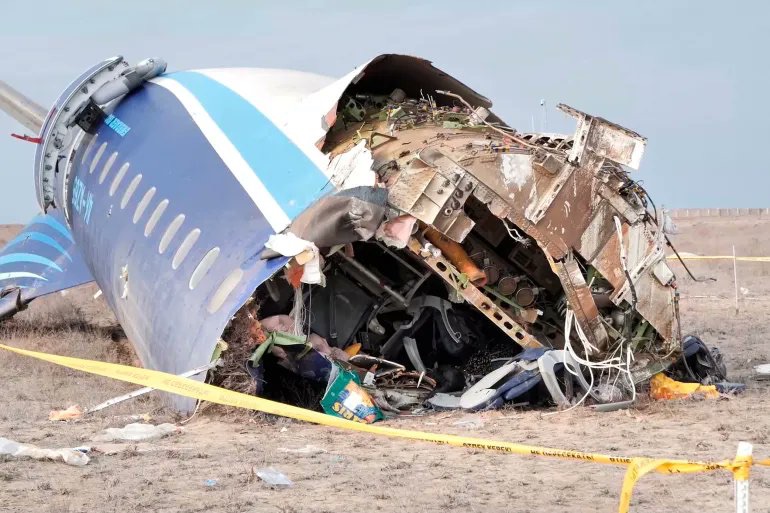
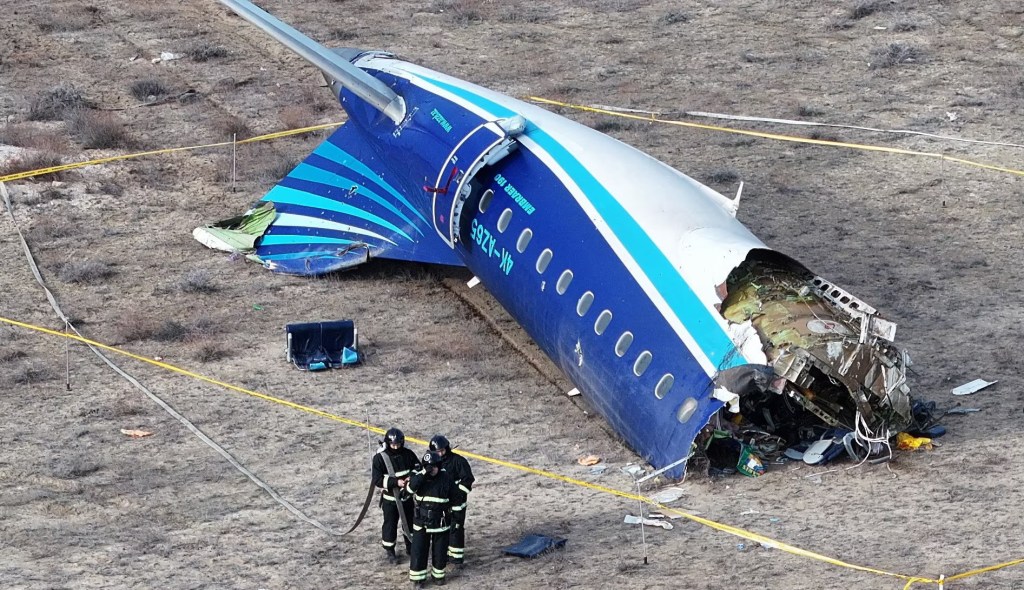
The plane ultimately crashed, bursting into a large fireball and split in half. Of the 67 people on board, 38 were killed. Almost immediately after the crash there were questions. What actually happened to flight 8243?
Photos from the crash showed damage not consistent with a bird strike. Damage to the tail looked more like the damage from the explosion of an air defense missile. In fact, several passengers had been injured from shrapnel from the explosion.
An image from the crash. The tail of the plane shows shrapnel damage.
Russia right away denied that this had happened. Several days later The New York Times put out a report which stated that Azerbaijani investigators believed that a Russian Pantsir S-1 had actually shot the plane. On February 4th, investigators found fragments from a Pantsir S-1 missile inside the airplane’s fuselage.
At the time the plane was attempting to land the city was under warning as Ukrainian drones had been spotted in the area and shot down.
On December 28th Russian President Vladimir Putin apologized to the Azerbaijani President Ilham Aliyev for the “tragic incident” although he didn’t elaborate further on the incident.
Today the Russian president, speaking with the Azerbaijani leader Ilham Aliyev, admitted to him that Russian air defense was responsible for the crash and that two Russian air defense missiles had exploded near the plane.
The Russian President very rarely admits to mistakes by his military. More than a decade after a Malaysian flight was brought down over Ukraine by Russian defense systems, Putin still denies Russian involvement.
The previous denial of the Russian involvement in the Azerbaijani airlines flight has caused some tension between Russian and Azerbaijan causing Aliyev to become increasingly critical of Moscow, even offering support to Ukraine and condemning what he called the “soviet occupation” of Azerbaijan. Some in the country were even calling for the relationship between Russia and Azerbaijan to be cut. It’s likely this admission of guilt by the Russian leadership is more about saving the relationship with an increasingly strong ally.
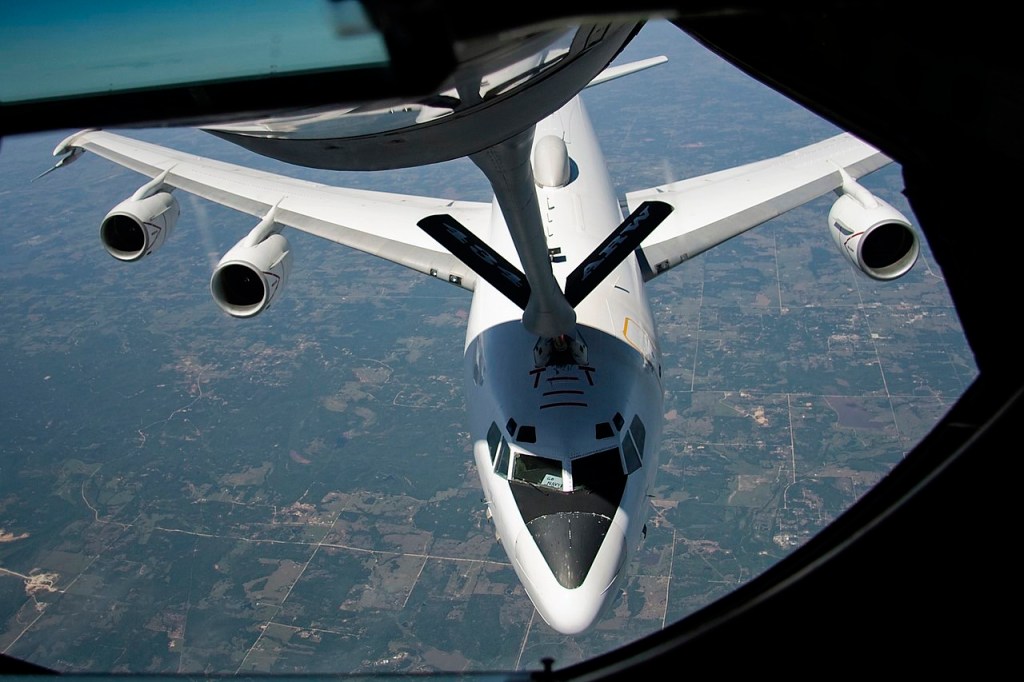
US Navy E-6B Mercury refueling from a KC-135 Stratotanker.
By.Scott Jackson
09/24/2025
On the night of September 23-24 both France and the United States carried out separate nuclear exercises. These exercises act as apart of a deterrence strategy aimed at making any potential adversaries think twice about attacking. They also provide real life training for the crews involved preparing them for a day that they hope never happens.
Some components of these drills were monitored in real time.
COST43 a U.S. Navy E-6B Mercury.
COST43 the callsign for a U.S. Navy E-6B Mercury, the Airborne Nuclear Command Post and Communications Relay. The jet is seen in the above image heading back to Ramstein AFB, Germany after this mornings nuclear exercise by U.S. Strategic Command (STRATCOM) over Northern Europe.
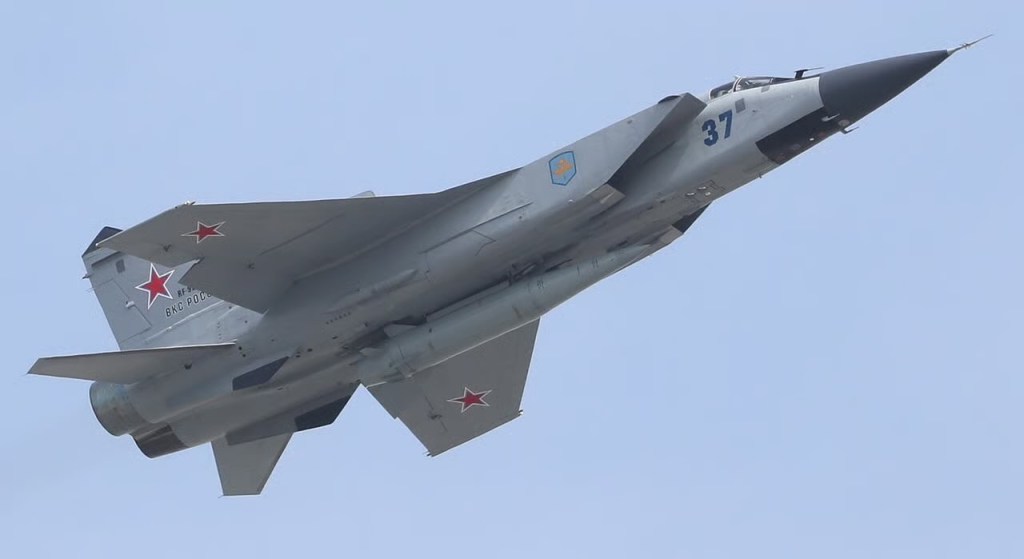
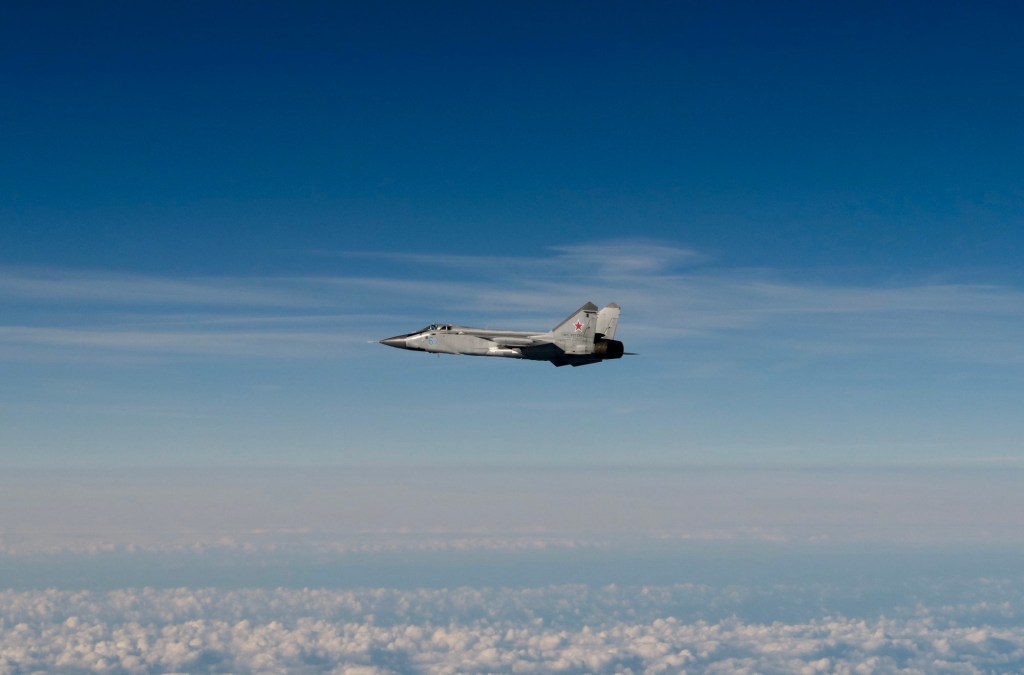
Today, in an act that the Estonian foreign minister is calling “unprecedentedly brazen”, three Russian MIG-31 “Foxhound” fighter jets violated Estonia’s border and remained inside Estonia for 12 minutes. They crossed the border in the area of the Gulf of Finland.
Russian MIG-31 “Foxhound”
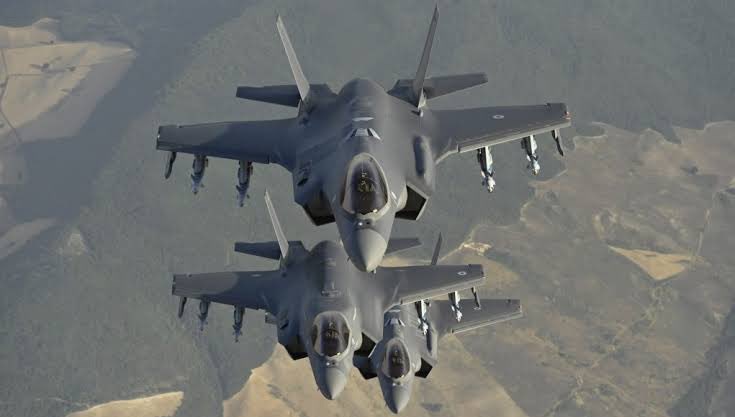
NATO forces responded to intercept the Russian fighters with several Italian F-35’s being scrambled to track and intercept the Russian MIG’s. The alliance’s spokeswoman Allison Hart said ”This is yet another example of reckless Russian behavior and NATO’s ability to respond.”
Swedish forces also responded with several JAS 39 Gripen scrambling to the Baltic area where they intercepted and tracked the three Russian jets.
Russian Mig-31Swedish JAS 39 Gripen
Tensions between NATO and Russia have remained high since the start of the Russian invasion of Ukraine but spiked even more recently as Russian drones flew into Polish airspace just 10 days ago. NATO responded to shoot down some of the drones in that incident as well. Poland called the incursion a deliberate effort to test NATO’s willingness to respond and its readiness.
“..three fighter jets entered our airspace, is unprecedentedly brazen-clear proof of Russia’s growing aggression.”
“Russia has violated Estonian airspace four times already this year, which is unacceptable in itself, but today’s violation, during which three fighter jets entered our airspace, is unprecedentedly brazen-clear proof of Russia’s growing aggression.” Margus Tsahkna, Estonian minister of foreign affairs. He continued “Russia’s ever-increasing testing of borders and aggressiveness must be responded to by rapidly strengthening political and economic pressure,”
In response to the incident in Poland, and now Estonia, NATO has launched new air patrol operations in eastern and Northern Europe. This operation is going by the name Eastern Sentry and is modeled after the Baltic Sentry operations that have been taking place in the Baltic. Baltic sentry added new aircraft and ships to its patrols after the recent Russian incursions and continuing acts of sabotage. The operation includes increasing air and sea patrols, as well as an increase in ground based interceptor launchers and radar. Eastern Sentry will focua mainly on Poland however it can be shifted to deal with Russian threats in other countries.
“Russia’s recklessness in the air along our eastern flank is increasing in frequency,” said NATO’s Secretary General Mark Rutte. He added that drones have recently violated the airspace of Estonia, Latvia, Lithuania and Romania.
“This was no accident.” EU foreign policy chief Kaja Kallas speaking on the Estonian situation.
The Russian ministry of defense has declined to respond to an email from GCR.
At the time of writing another situation is ongoing with 2 other Russian jets doing a low flying pass on one of polands Petrobaltic oil and gas platform in the Baltic Sea. While Polish airspace was not violated in this case it shows the willingness to engage in aggressive behavior on the side of Russia.
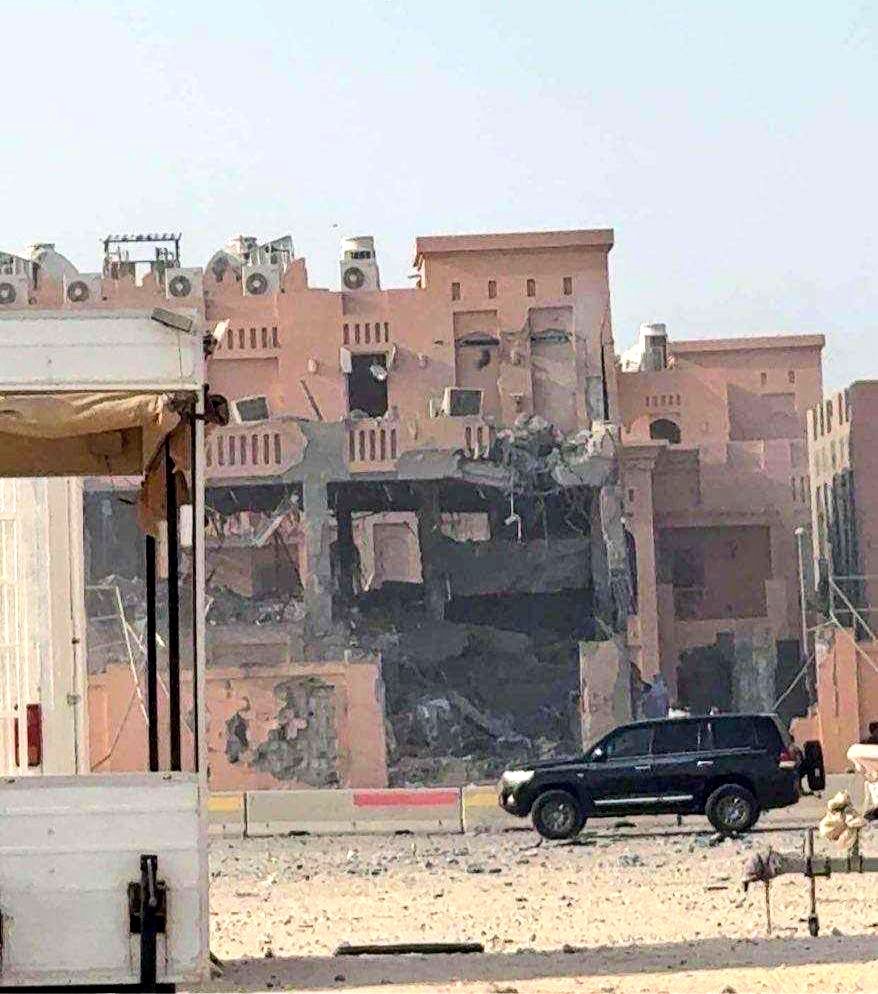
Images sent to me from planet labs show the before and after shot of the bombing of the Hamas negotiation team that took place in Doha, Qatar on September 9th, 2025.
BeforeAfter.
Yesterday, as the Hamas negotiations team was debating a recent proposal from the U.S. delegation when an explosion ripped through the building killing several members of the Hamas negotiations team, made up of senior members of the Palestinian extremist group and a Qatari Security official. Qatari leadership condemned the attack, which took place on their soil. Qatar has long been a financial supporter of Hamas transferring billions of dollars to the group since 2018 with Hamas saying the payments were expressly used for employee payroll and medical care for Palestinians.Those payments are a form of some contention in Israel as Benjamin Netanyahu approved the payments back when he was the primer of the Israeli security cabinet and some in Israel disagreed with the decision. He defended his actions to detractors saying “in coordination with security experts to return calm to (Israeli) villages of the south, but also to prevent a humanitarian disaster (in Gaza).
CCTV footage captured the moment of the Israeli airstrikes earlier against the Qatari capital of Doha. pic.twitter.com/iG7khL3ETs
Video shows the airstrike which targeted the Hamas leadership.
It’s now been over 48 hours since the attack and Qatar has threatened to hold Benjamin Netanyau responsible for the attack. The UN Security Council had postponed a meeting about Israel’s strike on Qatar until tomorrow “at Qatar’s request”, the council’s current president says. UNSC South Korea, the current UN Security Council president added, “so that the Prime Minister of Qatar can take part in the meeting”.
At the U.N. many stood with Qatar, however some questions were raised as to why Qatar has Hamas in their cities in the first place.
Today at the U.N. I asked Qatar: “If you don’t want targeted bombings on terrorists in your capital, why do you harbor terrorists in your capital? Why is your Al Jazeera serving as Hamas' non-stop propaganda arm? Why do you act as mediator by day, and a terror sponsor by night?” https://t.co/xi2EZlC5B7pic.twitter.com/tTghv5JK4U
The US seemed sidelined by the attack, an attack carried out on the soil of a US allied partner in the region. Just days ago US President Donald Trump said that they were close to reaching an agreement in negotiations with Hamas. It seems like the US was only made aware of the planned attack when Israel’s forces were already on route to attack.
“I immediately directed Special Envoy Steve Witkoff to inform the Qataris of the impending attack, which he did, however, unfortunately, too late to stop the attack,” Trump said in a statement.
Steve Cook, a senior fellow at the council for foreign relations wrote in his article ‘ It is unclear how many of Hamas’s leaders were killed in the operation. Hamas maintains that while five of its people plus a Qatari police officer were killed, its senior leadership survived. Those claims have yet to be verified. At the very least, the Israelis have demonstrated a willingness to go anywhere to eliminate Hamas. It is likely that the organization’s surviving leaders will be targeted again in time.’
The attack against Hamas has spread outrage among the Qatari leadership who see themselves as mediators in this conflict and as such it’s highly likely they will cease any of their part in future negotiation. Qatar sees this as a slap on the face after they worked to get a good number of the Israeli hostages that were taken on October 7th 2023, freed.
Cook,in his article put forward Egypt as a possible candidate for future negotiations but called the negotiations a “thankless task ” when “neither the Israeli government nor the Hamas leadership seem interested in a deal”
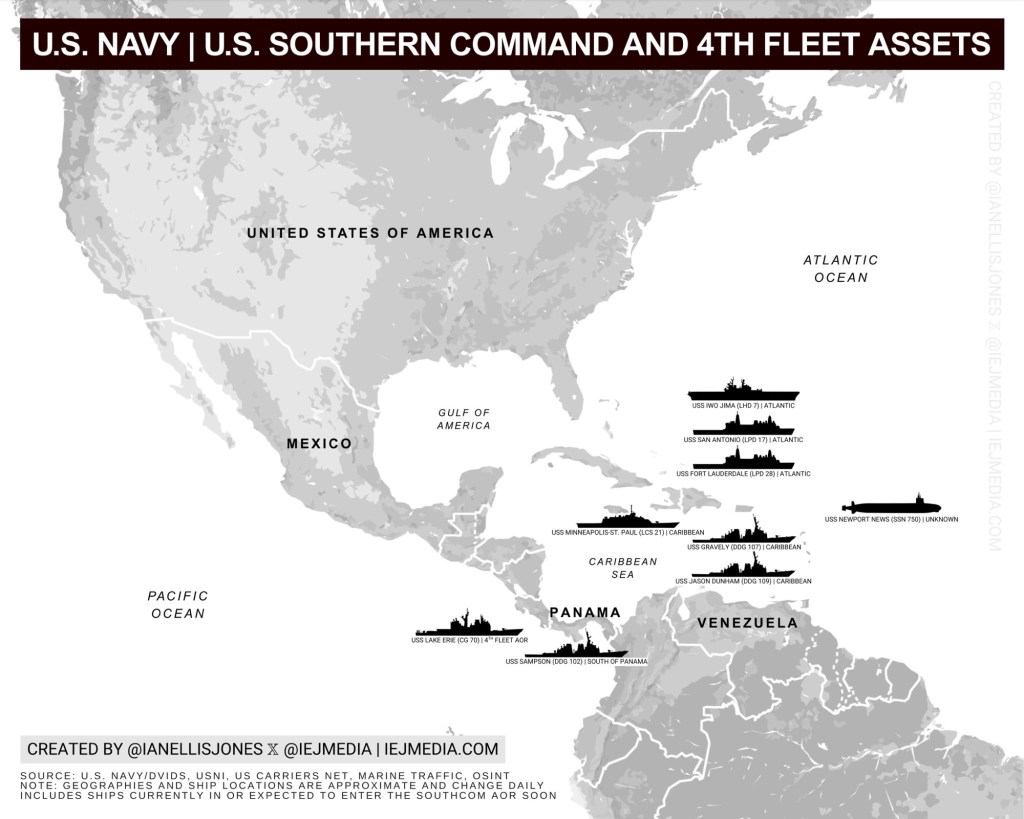
Map put together by Ian Ellis Jones over on Twitter shows the ships currently moving into the South American region. Some of the locations are true, as of when the image was posted, others are approximate.
By. Scott Jackson
08/30/2025
A look at the recent increase in U.S. forces already in or heading to the Caribbean.
The U.S. is increasing its presence in the region in an effort, they say, to deal with drug trafficking. This has been a big issue for Washington and is currently causing some tension as the White House called Venezuelan leader Maduro a “Narco-Terrorist” and have made him the main focus of these efforts. Is this a regular drug operation, or something more? For now nobody’s sure.
So far eight ships and a submarine have been deployed to the 4th fleet/Southern Command [SOCOM] AOR. Making this the largest confrontation between Venezuela and the U.S. in years.
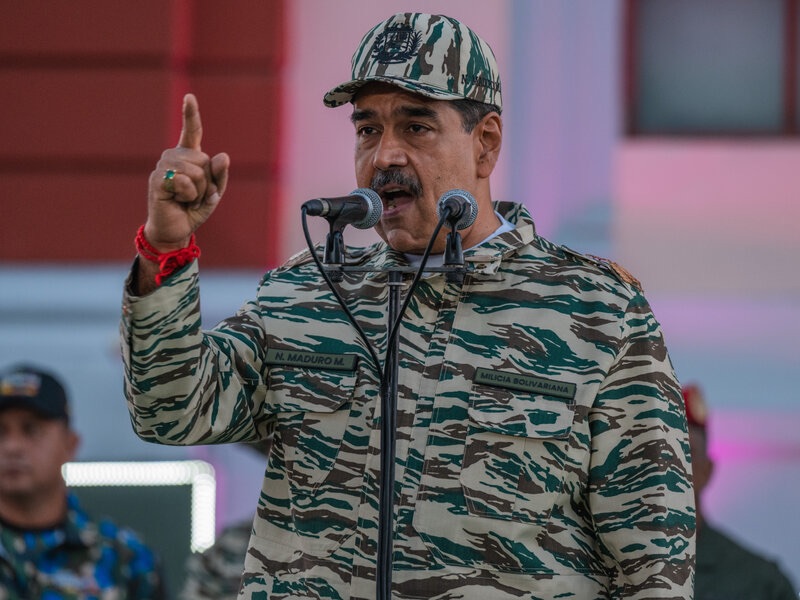
For Venezuelan President Nicolas Maduro, this attention only strengthens his goverment hold on the country. The U.S. feels Maduro’s election back in 2013 and 2024 was due to election interference and say his victory was only assured because of ballot stuffing and other types of election fraud. Currently Washington has a $50 million dollar bounty for his arrest on charges of drug trafficking. Maduro’s response to the threat of the U.S. warships steaming towards southern waters was to declare that Venezuela would respond with the activation of 4.5 million militiamen.
“This week, I will activate a special plan with more than 4.5 million militiamen to ensure coverage of the entire national territory — militias that are prepared, activated and armed,” Maduro announced on state television.
Most believe that this move by Washington is aimed more at a show of force over actual U.S. intervention in the region, but in case it’s not just a well armed navel stroll around the block let’s go over some things.
Who is Nicolás Maduro?
Nicolás Maduro speaking to his supporters about the American forces heading towards Venezuela.
Maduro was born in 1962 and before he was a president he made his money as a bus driver for a long time before rising to become a trade union leader. In 2003 he was elected to the National Assembly and frim there appointed to a number of positions under the then president Hugo Chávez. He served as the president of the National Assembly in 2005-06, and as Minister of Foreign Affairs from 2006-2012. From then on he was Vice President under Hugo Chávez until his death in 2013. After Chávez’s death Maduro assumed the role of president and has stayed in the role ever since. Since then, Maduro has managed to stay in office, consolidating power along the way. The elections the country has run show Maduro winning, however claims of election rigging have run rampant.
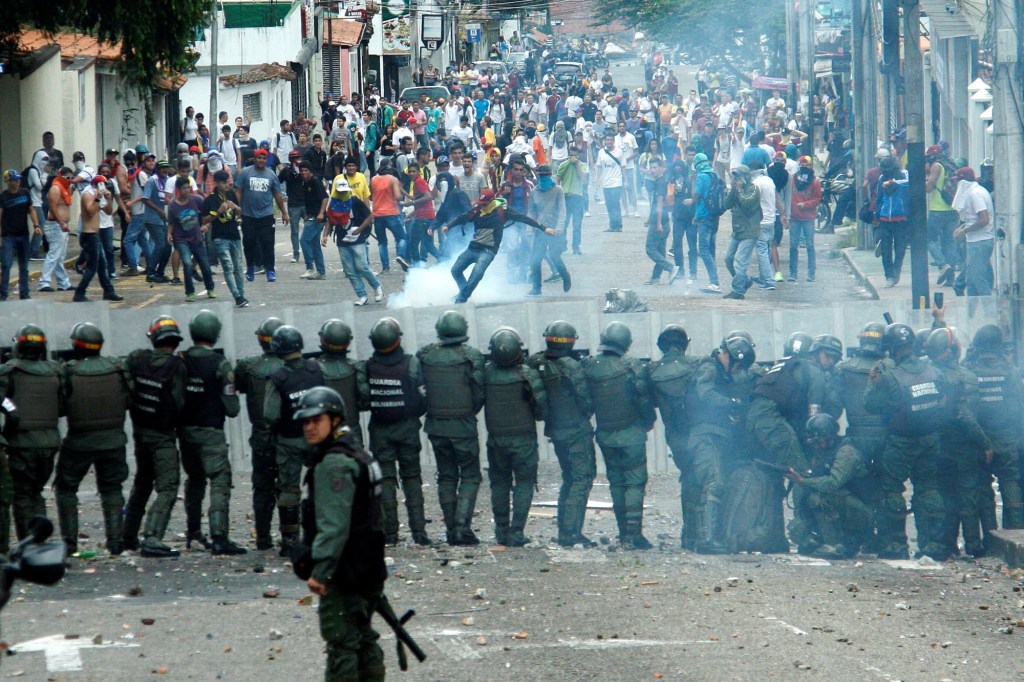
Since Maduro rise to power Venezuela has been forced to endure widespread authoritarian rule marked by rigged elections, human rights abuse and economic hardship. Maduro’s goverment can be characterized by its mass allegations of corruption, the suppression of critical information and poor leadership. Widespread shortages have plagued the country and inflation of its currency, the Bolivar, has skyrocketed, tripling in the last several years. For a country as resource rich as Venezuela is, having one of the largest oil deposits in the world, these problems are inflicted mostly by the actions and policy of their government.
Demonstrators clash with members of Venezuelan National Guard during a rally demanding a referendum to remove Venezuela’s President Nicolas Maduro in San Cristobal, Venezuela October 26, 2016. Photo: Carlos Eduardo
What U.S. assets are being sent to Venezuela?
For now it seems that the bulk of the forces being mobilized for this operation -whatever it ultimately ends up lmbeing, are from the USS Navy with some help from the Air Force.
Earlier today radio calls from a USAF RC-135 ‘Rivet Joint’ were recorded as they communicated with the Mcdall tower out in Tampa Fl. The RC-135 was refueling “somewhere over the Caribbean”. This means that the Air Force is doing ELINT missions and gathering data from the region. The Rivet Joint is capable of picking up radar signals from hundreds of miles away as well as other types of electronic surveillance and reconnaissance.
ABATE07 (KC-135) is somewhere over the Caribbean right now fueling a RC-135.
We also have reports of Navy P-8 Poseidon’s out of San Juan patrolling around the Caribbean several days ago. These planes are mostly used for anti-submarine work but can still be used as spotters for surface ships as well.
Venezuela has one submarine that might or might not be operational so I don’t see the ASW assets getting all that much use here.
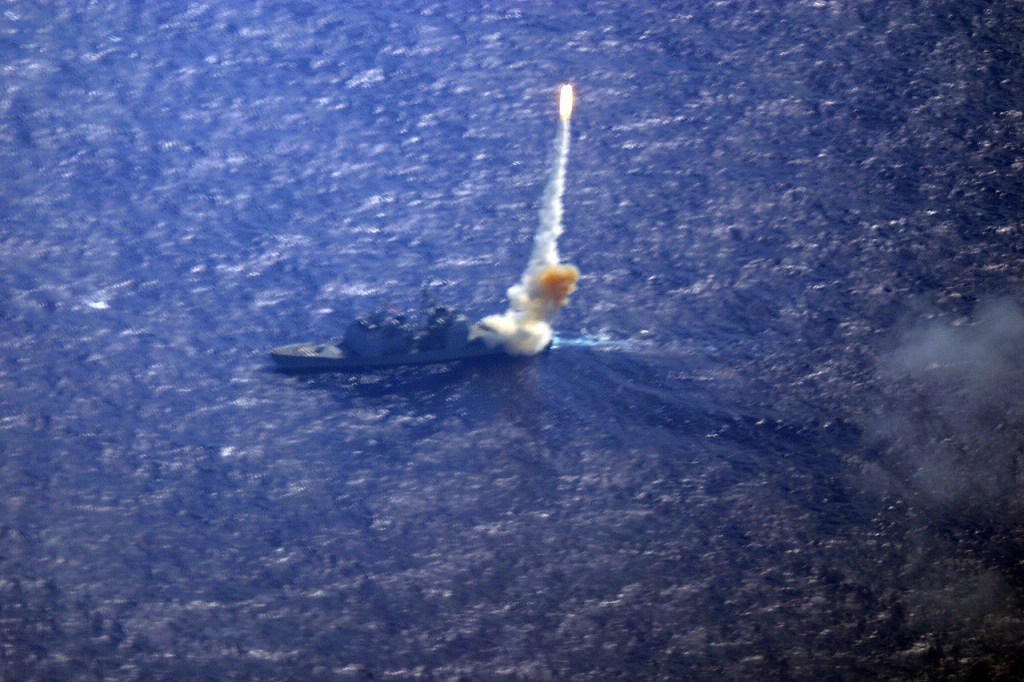
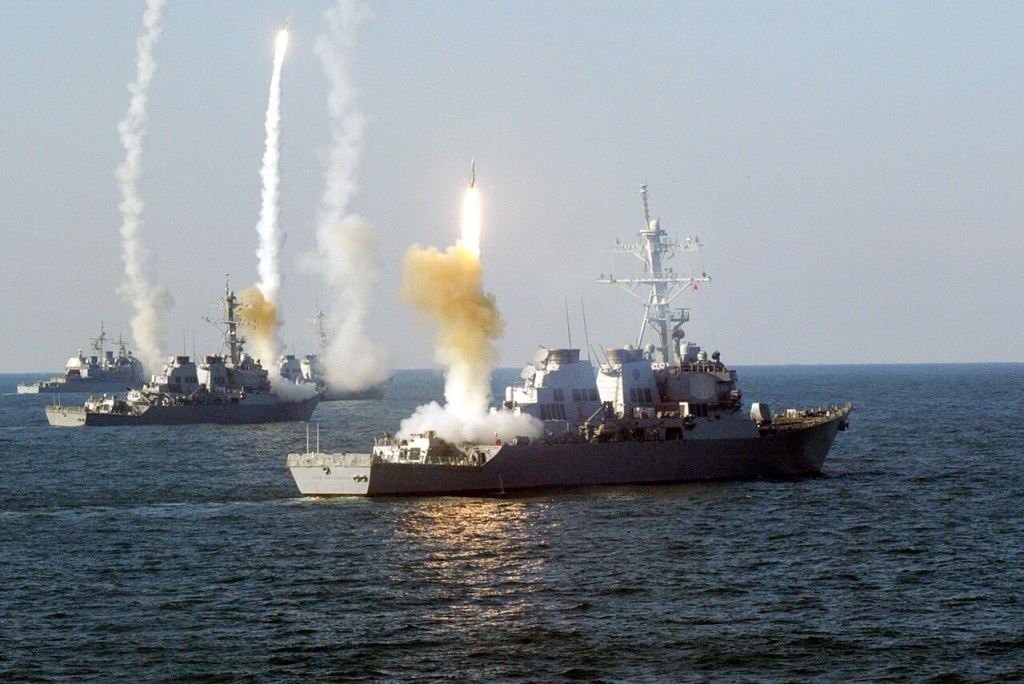
Ticonderoga-Class launching one of its standard missiles.
On to the ships. So far 9 ships have been ordered to the area. The most recent of the bunch is the Ticonderoga-Class guided missile cruiser USS Lake Erie (CG-70) and the Los Angeles-Class fast attack submarine USS Newport News (SSN-750).
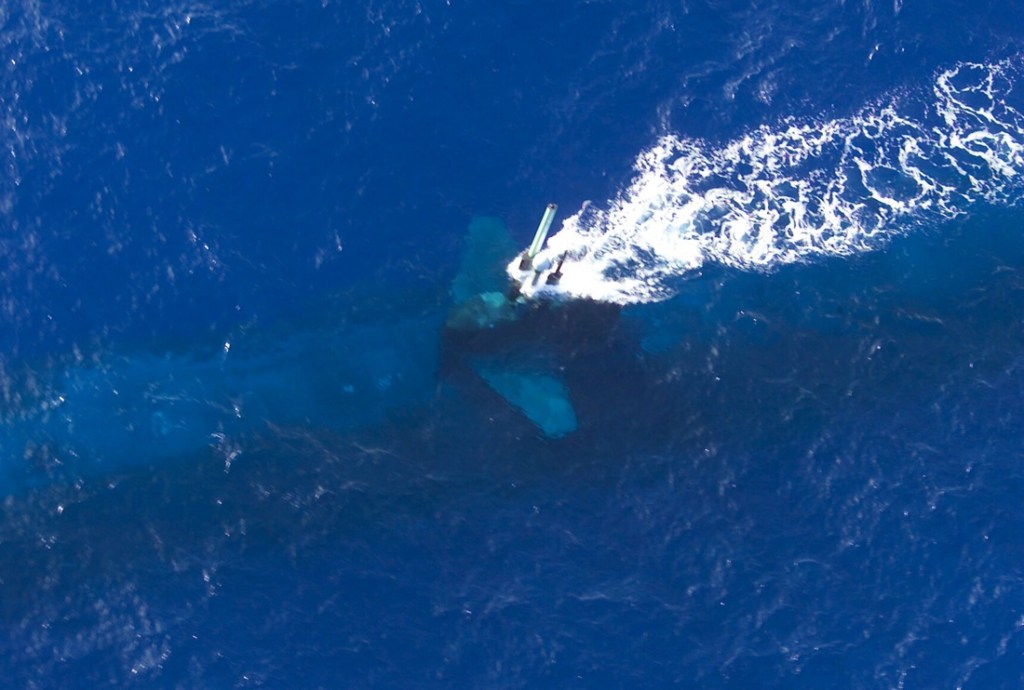
Los Angeles class submarine operating at periscope depth.
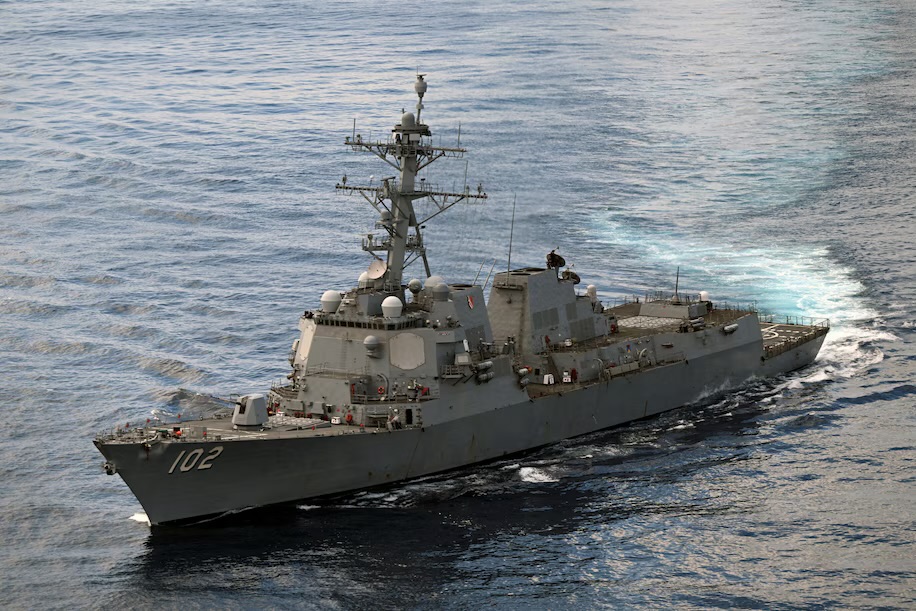
Three of the ships are Arleigh Burke-Class guided missile destroyers. USS Gravley (DDG-107), USS Jason Dunham (DDG-109), and USS Sampson (DDG-102). These ships along with the Lake Erie provide the bulk of the firepower. All of the ships listed so far, including the submarine are capable and likely carrying a number of Tomahawk cruise missiles, among others.
Arleigh burke-Class destroyers intercepting targets during an exercise
Last but not least we have the USS Minneapolis-Saint Paul (LCS-21) a Freedom-Class littoral combat ship. These ships were, according to the navy “envisioned to be a networked, agile, stealthy surface combatant capable of defeating anti-access and asymmetrical threats in the littorals.” Littorals refers to an area of the sea close to shore. Basically these ships are comparable to what other navies call corvettes.
Each of the freedom class comes with a hanger for the SH-60 or MH-60 Seahawk, as well as a ramp in the stern for launching smaller boats. These ships are capable of transporting and launching a small assault force with troops and fighting vehicles.
Image shows the USS Minneapolis-Saint Paul.
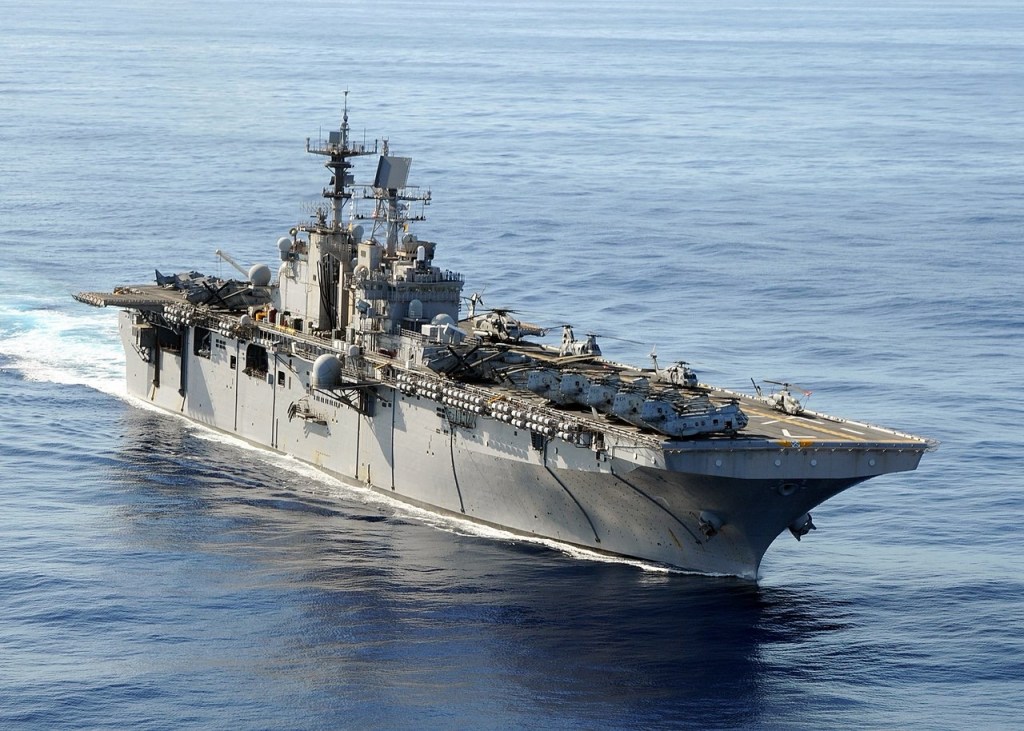
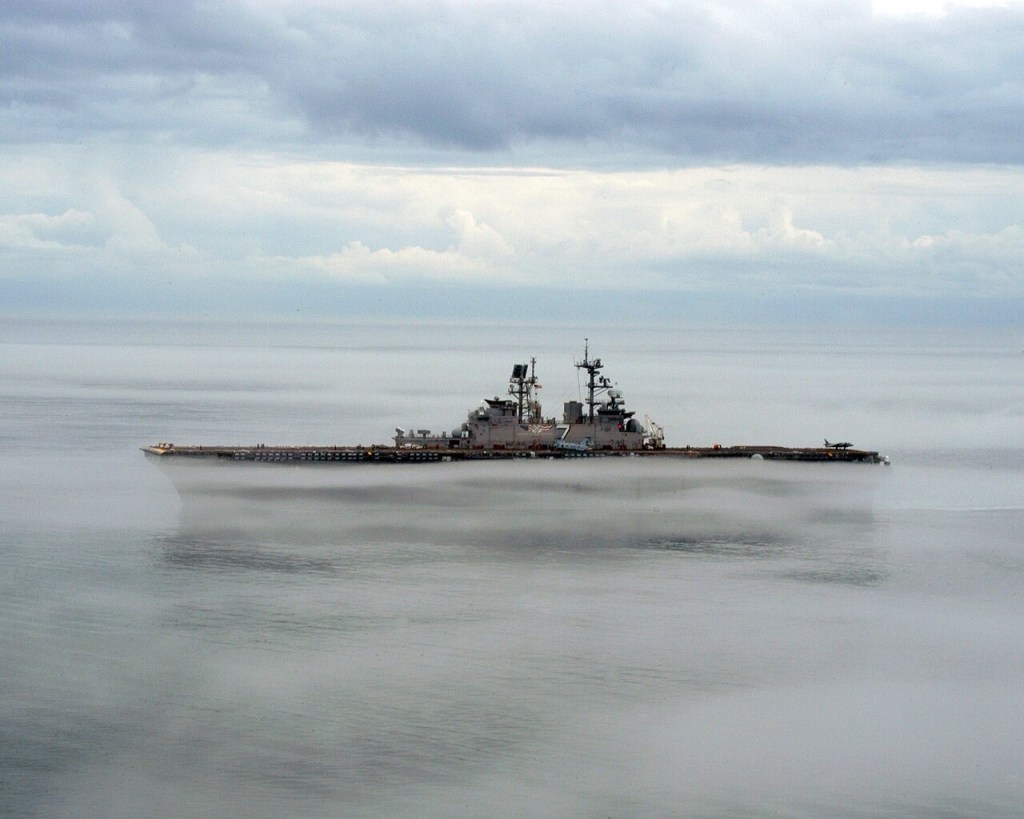
Next is the USS Iwo Jima (LHD-7) classified as a Wasp-Class amphibious assault ship and landing helicopter dock.
USS Iwo Jima (LHD-7) in the Atlantic sometime in 2008.
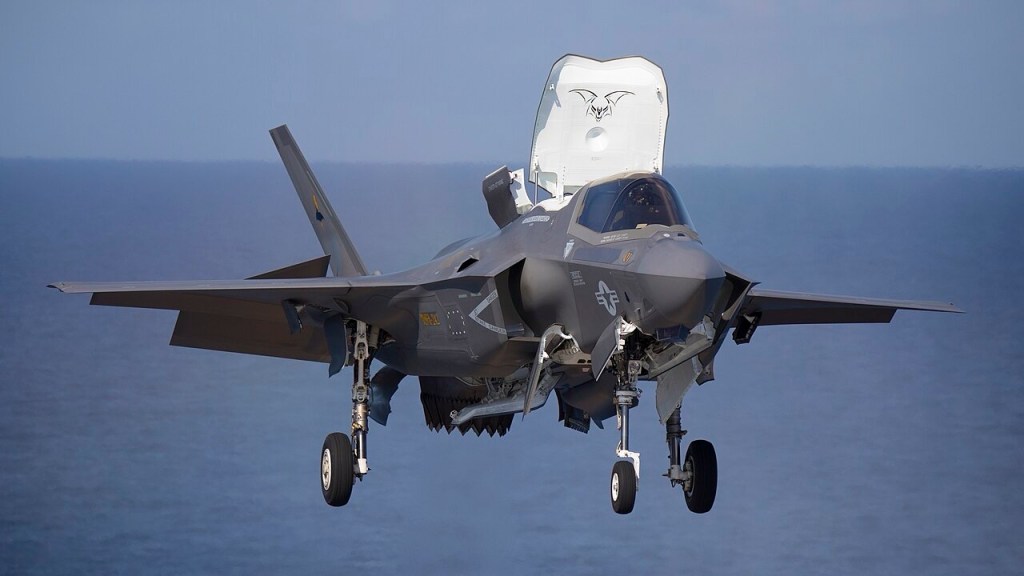
This ship carries various aircraft- mostly helicopters, and a lot of Marines as well as their equipment. This ship is essentially a floating marine base of operations capable of transporting them and their equipment into hostile territory and supporting them the AV-8B Harriers until 2027 when most of the assault ships are switching to F-35B’s. I don’t know if the Iwo Jima currently employs harriers or The F-35 currently.
USS Iwo Jima hiding in the fog.Marine Vertical take off F-35B coming in for a landing.
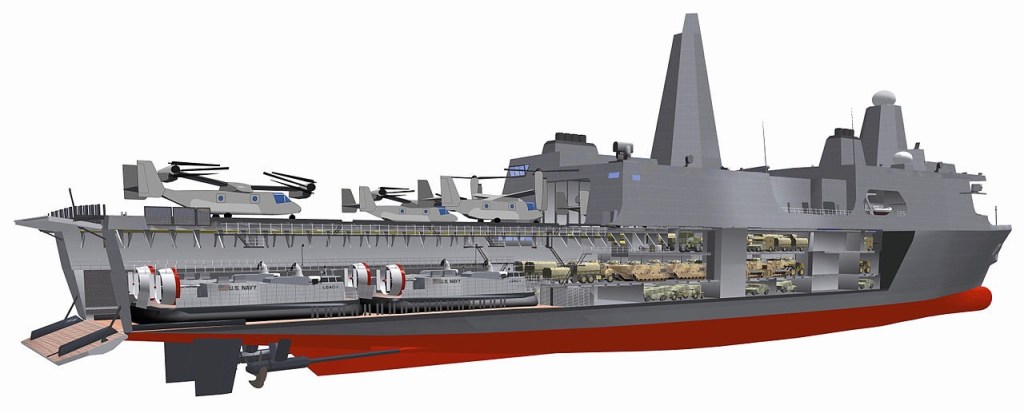
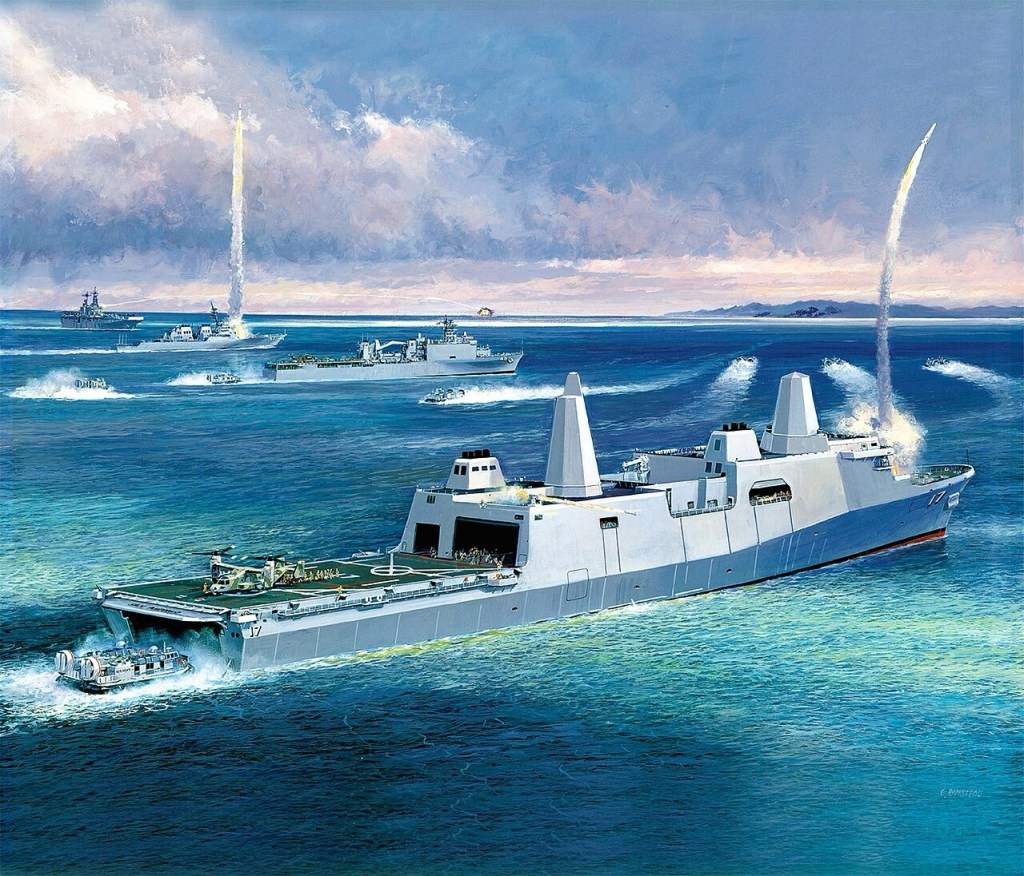
Moving on to the last two ships on our list we have the USS San Antonio (LPD-17) and the USS Fort Lauderdale (LPD-28) both of which are San Antonio-class amphibious transport dock’s. These ships are similar to the Wasp-class in that they are filled with marines and can be used as a launching point for their operations. They have a hanger for helicopters (or Ospreys) but lack the topside deck for planes.
Cut-away view of the San Antonio class. Artist concept of the San Antonio class.
These ships are designed as survivable and stealthy transports for ground forces. As shown in the image above they are also designed around the idea of launching the marines hovercraft to quickly transport massive amounts of marines and their equipment to the shores.






 Global Conflict Reporting
You must be logged in to post a comment.