Tag: satellite imagery

  • Russian Black Sea fleet ships damaged during Ukranian attack on port city of Novorissiyskz.

    Russian Black Sea fleet ships damaged during Ukranian attack on port city of Novorissiyskz.

    On Wednesday, August 12 2026, Ukranian forces launched a massive attack on the Russian Black Sea port city of Novorissiyskz. The attack was one of the largest that have hit the city and targeted warships at the naval base as well as at least two major grain terminals that were forced to shut down.

    Ukrainian President Vladimir Zelenskyy described the attack as a success and said that Ukraine had launched a unique mixture of long-range drones and weapons to target Russian fleet vessels in the bay area of the city. He called out damage to Russia’s Admiral Essen and Admiral Makarov frigates, a large landing ship, a corvette, and other vessels were struck in the attack.

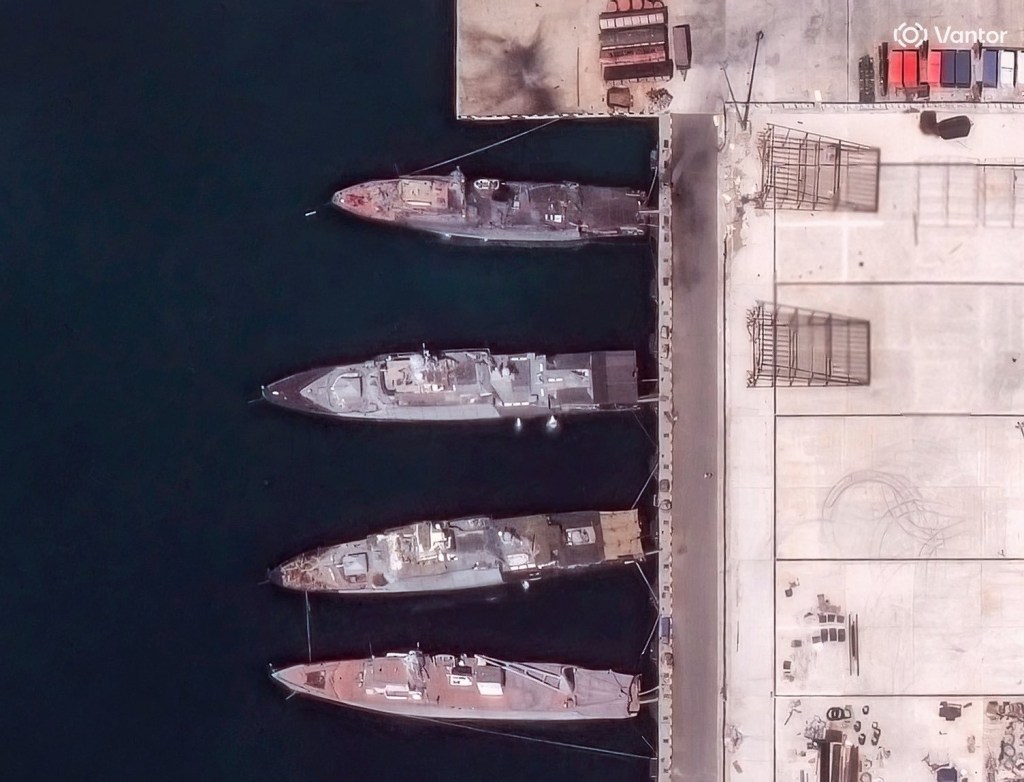
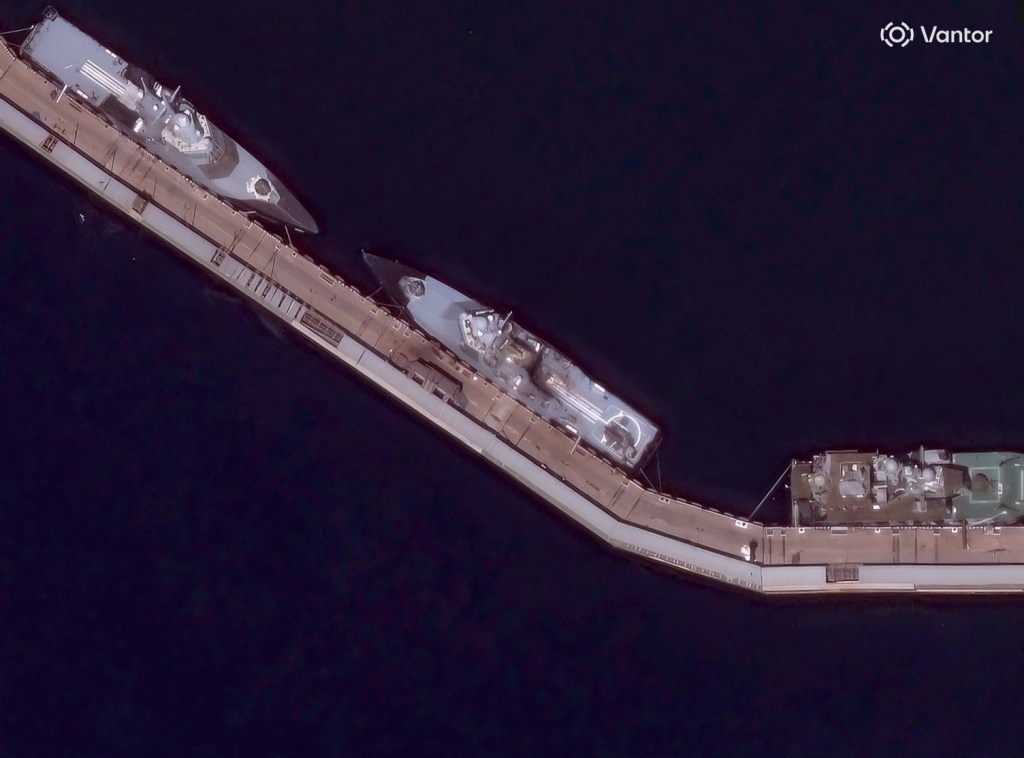
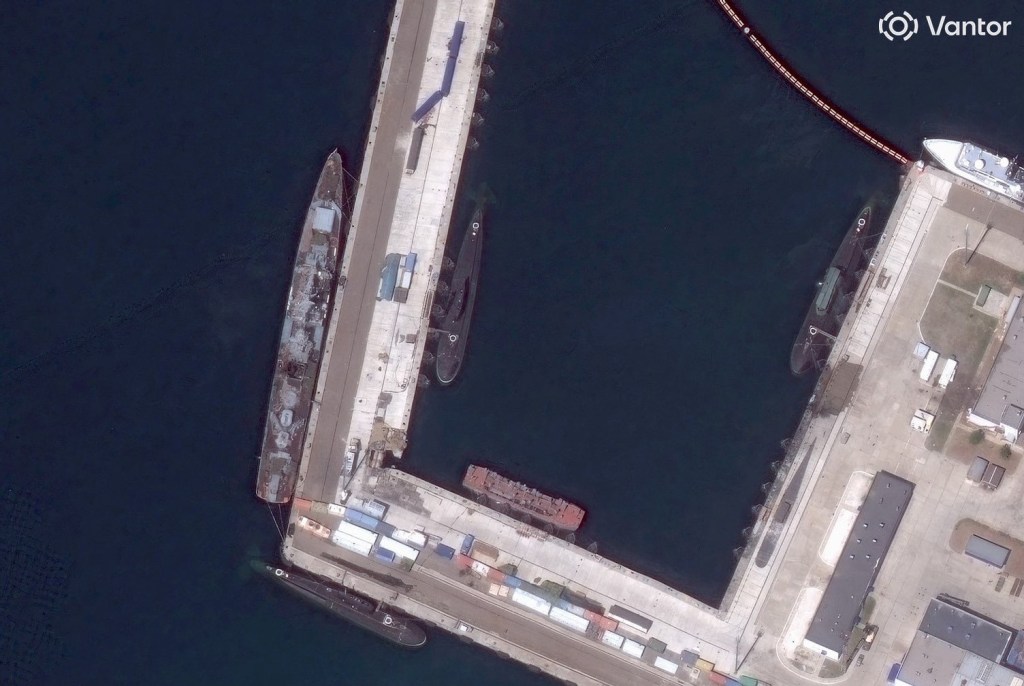
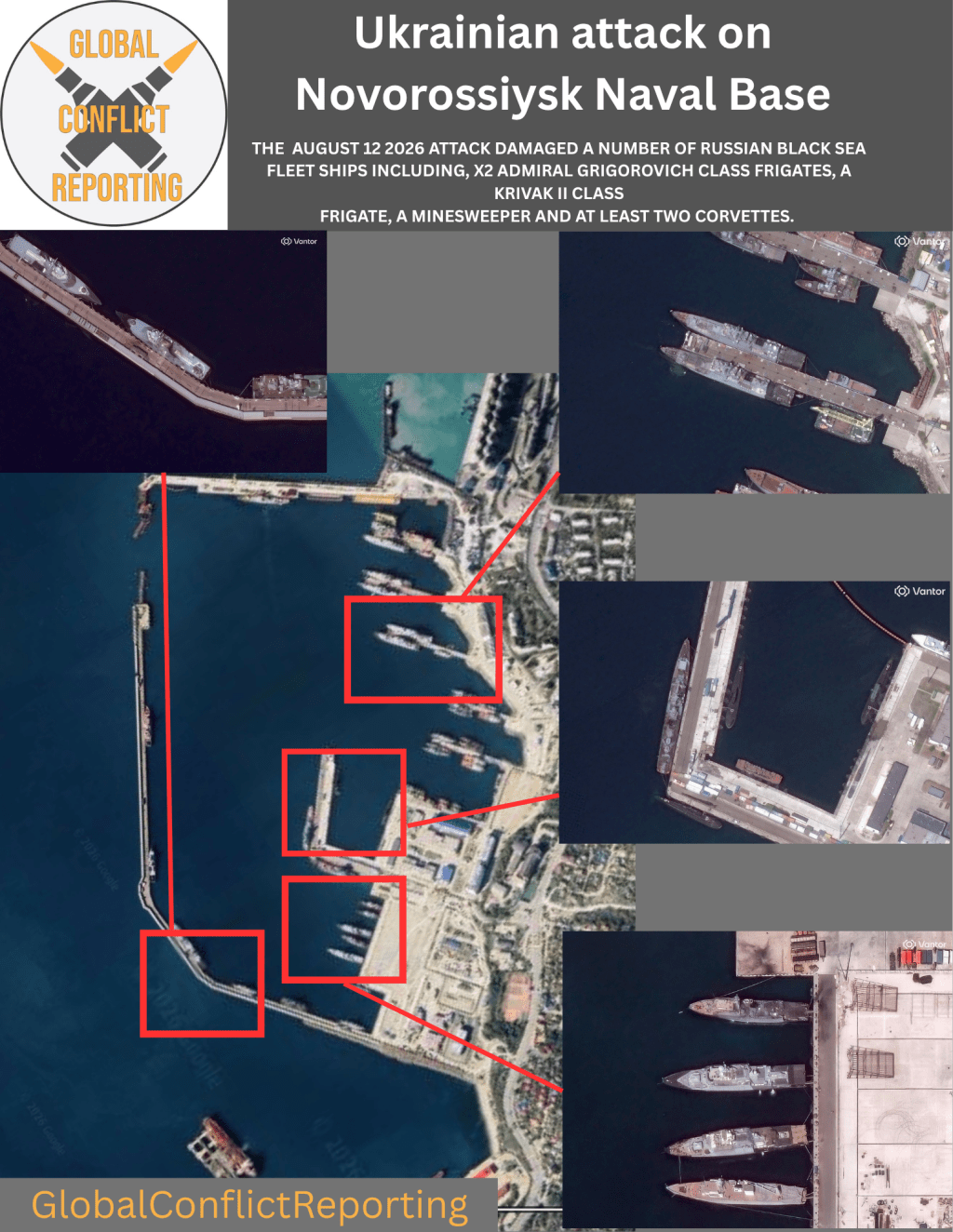
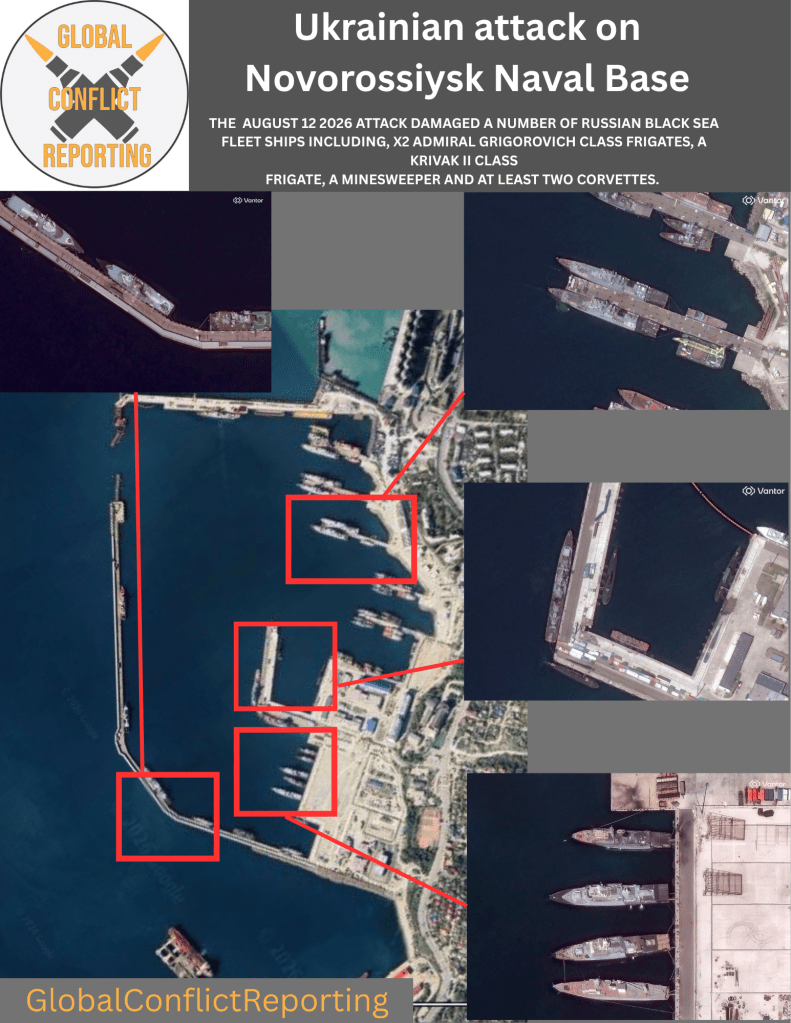
    Satellite images below show the damage to the vessels.
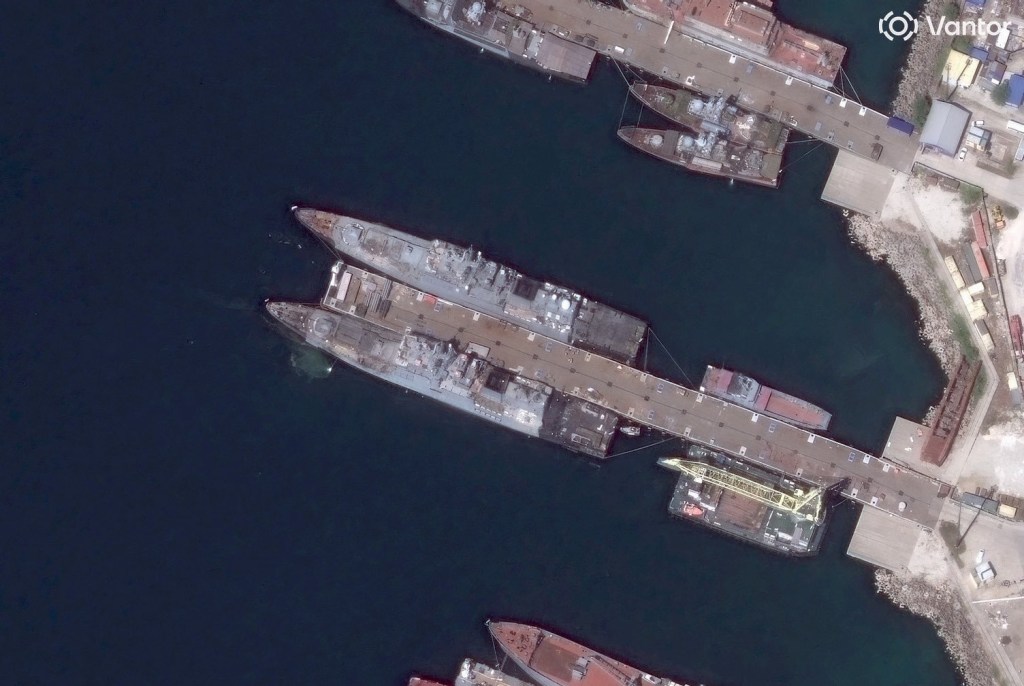
    Two Russian Project 11356R/Admiral Grigorovich class frigates, the Admiral Essen-class guided missile frigate (Top) and the Admiral Makarov (Bottom). Both capable of launching long range Kalibr cruise missile. The ships seem to have been hit multiple times including in the upper bow of the ship where the VLS cells are located.
    266M class minesweeper (top) shows signs of fire damage on the stern area as well as port areas around the ship.
    Two corvettes. Unknown class. Possible Project 22160.
    As the old navy saying goes, “Hot dog pack, Smokestack, Knife in the Back, two Guns in the Back — Krivak.”
    Project 1135M / Krivak II Class Guided Missile Frigate, Pitlivy. Damage to the ship appears to focus on the smoke stack. It’s possible the two Kilo class submarines were also damaged but it’s not clear.

    The marks that were noted with the images look like what’s known as short-duration fires, indicative of a drone strike. That is a quick blast and maybe a bit of lingering fire. It’s a lot harder to tell from this resolution what exactly is damaged on the ships and surrounding area.

    After the attacks NASA FIRMS detected fire at multiple areas around the city.
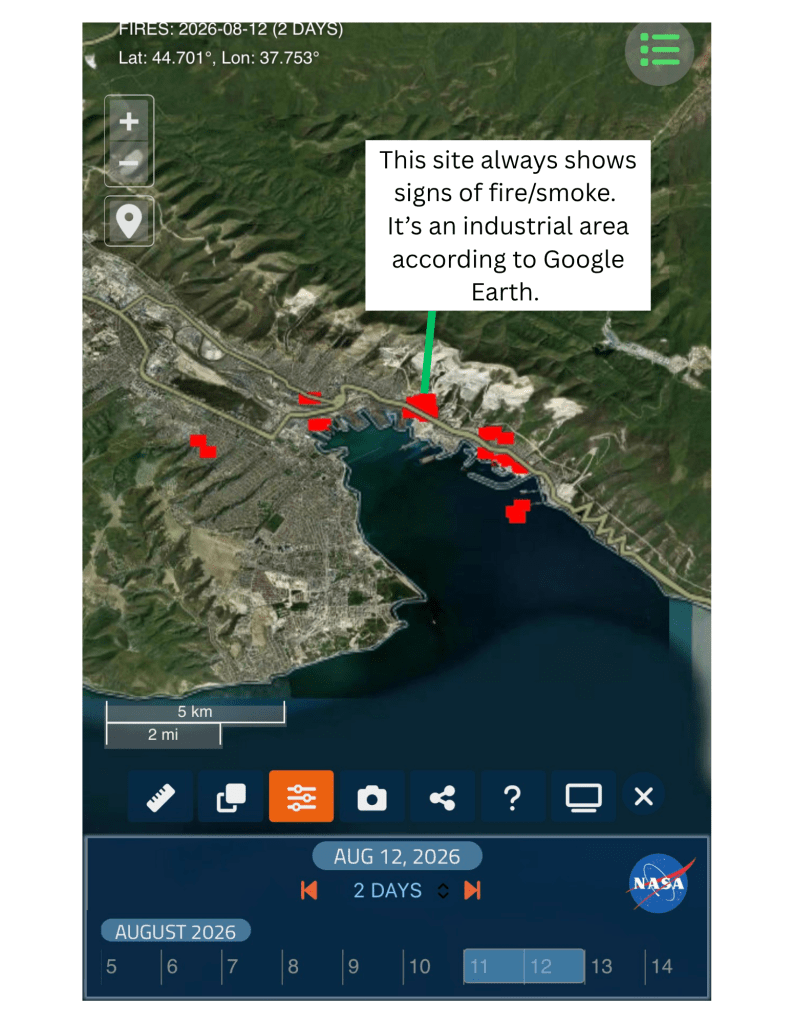
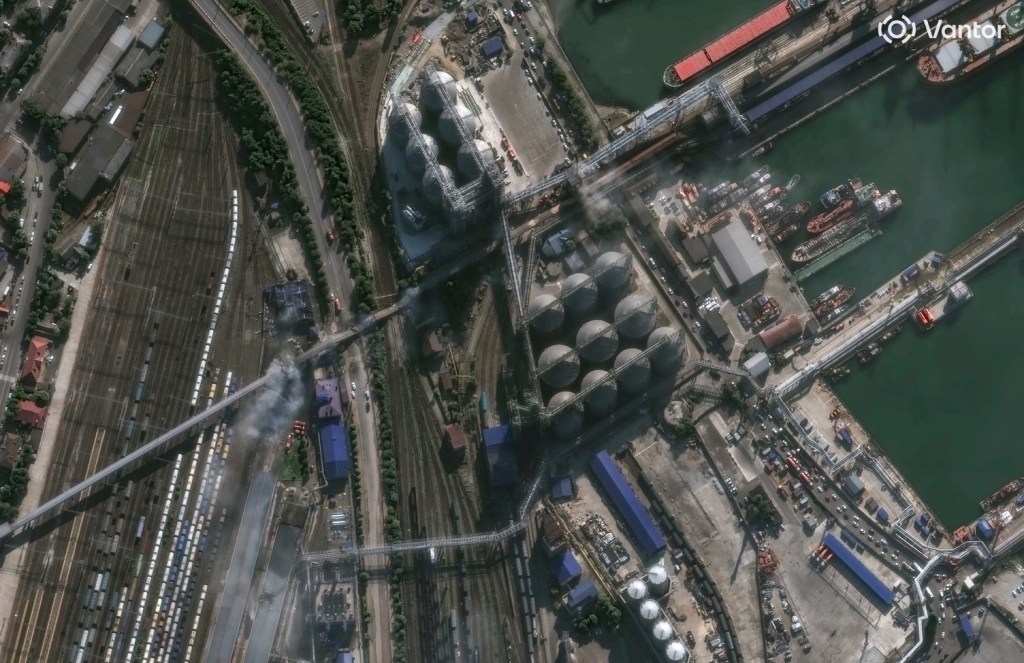
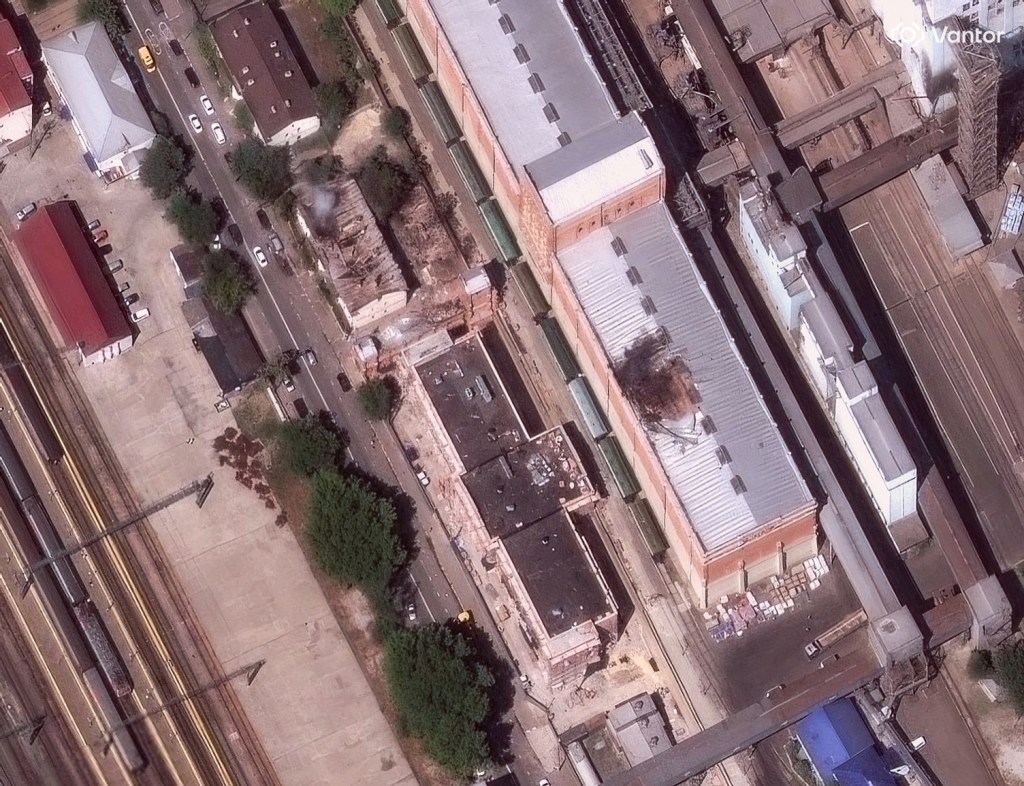
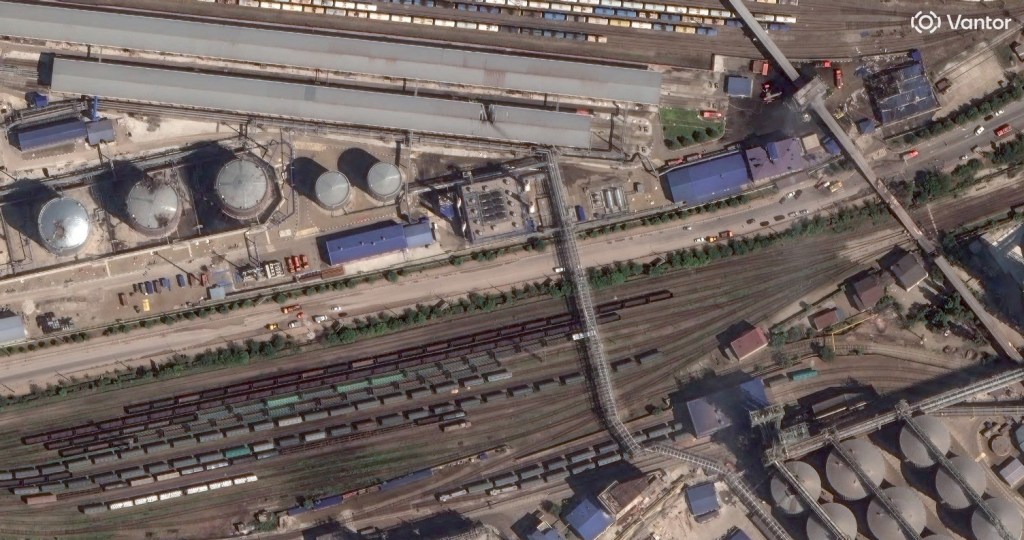
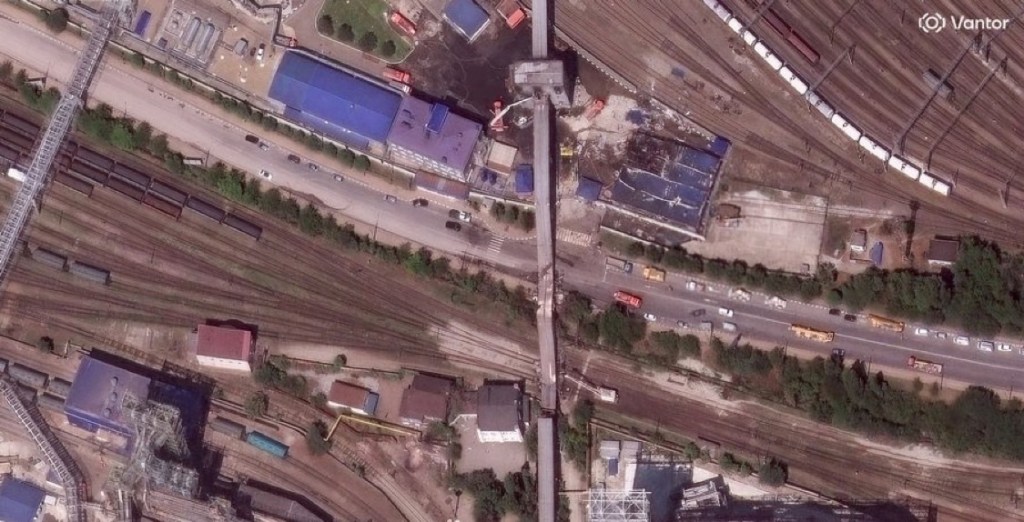
    More images have been released online showing damage to grain and port infrastructure.
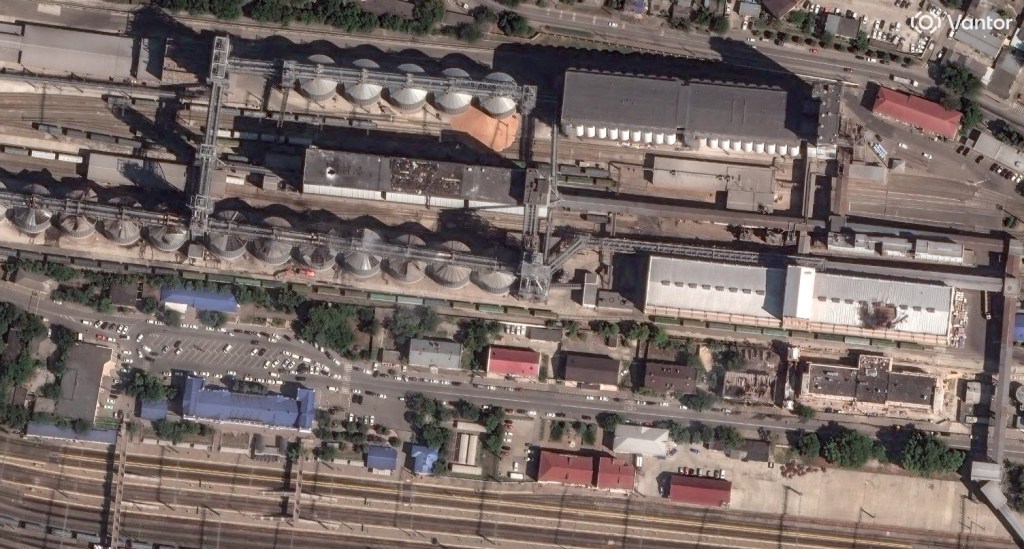
    building damage at the grain facility.
    Loading terminal for the port damaged.
    More building damage.
    Bridge dropped across the train tracks, closing traffic on the road and the tracks.
    Better shot of the bridge.
    Before

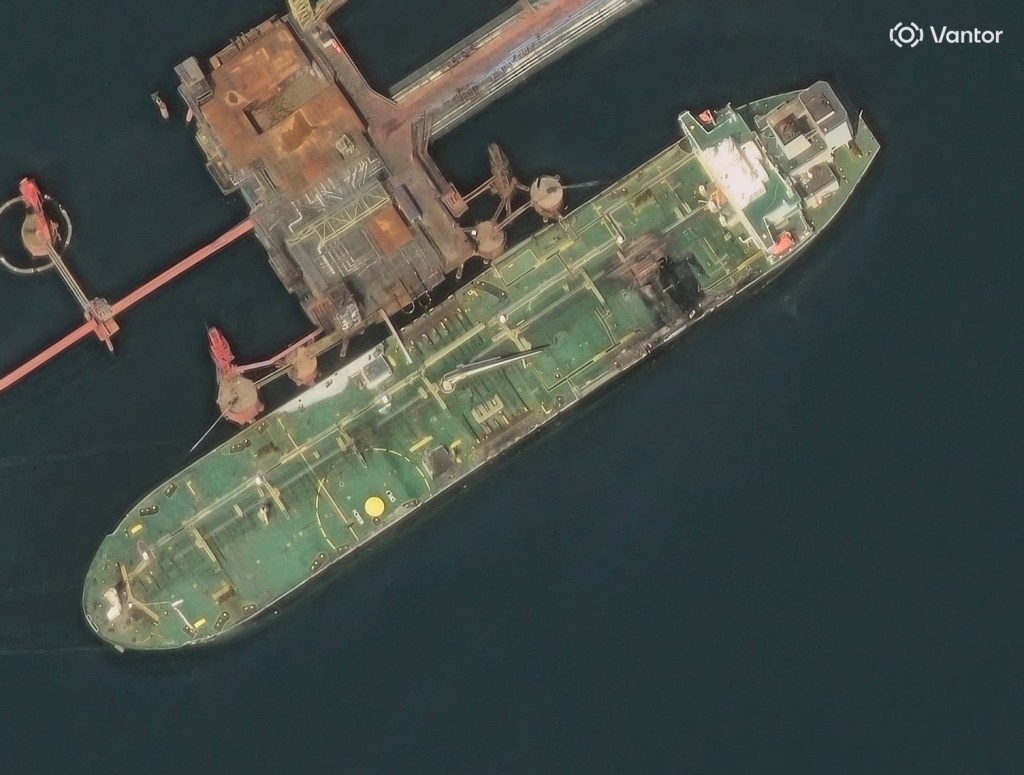
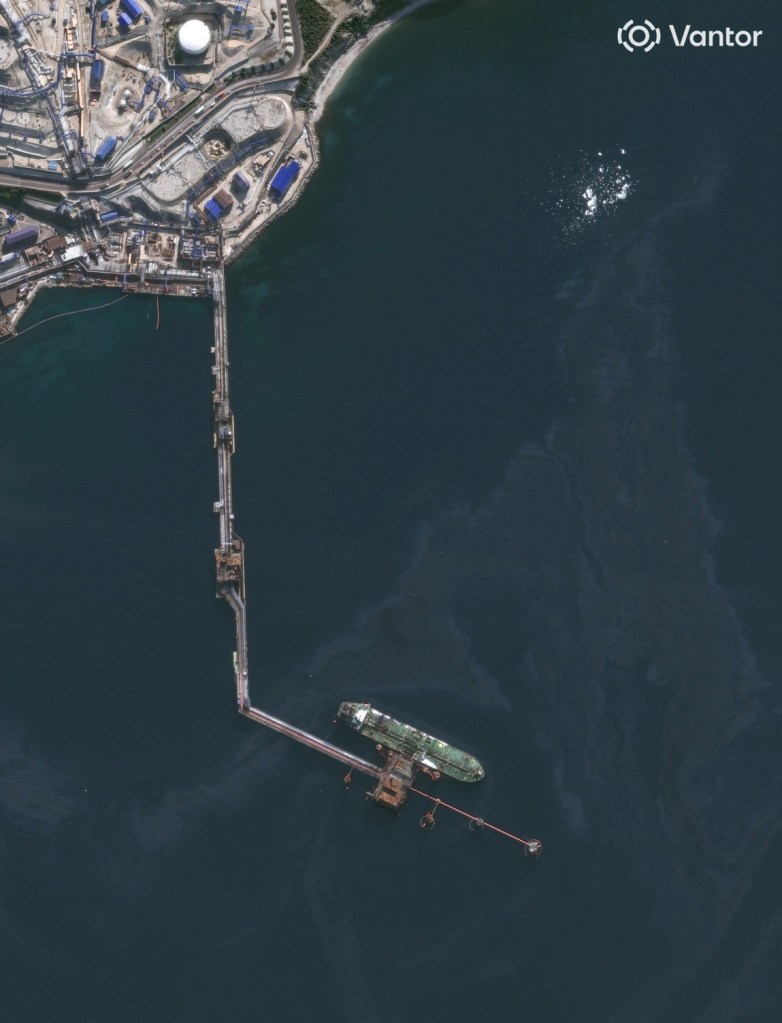
    This image is thought to show an oil spill after a tanker was damaged during the attack.


    Importance of Novorissiyskz and the fall of the Black Sea Fleet.

    Novorossiysk has been important to Russia even before they were forced to pull what remained of the Black Sea Fleet out of Sevastopol in Crimea. Novorossiysk sits at the intersection of key transport corridors linking Russia to the Mediterranean, Middle East, Africa, Asia, and beyond, and connects to major rail and road networks serving Russia’s grain-producing regions in the south and Volga areas. The port handles a large percentage of Russia’s seaborne exports with some estimates putting it at around 20% of all exports. Grain, oil, and general goods all flow through the port.

    Russia has invested in expanding the port at Novorossiysk but the recent attacks and the overall war have caused some delays in those plans.

    The Black Sea Fleet, once one of the prides of all of the Russian military, is now functionally out of the war as the number of losses has crippled the fleet’s ability to project power.

    Early in the war, the fleet was used to launch large, coordinated cruise missile strikes across Ukraine; however, early losses of key ships showed signs of things to come. 

    In March 2022, Ukraine took out the landing ship Saratov with a Tochka-U ballistic missile. The next month, the Black Sea Fleet flagship, the missile cruiser Moskva, was lost to a Ukrainian Neptune anti-ship missile. The sinking of the Moskva was a huge loss to Russian command and control, air defense coverage, and prestige. 
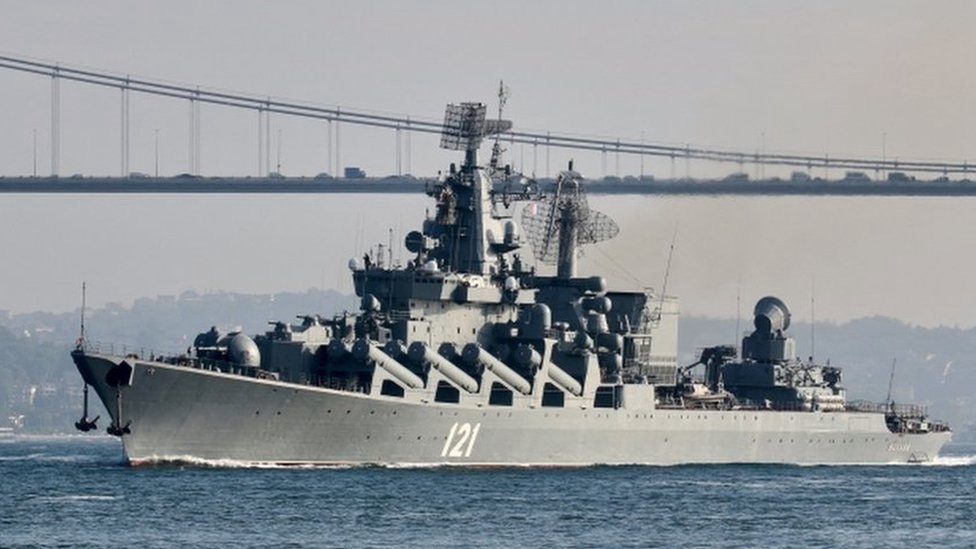
    Soviet era missile cruiser Moskva

    By 2023, Ukraine was given stocks of high-tech Western munitions (Storm Shadow/SCALP) as well as improvements to their own domestically produced weapons. This allowed Ukraine to begin striking targets in Sevastopol in Crimea. Infrastructure, dry docks, and ships in port were all targeted, as well as the headquarters of the Black Sea fleet, which was destroyed. In September of 2023, the improved Kilo submarine Rostov-on-Don was struck while in dry dock in Sevastopol.

    Destruction of the Black Sea Fleet Headquarters in Sevastopol in occupied Crimea.

    Moving into 2023 Russia ability to resupply or conduct amphibious operations with its landing ships is severely degraded as multiple landing and supply ships are sunk. At this point Ukraine has moved on from missiles to surface based attack drones. Multiple Ropucha-class landing ships are lost. Russia was already moving some of the fleet out of Sevastopol by this point, dispersing the fleet to other locations, most ended up at Novocherkassk. Multiple maritime assessments by the United Kingdom and others say that at this point Russia’s Black Sea fleets freedom of maneuver was already under serious pressure.

    In 2023-2024 Continued sea drone, aerial drone, and missile attacks made Sevastopol increasingly untenable as a primary operating base. Russia moved the bulk of its remaining major combatants to Novorossiysk on the Russian mainland coast. Key 2024 losses included additional landing ships (Caesar Kunikov), the corvette Ivanovets, the patrol ship Sergei Kotov, and others to USVs and missiles.
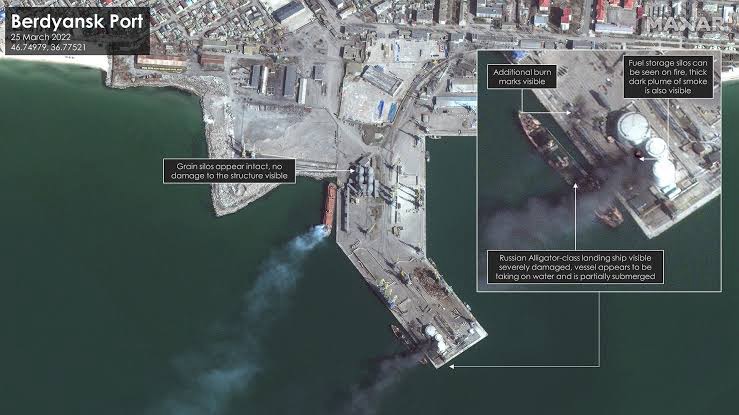
    Satellite images shows the loss of a landing ship at the occupied port of Berdyansk.

    An early war goal for Russia was the taking of the city of Odessa, a major grain and port that’s location was and is strategically important— especially to the defense of the fleet. Hundreds of articles written in the early days of the war covered the possibility of Russia attempting an amphibious landing to take Odessa. By early 2024, those articles have become irrelevant as the estimated 9-12 operational prewar landing ships have been attrited to 4.

    Article covers a possible Russian amphibious landing of Odessa.

    By mid-to-late 2024, Western assessments (including UK MoD) characterized the BSF’s surface strike role as “functionally inactive.” Russia retained the ability to launch Kalibr missiles from surviving surface ships and especially submarines, as well as from coastal batteries (Bastion-P and Bal systems), but large-scale surface operations in the western and central Black Sea had largely ceased. Ukraine successfully opened and sustained a maritime grain corridor (mainly from Odessa) under these conditions.

    That brings us to now. The Russian Black Sea fleets most important assets are the ships that are already damaged and awaiting repairs. Repairs and maintenance have slowed to a crawl because ships in dry docks are often targeted and destroyed. Even Submarines faced growing threats from underwater drones and combined strikes. Surface ships and support vessels continued to take losses. By early 2026, Ukrainian Ministry of Defence assessments (corroborated in broad terms by independent analyses) indicated that approximately 30% of the fleets pre-war combat strength had been destroyed or seriously damaged. Some counts of major combatants and overall capability degradation run higher depending on their individual methodology.

    Novorossiysk became the fleet’s last major functional base and primary concentration point. Russia fortified it with air defenses and other measures, and some submarines were fitted with counter-drone cages and partially submerged at berth for protection. However, Ukrainian long-range systems (aerial drones, Neptune variants, surface drones, and coordinated multi-domain packages) repeatedly have managed to reach the port.
  • Middle East war widens as Houthis launch attacks on Saudi oil facilities.

    Middle East war widens as Houthis launch attacks on Saudi oil facilities.

    On July 25 2026, Yemeni Houthi forces claim to have carried out ballistic missile strikes on two Aramco oil facilities in Saudi Arabia. 

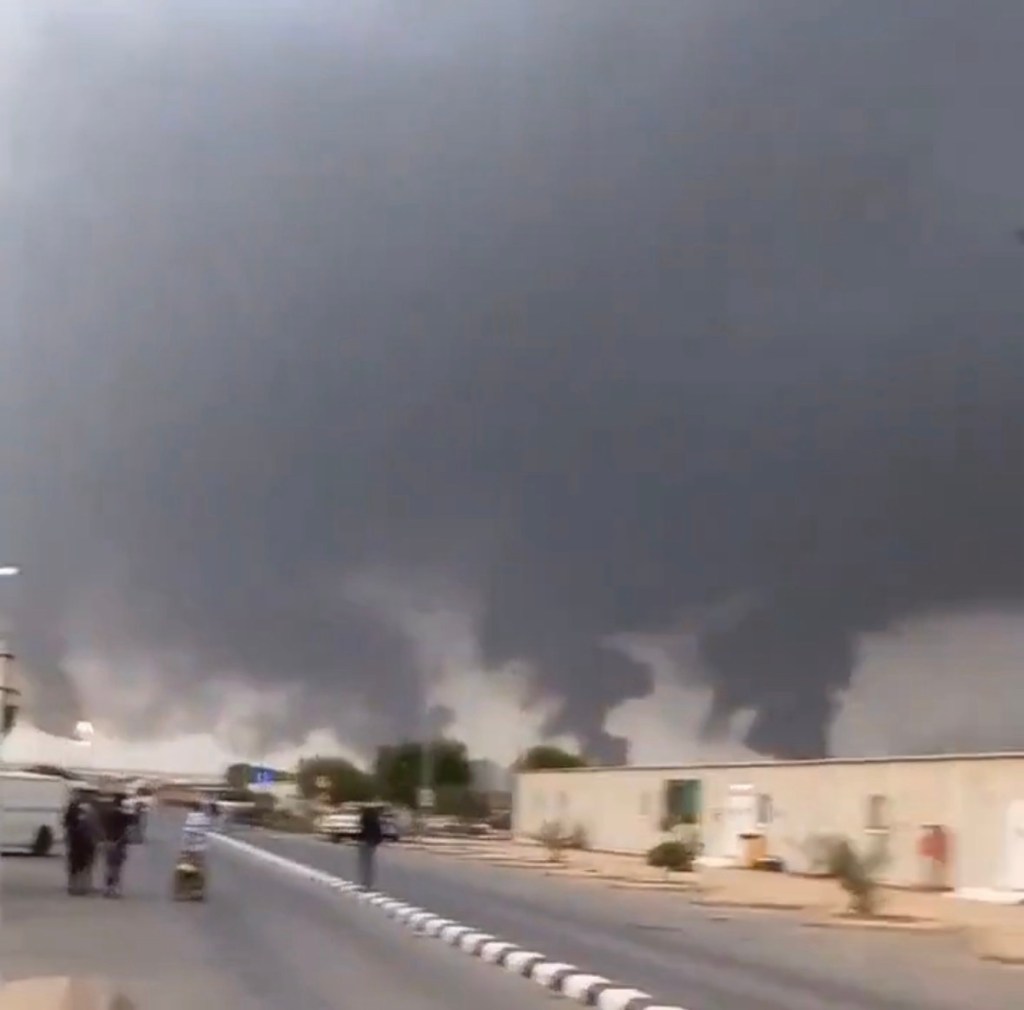
    Image reported to be of the Aramco oil refinery in Jazan.

    In a statement released on IRGC connected media networks, Houthi spokesperson, Yahya Saree said the group fired ballistic missiles and drones at facilities belonging to the state oil company, Aramco, in the Red Sea towns of Yanbu and Jazan. 

    Videos released online show smoke rising from the Jazan oil refinery. 

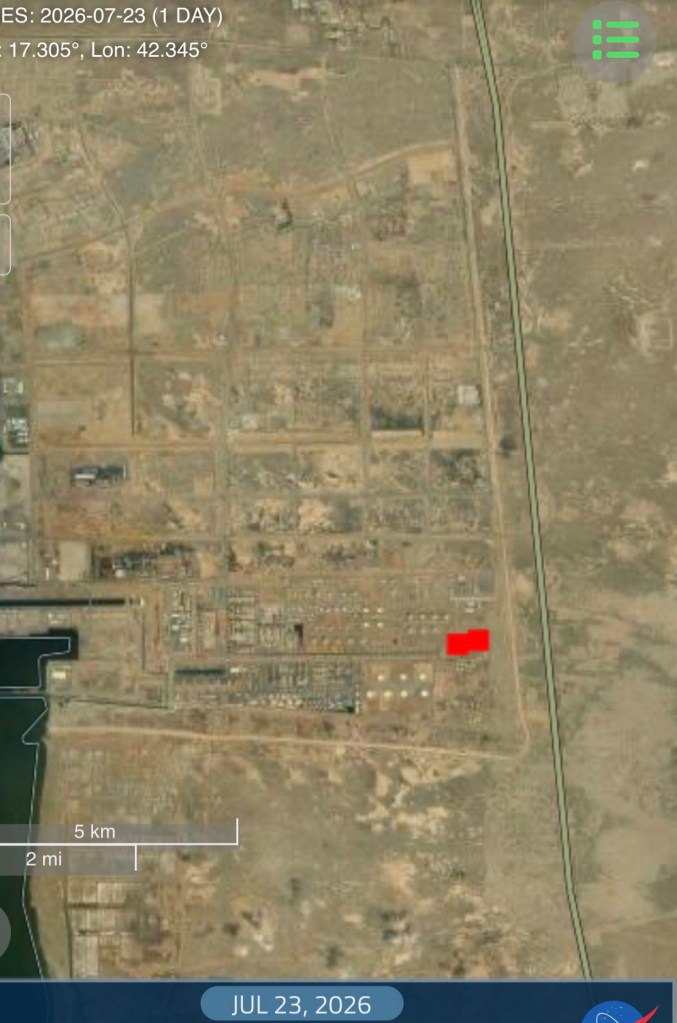
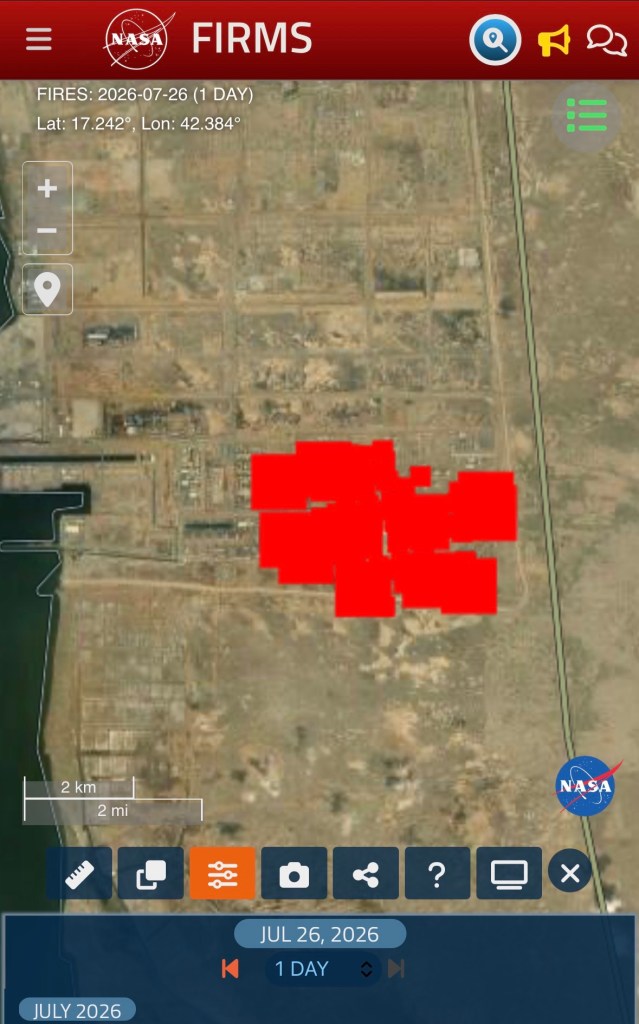
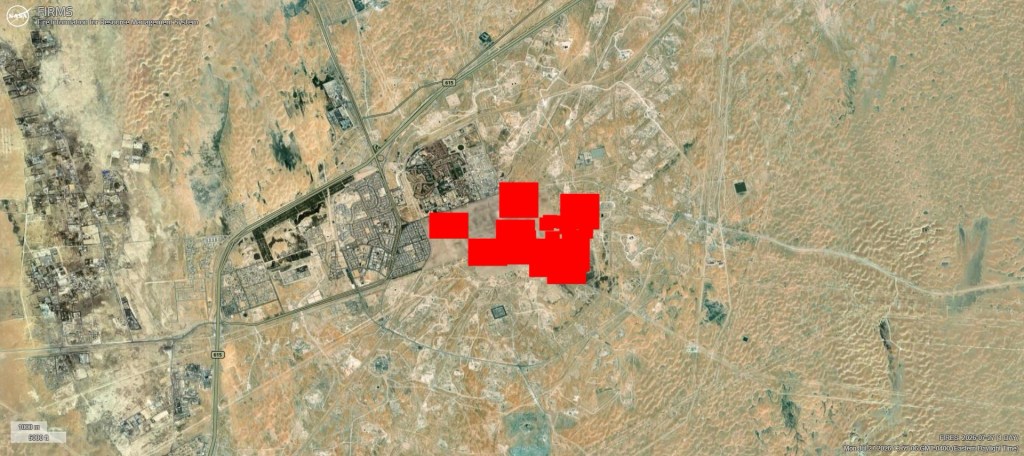
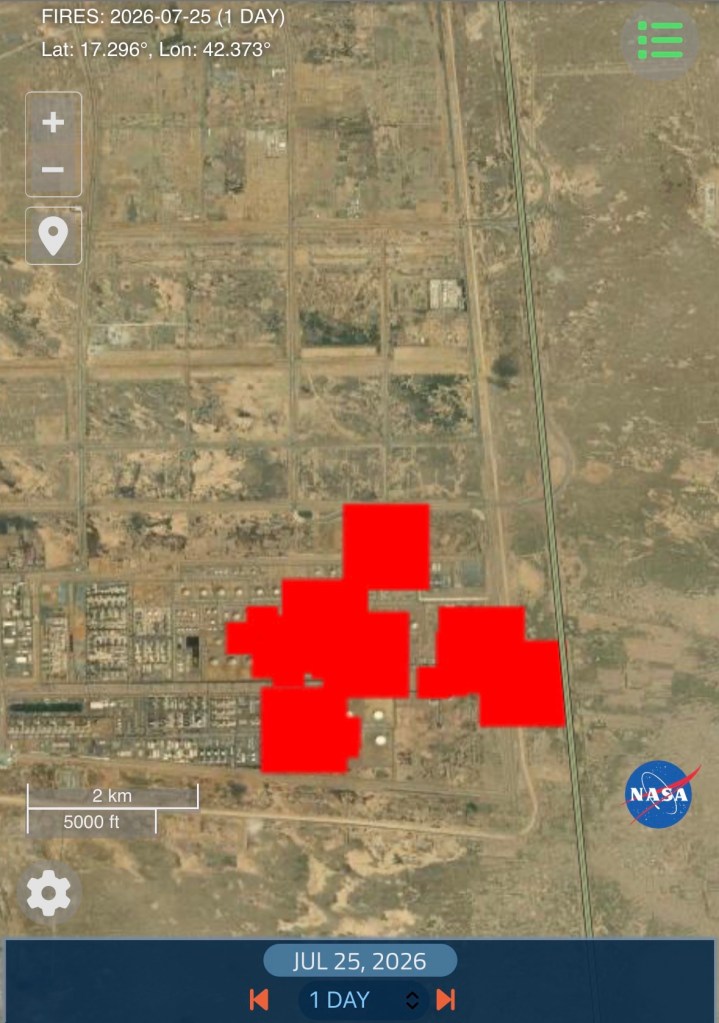
    NASA FIRMS, a satellite program used to detect wildfires, shows fires at both Yanbun and Jazan oil refineries.

    FIRMS shot showing Jazam refinery on July 25th, 2026.
    Comparison shot from the 23. The image from the 25th shows much more than is expected. Since then the fire has spread.
    This image shows the area of fire spreading,

    These attacks were claimed by the Saudi’s and their coalition of allies as a proportionate response for Saudi-led coalitions airstrikes on Houthi military positions in Hodeidah (Hodeida) and Kamaran Island. These strikes were carried out The Houthis on July, 23 2026 struck two Saudi oil tankers, the Encelia and Layla, operating in the Red Sea. The strike stemmed from a blockade of the Bab al-Mandab that the Houthis had annonced beforehand.

    The Houthis in Yemen are strongly aligned with Iran who offer training, weapons and other aid. They have been uncharacteristically uninvolved with the ongoing war between the U.S. and Iran, usually opting to fight alongside or at least operate as a sort of distraction. During the Israeli war in Gaza, a war that involved Iran because Iran supported Palestinian Hamas. During this time the Houthis would launch missiles into Israel as well as launch missiles at any Israeli/US alligned ships sailing.

    Update:

    As of writing this the Houthis have carried out an attack on the Aramco Abqaiq oil processing facility in Saudi Arabia. The plant is the largest of its kind in the world and process between 5-7 percent of the world’s global oil supply. A large fire broke out after Houthis drones struck the facility.

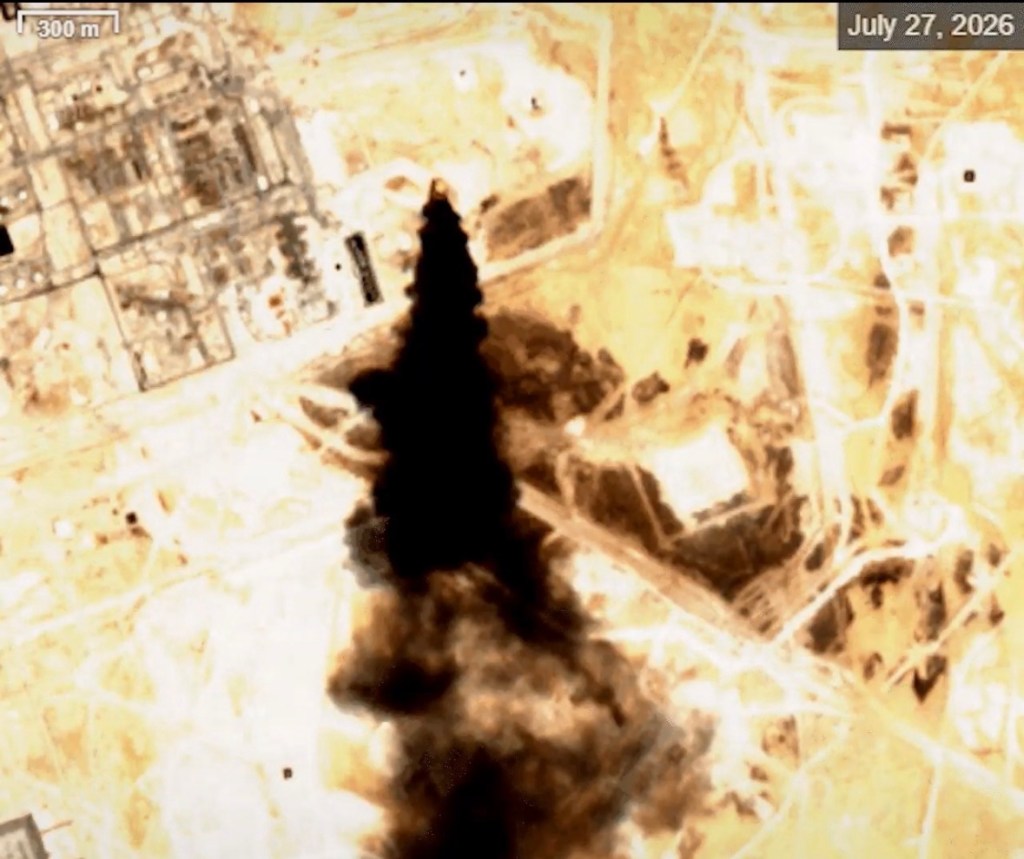
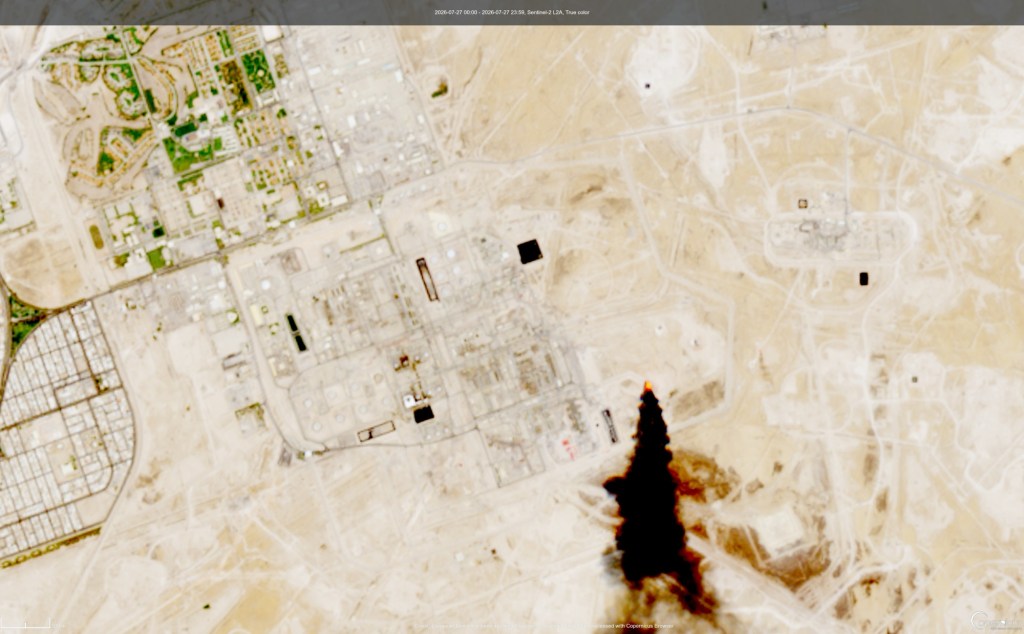
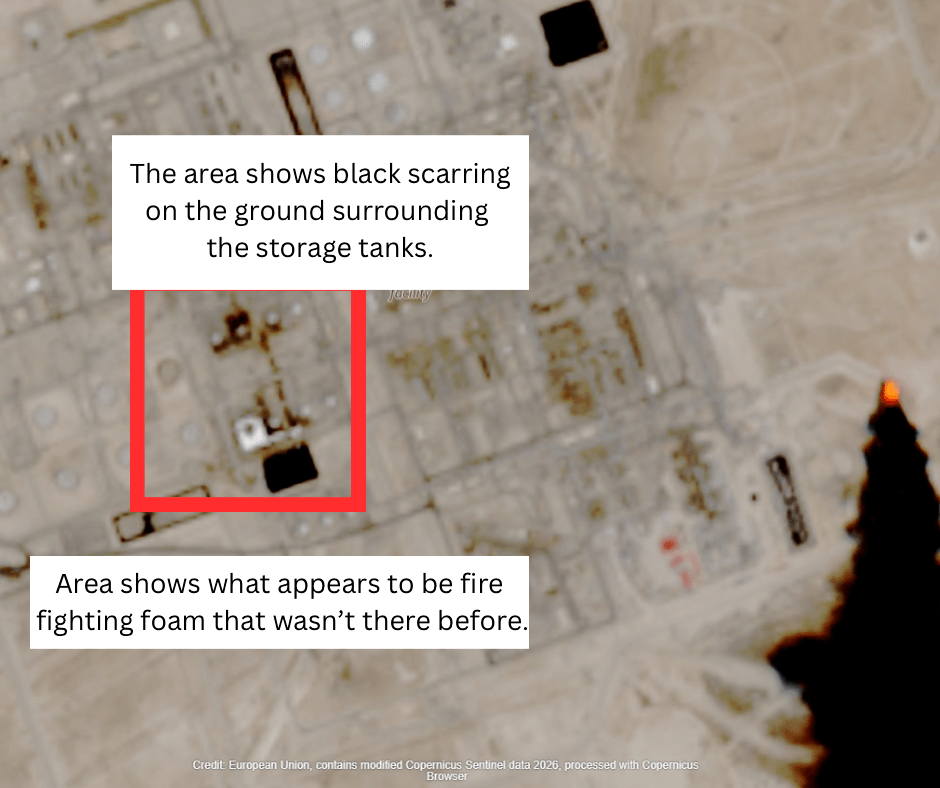
    NASA FIRMS shows a fire covering most of the plant. When looking at low-resolution satellite imagery from today we can see a large plume of smoke coming from a smokestack which doesn’t usually produce such a large plume. We can also see an area which appears to have been covered with firefighting foam. Another area nearby shows what appears to be ground scarring from a fire.

    Overview showing the Abqaiq oil processing facility. Think black smoke is pouring from the facility.
    Looking closer we can see areas that just today start to show signs of fire fighting foam and ground scarring.
  • Operation Spiderweb

    By. Scott Jackson


    06/02/2025

    On Sunday, we reported on a major covert drone attack carried out by Ukraine on Russian airbases across the country destroying a not insignificant percentage of Russia’s long range strategic bomber fleet. This attack stunned Moscow as well as western leaders who by all accounts weren’t made aware of the strike beforehand.

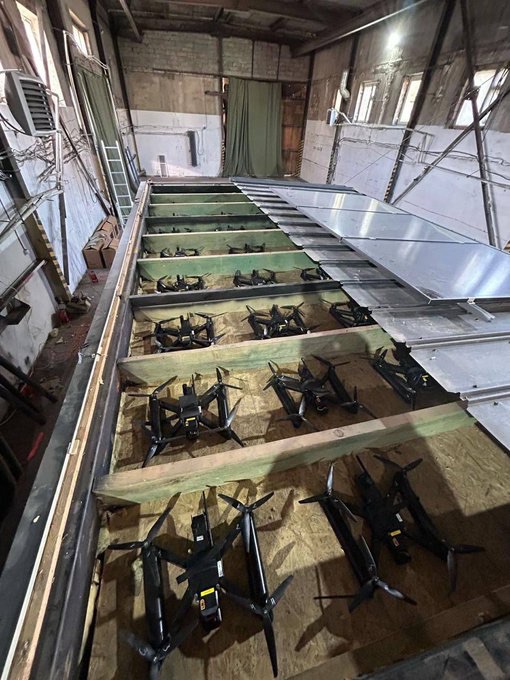
    ‘Operation Spiderweb’, the name given to the operation was carried out using semi trucks that were loaded up with a reported 117 drones total. The drones were used to target 4-5 different airbases spread all over Russia with the furthest being in Siberia.

    The trailers on the semi trucks were each disguised as sheds being hauled. When parked near their targets the roof was activated remotely and would slid off allowing the drones inside to be piloted remotely into their targets. Ukraine has done mass drone attacks before, often even but drones launched from Ukraine have to travel much further and are at a greater danger of being shot down by Russian Air Defense.

    Image released by Ukrainian security services shows the back of the trucks which were used as makeshift drone carriers.

    The drivers of the trucks were all Russian truck drivers contracted out by one (or several guys) using the name Artyom. They were contacted with delivery instructions and all had similar stories about getting to their drop off point and then the roof sliding off and drones started flying out. Russia is still investigating.

    Let’s go over each of the airbases and look at the numbers for Russian loses as best we can. These numbers are all based on satellite images received as well as open source information. Take the following breakdown for what it’s worth, an analysis done with less than an optimal amount of data.

    Before we jump in I’ll link to some videos one from the day of the attack and the other released today which has some more data we can use and is almost 5 minutes long.

    Here is the first.

    Video shows the first footage most were shown of Operation Spider Web.
    Belaya Airbase. Probably the hardest hit of the airbases.
    This video was released the day after the attack and shows strikes from all of the bases. A lot of the analysis I’m doing here will include things seen in this video.

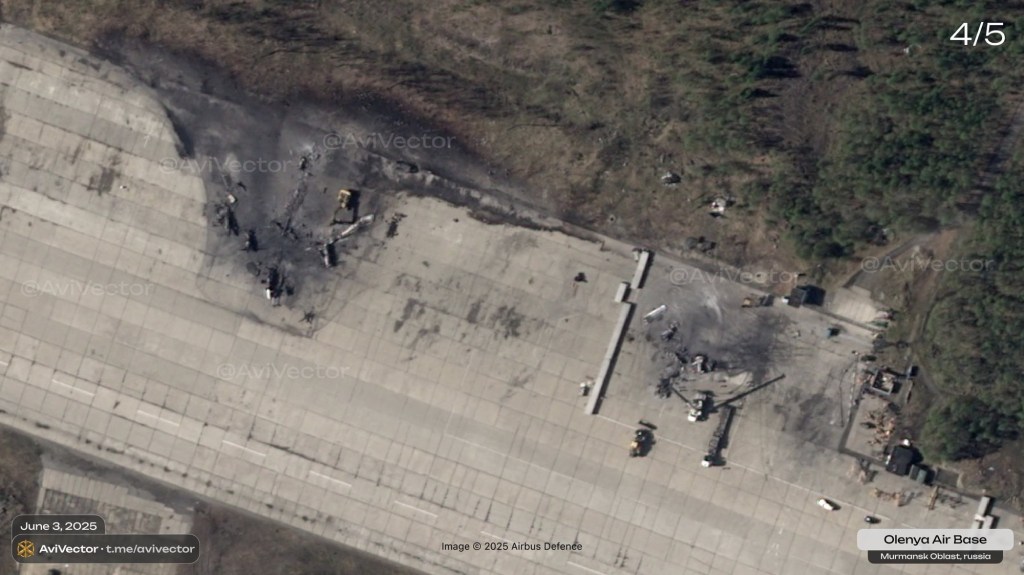
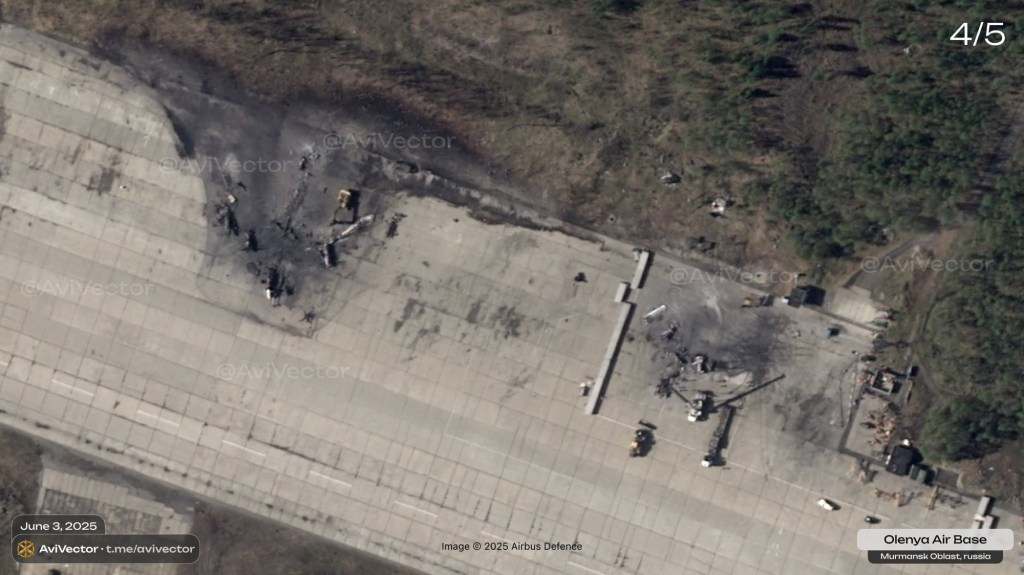
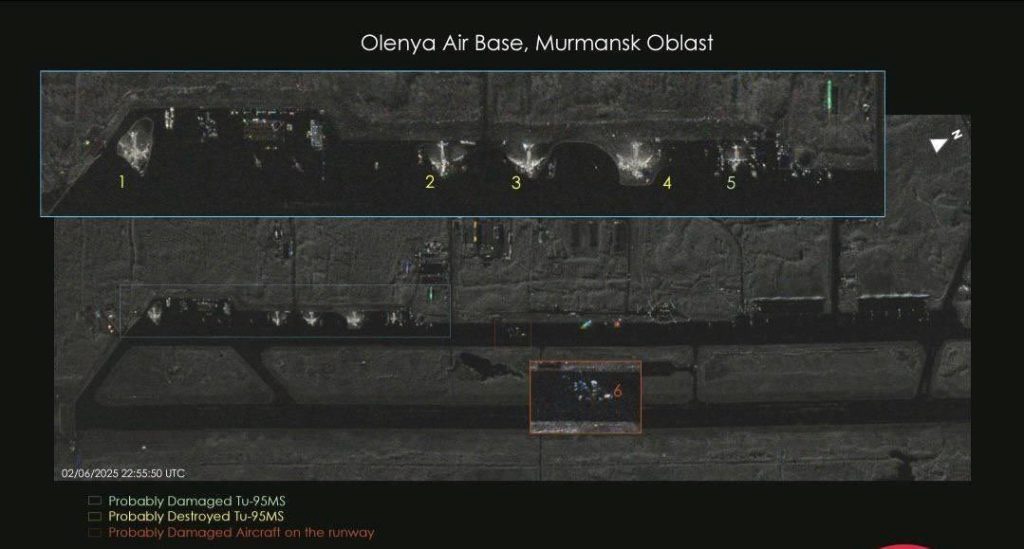
    Olenya Air Base

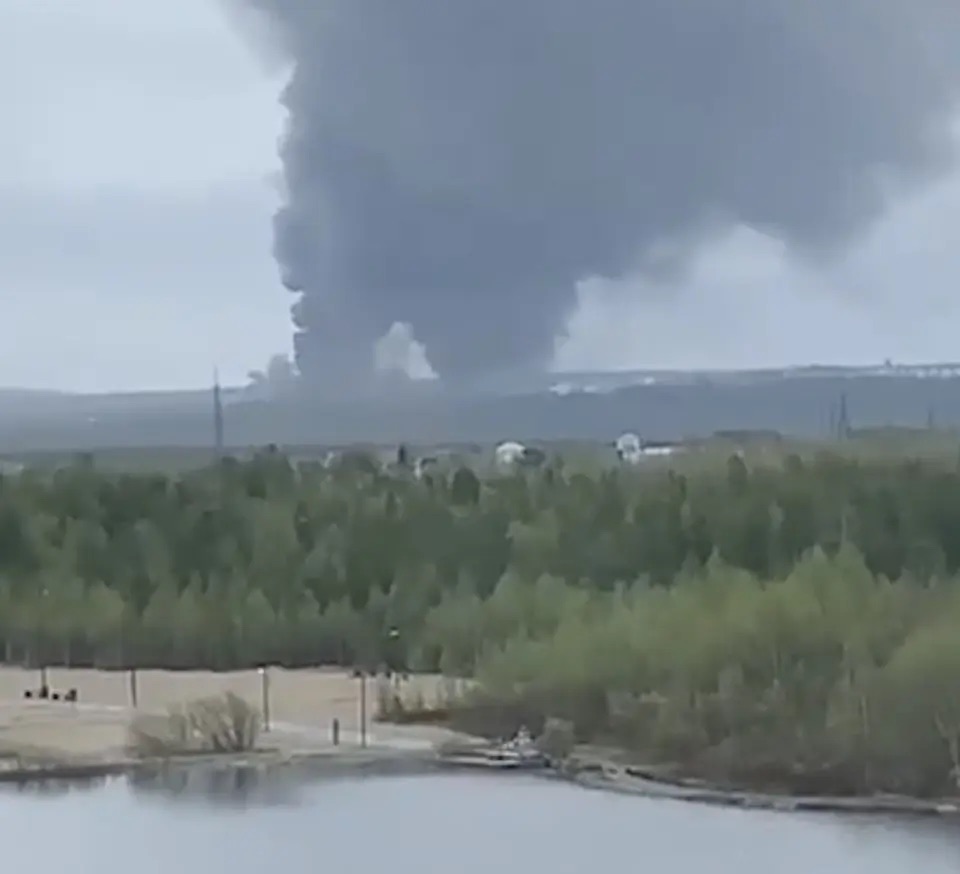
    Olenya Air Base directly after the drone attack.

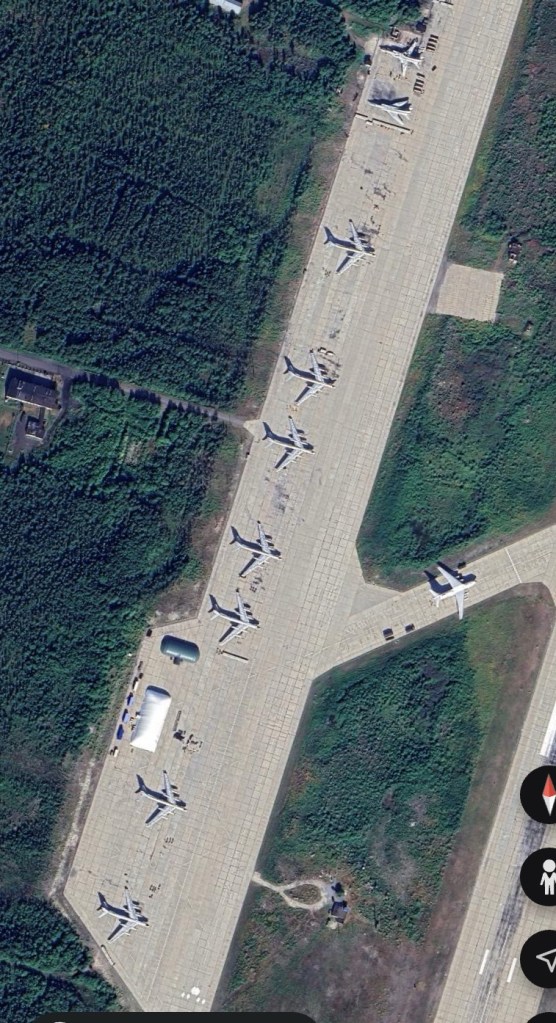
    On the Kola Peninsula, Air Base Olenya is an important part of Russia’s military operations. The bases aircraft are mostly made up with a collection of Sukhoi Su-24 and Tupolev Tu-95s.

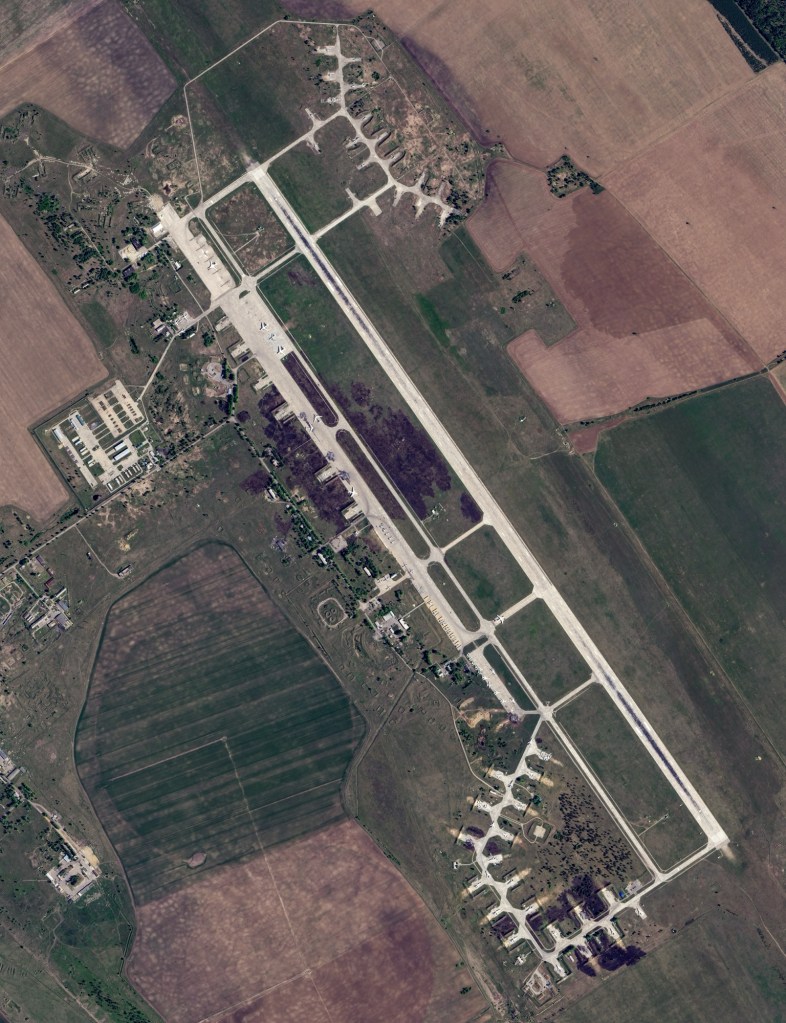
    Most recent Google Earth Image from Olenya Air Base.
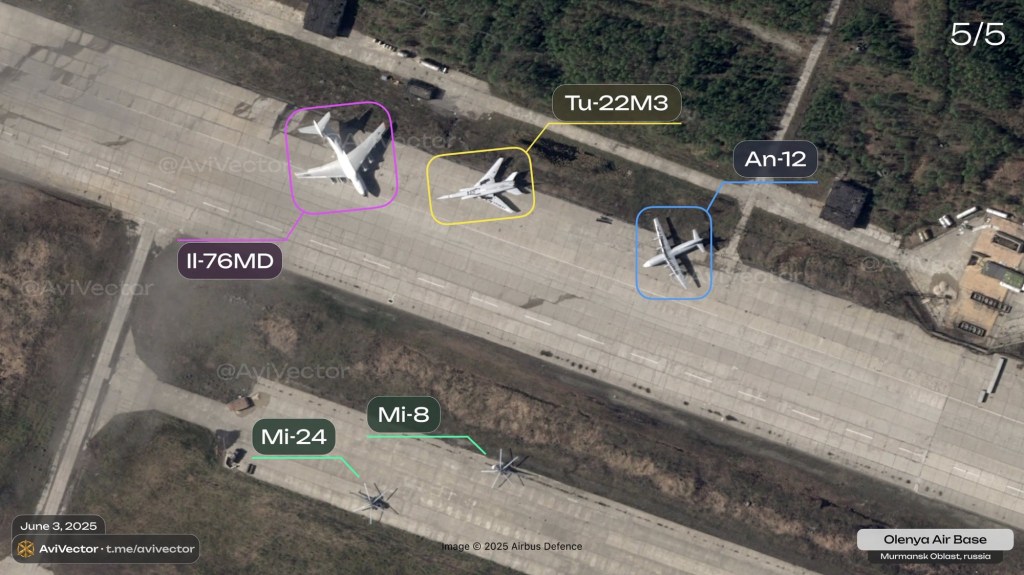
    Most recent imagery shows a line of TU-95
    This image is from Olenya but more recent than the Google earth inages.

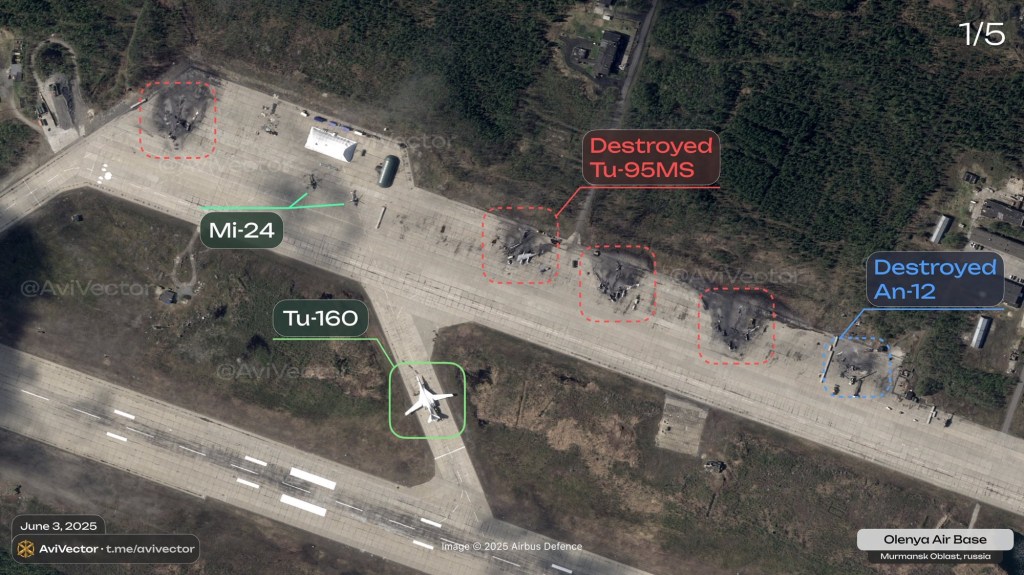
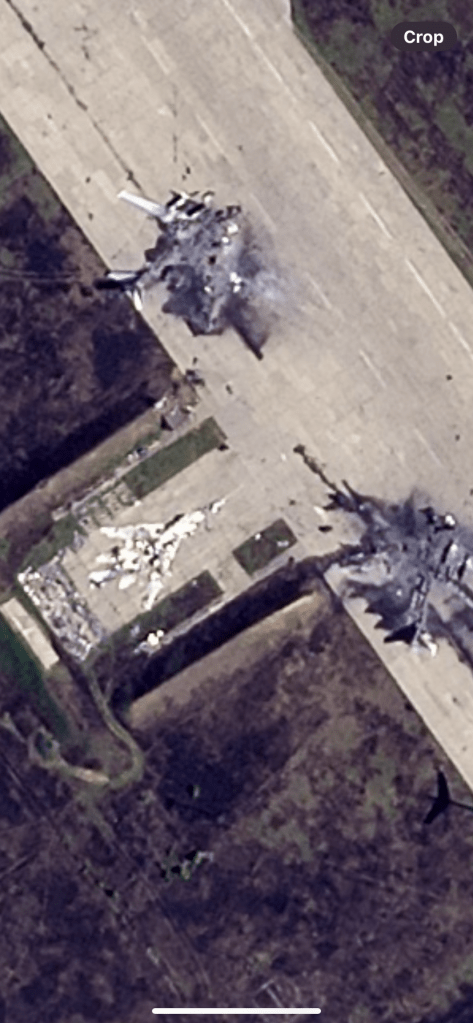
    After Ukraine’s attack images look a bit different.

    The below shows the wider view in the aftermath of the attack .

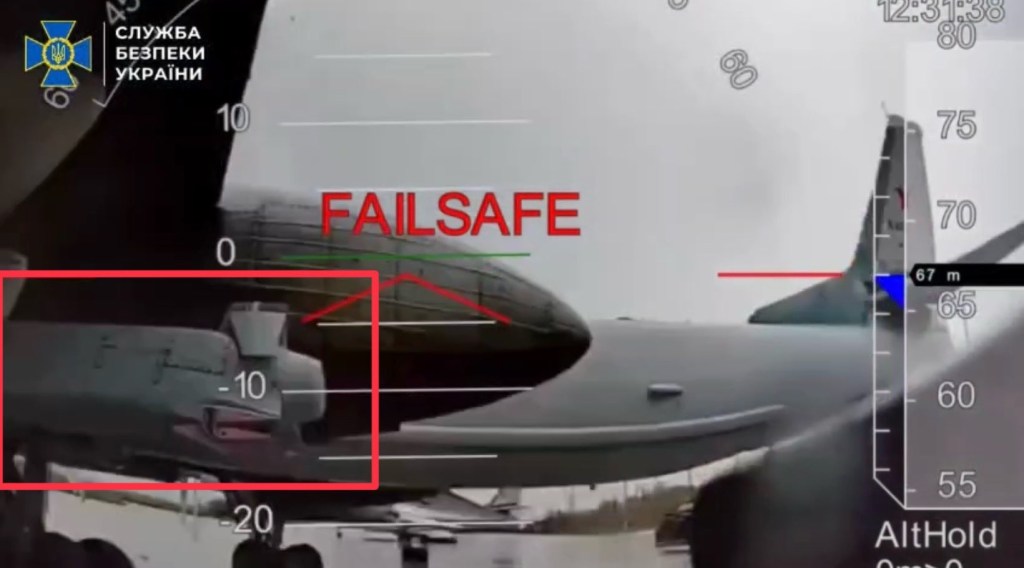
    After looking at this data as well as the video clips of the attacks it’s believed that at least 4 Russian Tu-95 bombers were destroyed at Olenya air base along with one An-12 transport aircraft.

    Online sleuths have pointed out that in the video released after the attack you can see that at least one of the Tu-95’s had already been loaded with Kh-101 cruise missile. These bombers among others have been responsible for the recent missile wave attacks launched at Ukraine and her city’s. Some of the largest missile and drone attacks of the war have been carried out in the past 2 weeks.

    Alleged Russian cruise missile spotted during operation spiderweb.

    Ivanovo

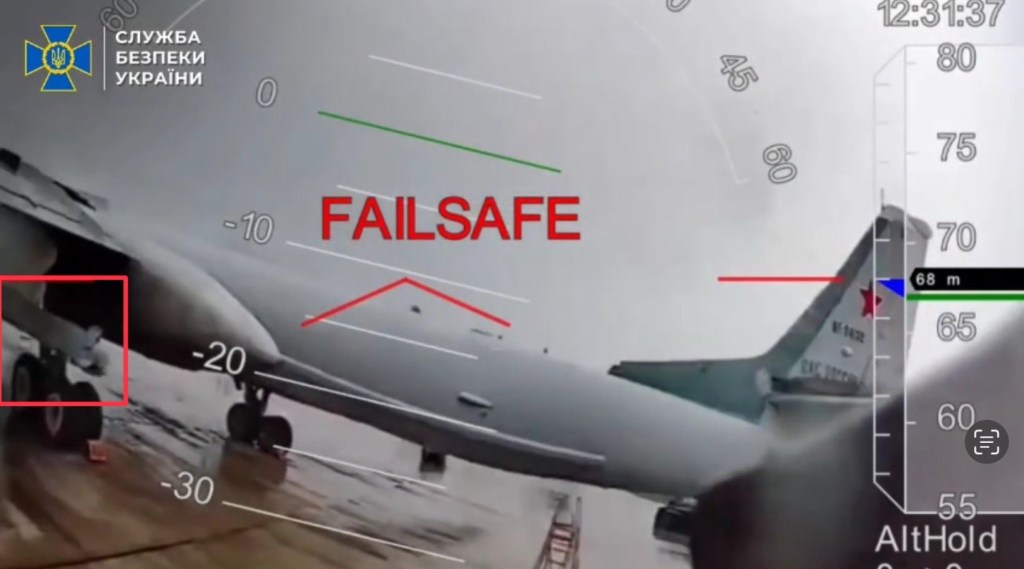
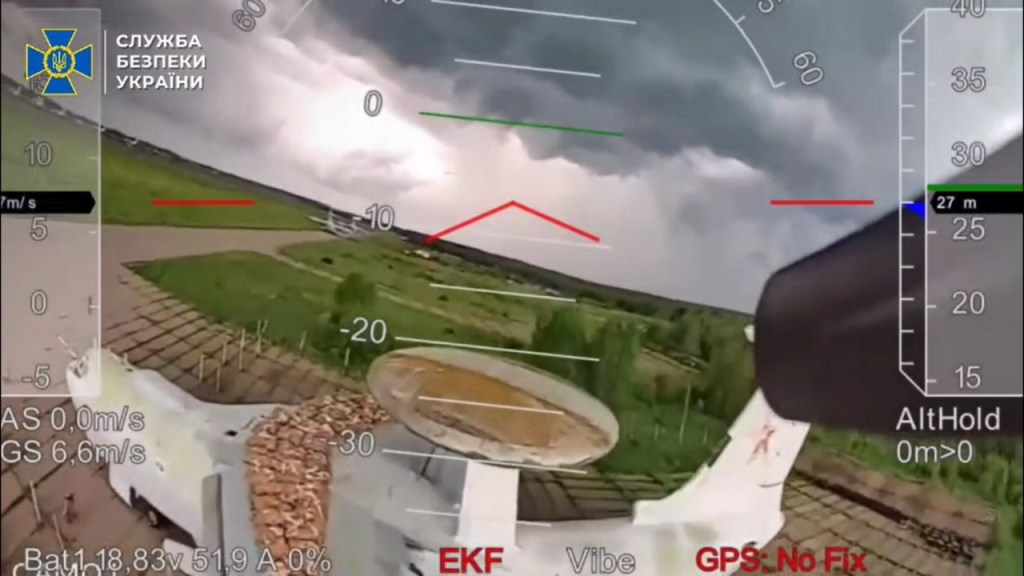
    Ivanovo Severny Air base houses the 144th AEW&C regiment as well as rhe 610th Combat Use and Retraining Center for Military Transport Aviation.. The Ivanovo airbase houses a number of retired A-50 (and possibly active A-50’s) as well as transport aircraft like the Il-76. The video shows two A-50s being struck however I don’t know if these are the operational A-50s. Now we know Ukraine watched and planned this mission for a year and a half. I would like to think they wouldn’t waste the time attacking an airfield that holds nothing except some old parts planes. They had great Intel for this operation so it’s possible but I wanted to at least mention the uncertainty.

    Two images from a drone on the day of the strikes. These planes are covered in tires and other things used to break up line of sight for drones. Russia often uses tires for this purpose.

    Dyagilevo air base

    Of all the airbases. This is the one I have the least data for. I’ve yet to see satellite imagery from after the attack so I’ll just go by the video. It seems that a number of Tu-22s were targeted. At least 4 possibly more however I did notice that some of the planes shown in the video were struck multiple times. Will update this if I can get more info.

    Belaya

    Belaya air base in theUsolsky District, Irkutsk Oblast was hit pretty aggressively compared to the others.

    The base houses two types of Russias strategic bombers with the 200th Guards Heavy Bomber Aviation Brest Red Banner Order of Suvorov Regiment using Tu-22M3, the 444th Heavy Bomber Aviation Regiment with the Tu-22M3 and the 181st Independent Composite Aviation Squadron with the Antinov A-12 and A-30. Present at the base during the attack were also Tu-95s.

    This is the before shot of the airbase. Included fkr comparison with the after shot. This base has several decoy parking slots used to fool drones and satellites. That being said the paint for the decoys is very old so it’s fairly easy to spot. Sat images done by Planet labs.
    The shot after Operation Spiderweb. Sat images done by Planet labs.

    If my math is correct this airbase lost at least a solid 4 Tu-22’s, those are the ones that I can see, from the images, burned up and are completely destroyed. The video m of the attack shows multiple other Tu-22s that were targeted making me think that there is a good chance that some were damaged and need repaired or are not recoverable but we just can’t see it. So for now I’m sticking with 4 but it has an asterisk.

    I’m not counting this one, which is an obvious decoy. The fake wreckage might have fooled me but I’ve seen this base before. Pictures of this spot exist prior to the operation.

    The image with the decoy shows 2 of the 3 completely destroyed Tu-95’s. There is one more further down the runway which can be seen in the imagery and is shown to be struck in the video.


    Afterthoughts

    This attack will go down as one of Ukraines highlight moments in the war, showing a weakness in Russia’s current method of parking their airplanes.

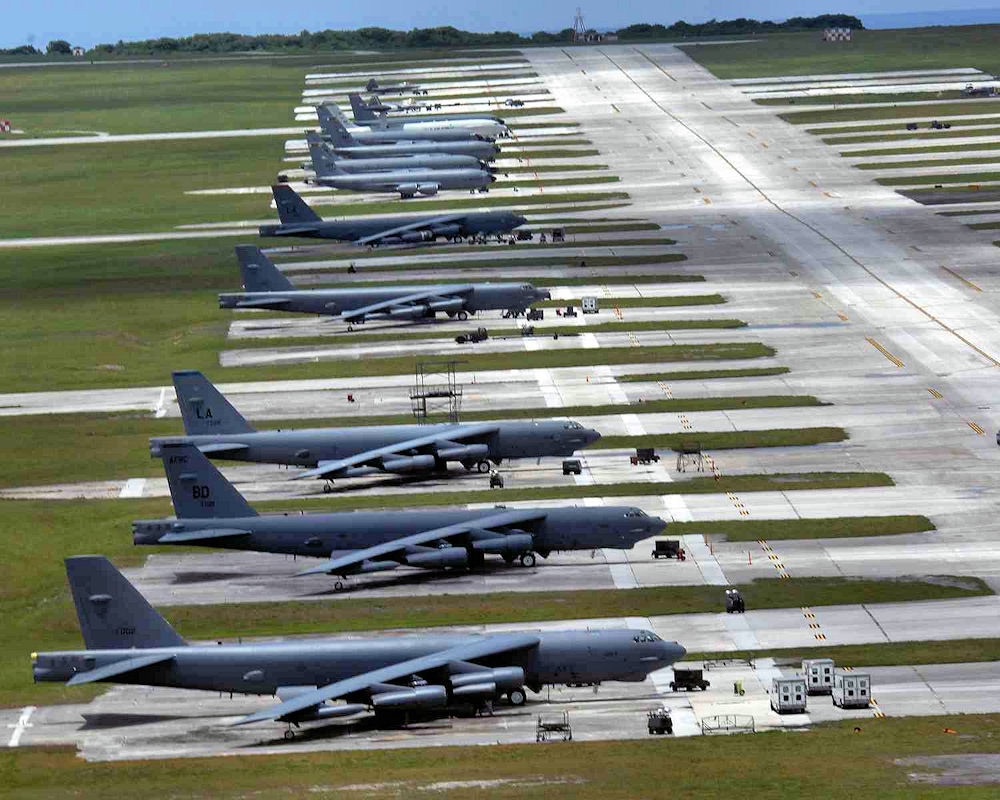
    The line of B-52 Stratofortress at Anderson AFB.

    However. While my own country of the U.S. does have Hardened Aircraft Shelters, they are usually only found being used on the frontlines areas like the Middle East or in The Pacific. Protecting those w deployed assets is extremely important but it’s becoming increasingly glaring that some day, one of the US’s enemy’s could stage a similar attack, knocking out multiple squadrons of long range bombers before anybody even knows what’s happening. China on the other hand has been ahead of the game in this field building vast hundreds of these shelters for their air fleets. China who also happens to be in the forefront of drone warfare and combat tech. Could it be thag China sees a threat because they know the possibility’s of what rcan be accomplished with drones?

    The opening of a Hardened aircraft shelter located in South Korea.
    I’d like to thank everybody who provided imagery for this, especially planet labs who allows me to be on their mailing list to receive these images when something big happens. That was a nice surprise after I started trying to find sat images to find them in my email. 

    -Scott