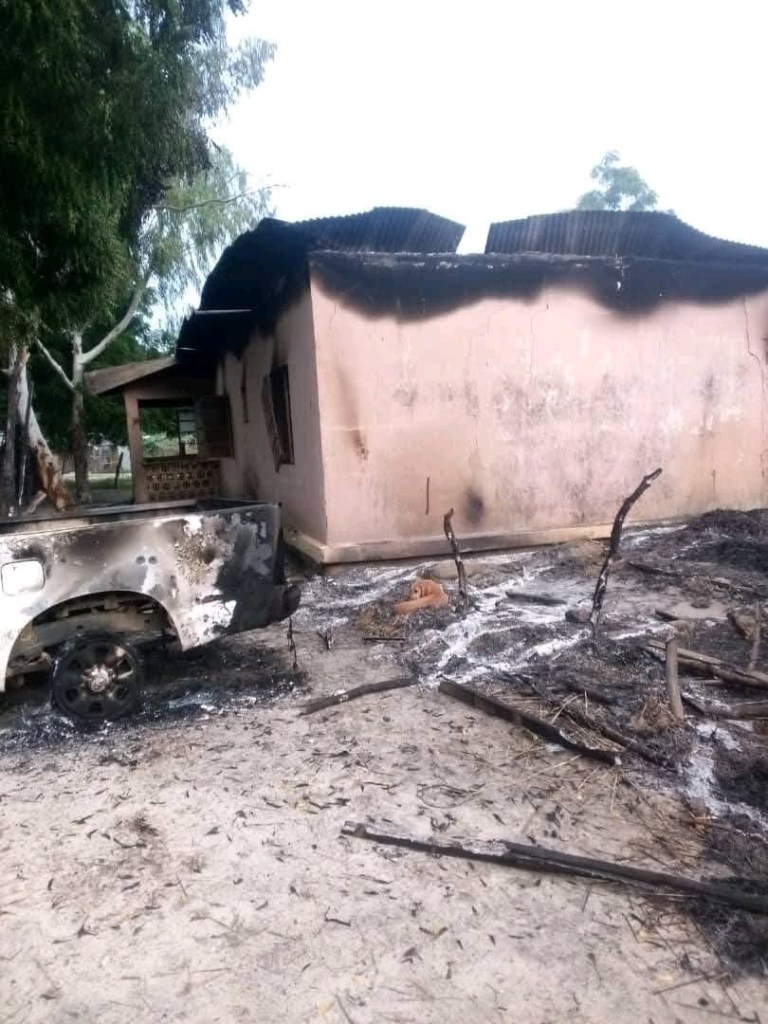
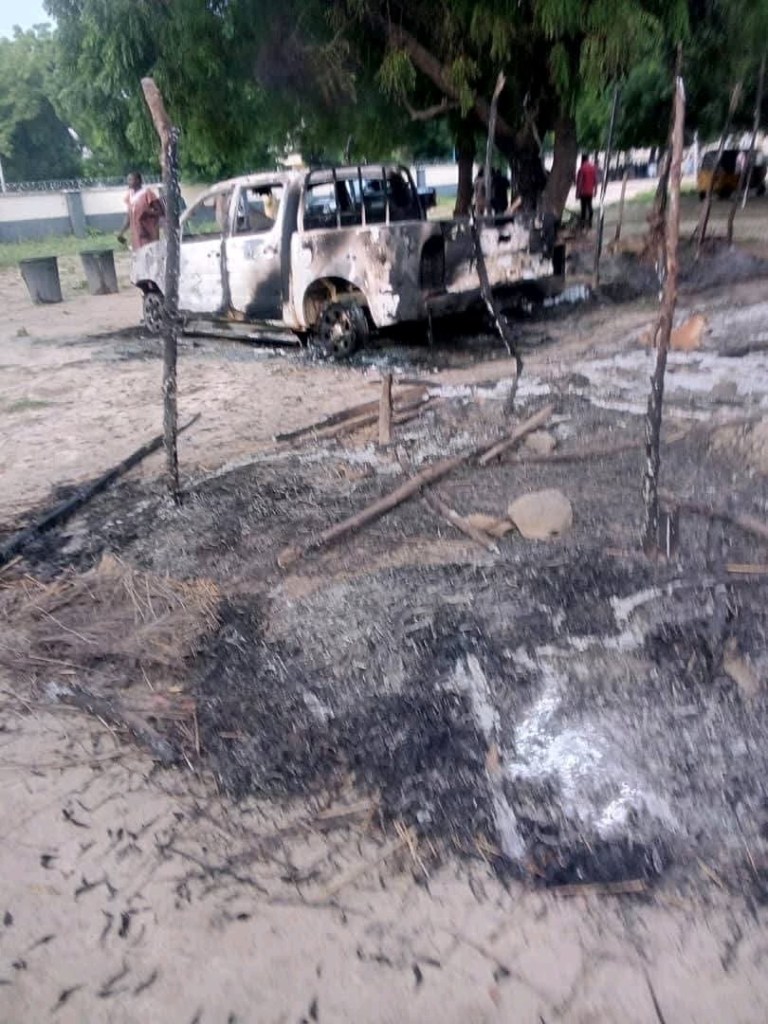
Last night, the Jihadist group, Boko Haram killed more than 70 people in an overnight attack in the village of Darul Jamal on the border of Nigeria and Cameroon in the Borno State.
Dozens of armed men arrived on motorcycles around 8:30pm on Friday night and started firing indiscriminately. Residents say the gunmen went house to house killing the men and leaving the women behind.
The leader of the village, who asked to remain anonymous told Reuters “They went house to house, killing men and leaving women behind. Almost every household is affected,”
He said that they have recovered 70 bodies on Saturday morning but thag more were still missing .
Malam Bukar fled with his wife and three kids, he said “They came shouting, shooting everyone in sight.”
The governor of the Borno state, Babagana Zulum, visited the village on Saturday, the day after the attack and spoke to AFP news agency.
“It’s very sad, this community was resettled some months ago and they went about their normal business,”
He also said
“The numerical strength of the Nigerian army is not enough to contain the situation,”
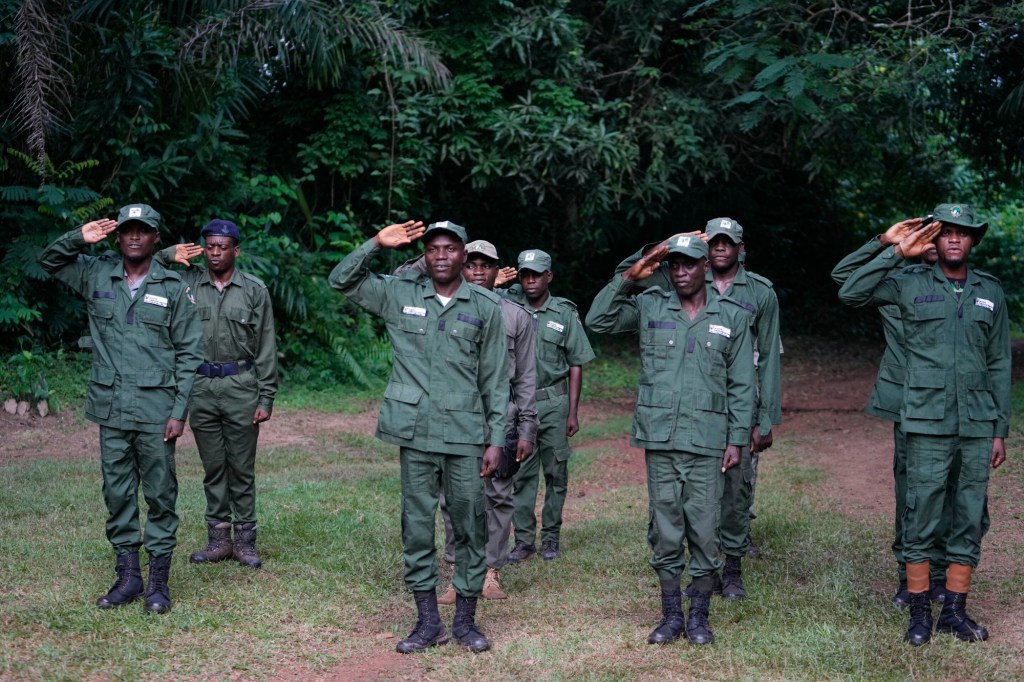
Zulum added that a newly established force called the Forest Guards was set to bolster security personnel in the embattled region.
Images of Nigerian Forest Guard. Each region is expect to recruit anywhere from 2,000-5,000 to help deal with ongoing security concerns. They will fight poachers and hopefully help deal with the threat of terrorist.
This attack comes as Islamic Jihadist have been making a resurgence in the area with Boko Haram and their rivals, the west African branch of the Islamic State (ISWAP) both stepping up attacks.
“Western education is forbidden” a quick history of Boko Haram.
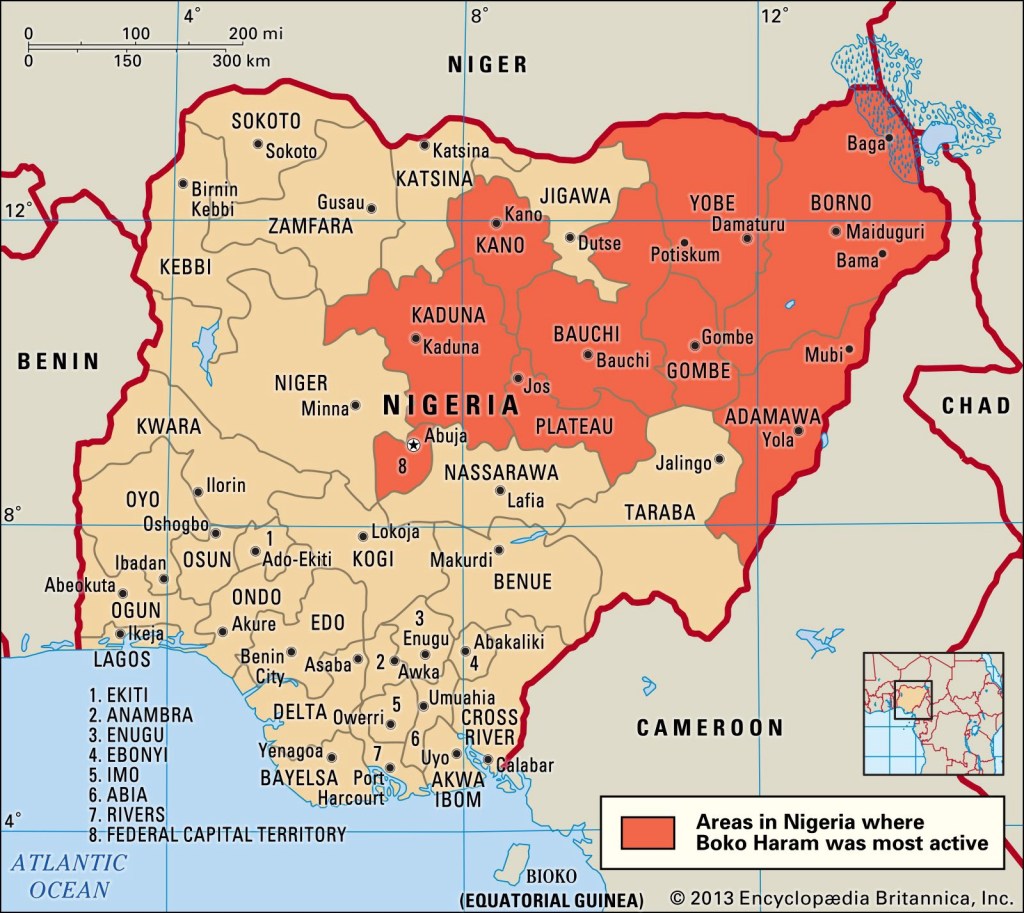
Map showing the area of activity from Boko Haram.
Boko Haram has existed in Nigeria, in one form or another since the early 90’s. The group calls itself Jama‘atu Ahl as-Sunnah li-Da‘awati wal-Jihad” (JASDJ; Group of the Sunni People for the Calling and Jihad) and “Nigerian Taliban”.
The group looks to overthrow the current goverment in Nigeria and replace it with a regime based on Islamic law. Boko Haram stands for “Western education is forbidden”. Boko being a holdover word for book from the time of English colonialism. In 2009 thr group suffered a major setback when clashes with Nigerian security forces left hundred of their members dead. They have been rebuilding ever since and have become much more dangerous under the leadership of their former second-in-command, Abubakar Shekau who claimed leadership of the group in 2010. Since that time the group has displayed more effective operational terror capabilities, utilizing improvised explosive device (IED), vehicle-borne IED (VBIED), and female suicide attacks against a wide range of targets. In 2011 the group bombed the UN headquarters in Abuja killing over 20.
Abubakar Shekau
In 2014 Boko Haram was carrying out near daily attacks against Christian people or Nigerian goverment forces, schools, the media, politicians and even other Muslims they viewed as collaborators.
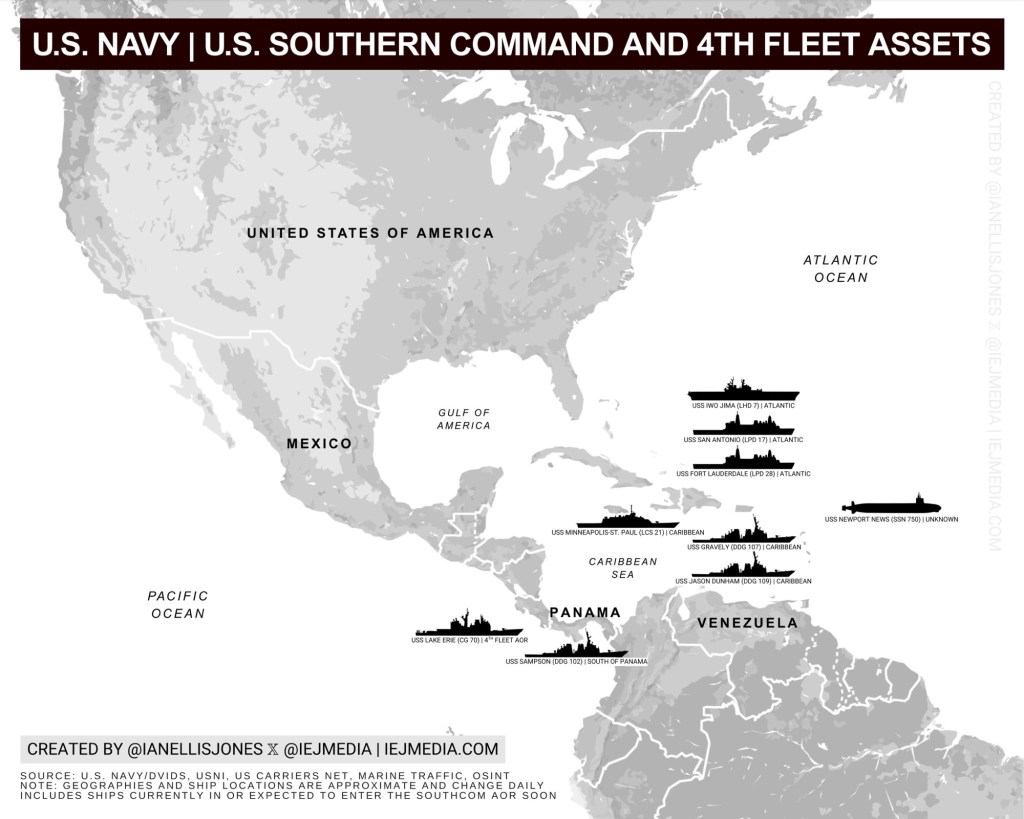
Map put together by Ian Ellis Jones over on Twitter shows the ships currently moving into the South American region. Some of the locations are true, as of when the image was posted, others are approximate.
By. Scott Jackson
08/30/2025
A look at the recent increase in U.S. forces already in or heading to the Caribbean.
The U.S. is increasing its presence in the region in an effort, they say, to deal with drug trafficking. This has been a big issue for Washington and is currently causing some tension as the White House called Venezuelan leader Maduro a “Narco-Terrorist” and have made him the main focus of these efforts. Is this a regular drug operation, or something more? For now nobody’s sure.
So far eight ships and a submarine have been deployed to the 4th fleet/Southern Command [SOCOM] AOR. Making this the largest confrontation between Venezuela and the U.S. in years.
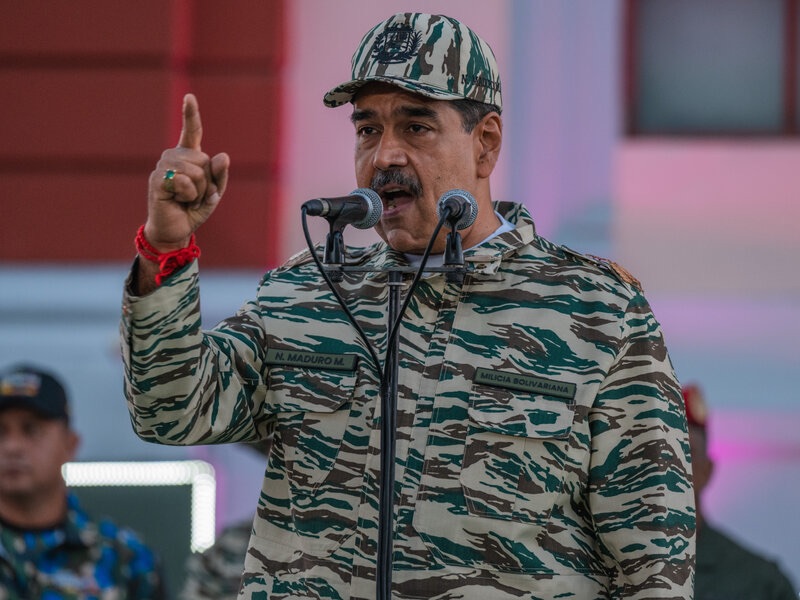
For Venezuelan President Nicolas Maduro, this attention only strengthens his goverment hold on the country. The U.S. feels Maduro’s election back in 2013 and 2024 was due to election interference and say his victory was only assured because of ballot stuffing and other types of election fraud. Currently Washington has a $50 million dollar bounty for his arrest on charges of drug trafficking. Maduro’s response to the threat of the U.S. warships steaming towards southern waters was to declare that Venezuela would respond with the activation of 4.5 million militiamen.
“This week, I will activate a special plan with more than 4.5 million militiamen to ensure coverage of the entire national territory — militias that are prepared, activated and armed,” Maduro announced on state television.
Most believe that this move by Washington is aimed more at a show of force over actual U.S. intervention in the region, but in case it’s not just a well armed navel stroll around the block let’s go over some things.
Who is Nicolás Maduro?
Nicolás Maduro speaking to his supporters about the American forces heading towards Venezuela.
Maduro was born in 1962 and before he was a president he made his money as a bus driver for a long time before rising to become a trade union leader. In 2003 he was elected to the National Assembly and frim there appointed to a number of positions under the then president Hugo Chávez. He served as the president of the National Assembly in 2005-06, and as Minister of Foreign Affairs from 2006-2012. From then on he was Vice President under Hugo Chávez until his death in 2013. After Chávez’s death Maduro assumed the role of president and has stayed in the role ever since. Since then, Maduro has managed to stay in office, consolidating power along the way. The elections the country has run show Maduro winning, however claims of election rigging have run rampant.
Since Maduro rise to power Venezuela has been forced to endure widespread authoritarian rule marked by rigged elections, human rights abuse and economic hardship. Maduro’s goverment can be characterized by its mass allegations of corruption, the suppression of critical information and poor leadership. Widespread shortages have plagued the country and inflation of its currency, the Bolivar, has skyrocketed, tripling in the last several years. For a country as resource rich as Venezuela is, having one of the largest oil deposits in the world, these problems are inflicted mostly by the actions and policy of their government.
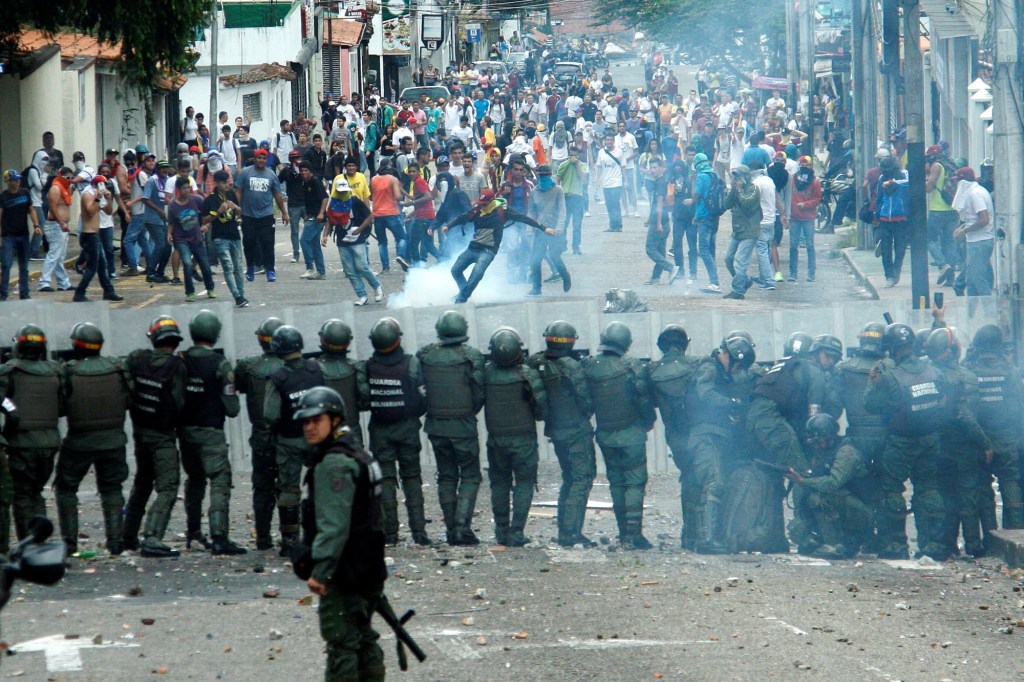
Demonstrators clash with members of Venezuelan National Guard during a rally demanding a referendum to remove Venezuela’s President Nicolas Maduro in San Cristobal, Venezuela October 26, 2016. Photo: Carlos Eduardo
What U.S. assets are being sent to Venezuela?
For now it seems that the bulk of the forces being mobilized for this operation -whatever it ultimately ends up lmbeing, are from the USS Navy with some help from the Air Force.
Earlier today radio calls from a USAF RC-135 ‘Rivet Joint’ were recorded as they communicated with the Mcdall tower out in Tampa Fl. The RC-135 was refueling “somewhere over the Caribbean”. This means that the Air Force is doing ELINT missions and gathering data from the region. The Rivet Joint is capable of picking up radar signals from hundreds of miles away as well as other types of electronic surveillance and reconnaissance.
ABATE07 (KC-135) is somewhere over the Caribbean right now fueling a RC-135.
We also have reports of Navy P-8 Poseidon’s out of San Juan patrolling around the Caribbean several days ago. These planes are mostly used for anti-submarine work but can still be used as spotters for surface ships as well.
Venezuela has one submarine that might or might not be operational so I don’t see the ASW assets getting all that much use here.
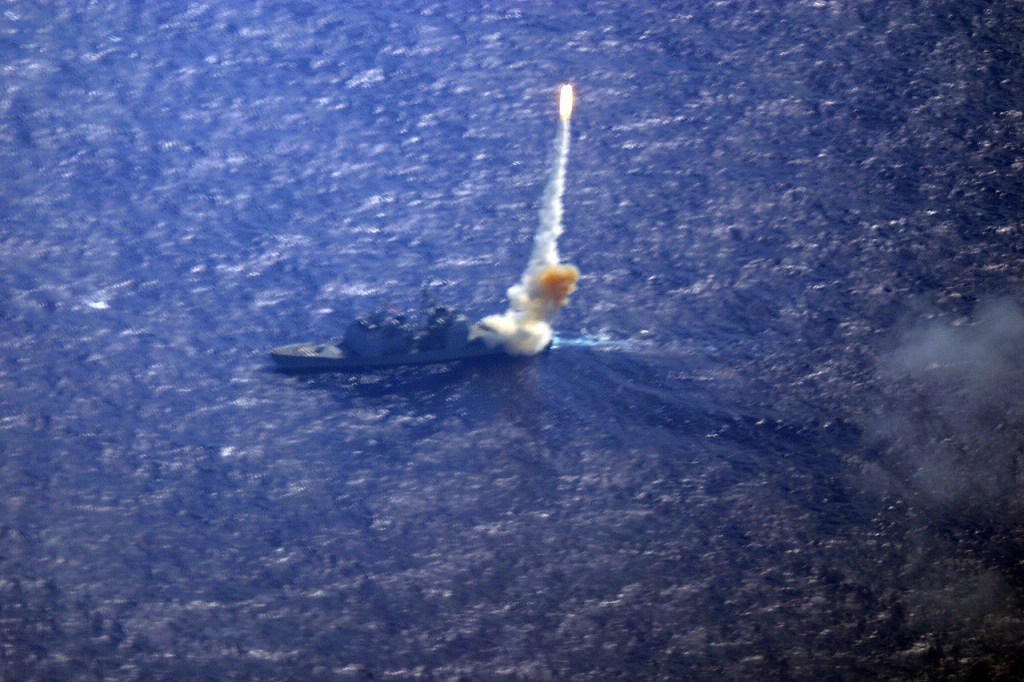
Ticonderoga-Class launching one of its standard missiles.
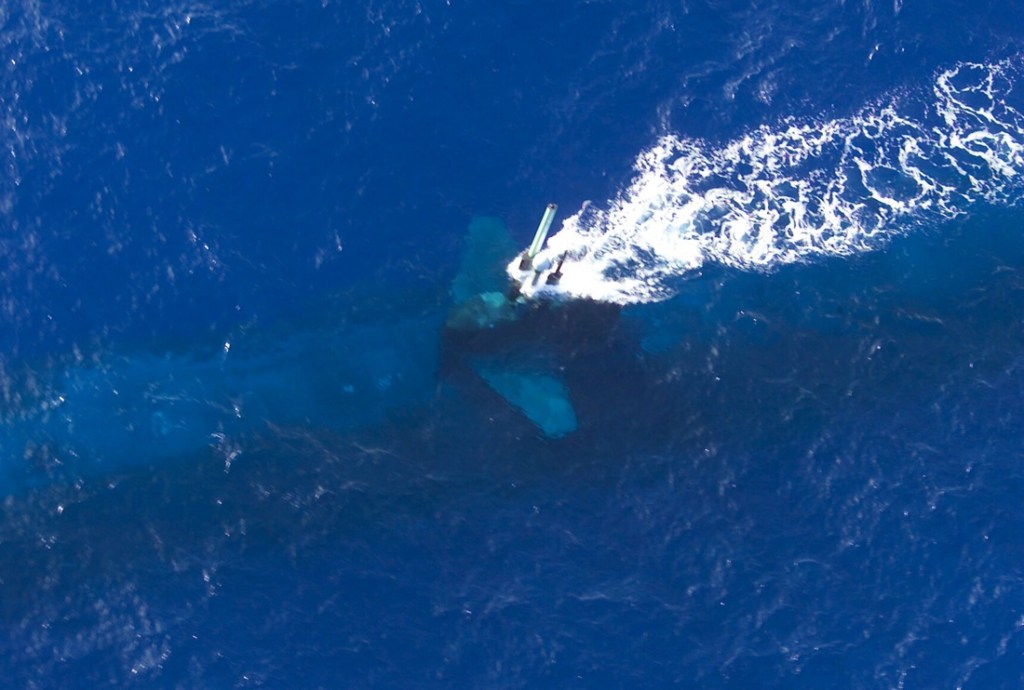
On to the ships. So far 9 ships have been ordered to the area. The most recent of the bunch is the Ticonderoga-Class guided missile cruiser USS Lake Erie (CG-70) and the Los Angeles-Class fast attack submarine USS Newport News (SSN-750).
Los Angeles class submarine operating at periscope depth.
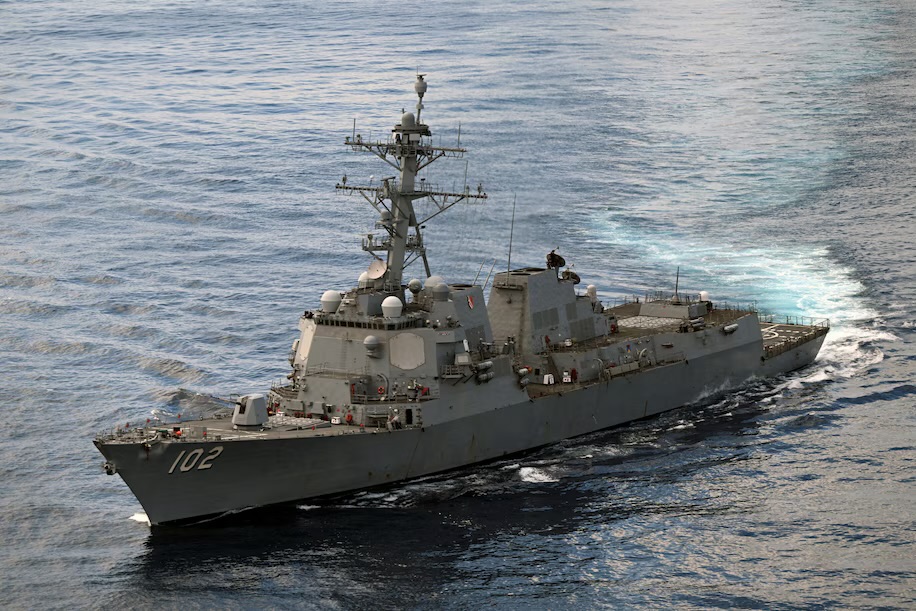
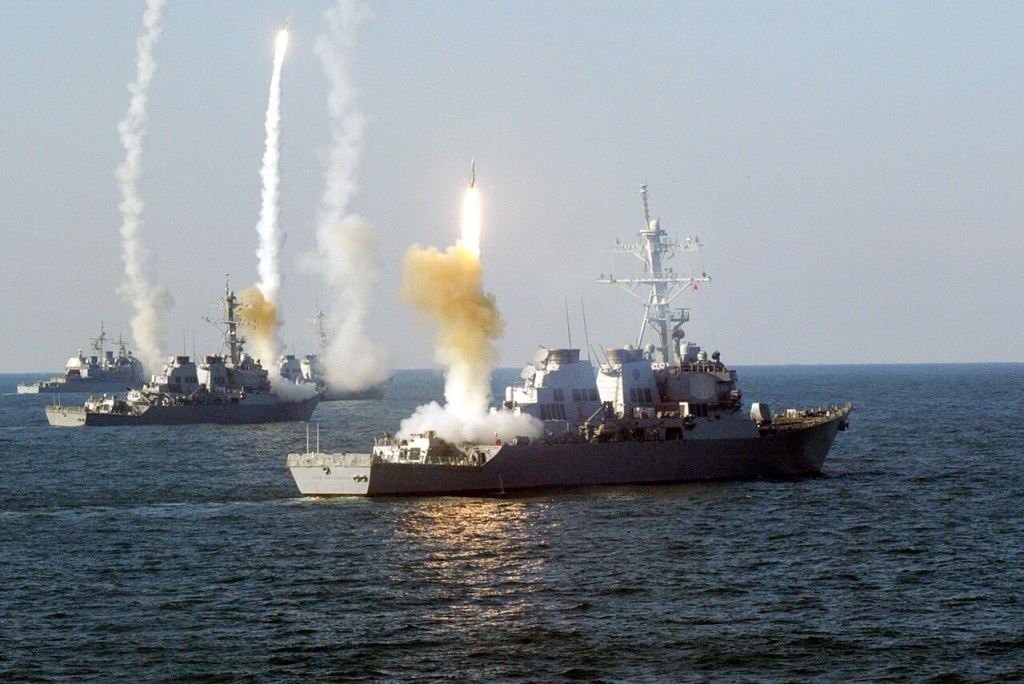
Three of the ships are Arleigh Burke-Class guided missile destroyers. USS Gravley (DDG-107), USS Jason Dunham (DDG-109), and USS Sampson (DDG-102). These ships along with the Lake Erie provide the bulk of the firepower. All of the ships listed so far, including the submarine are capable and likely carrying a number of Tomahawk cruise missiles, among others.
Arleigh burke-Class destroyers intercepting targets during an exercise
Last but not least we have the USS Minneapolis-Saint Paul (LCS-21) a Freedom-Class littoral combat ship. These ships were, according to the navy “envisioned to be a networked, agile, stealthy surface combatant capable of defeating anti-access and asymmetrical threats in the littorals.” Littorals refers to an area of the sea close to shore. Basically these ships are comparable to what other navies call corvettes.
Each of the freedom class comes with a hanger for the SH-60 or MH-60 Seahawk, as well as a ramp in the stern for launching smaller boats. These ships are capable of transporting and launching a small assault force with troops and fighting vehicles.
Image shows the USS Minneapolis-Saint Paul.
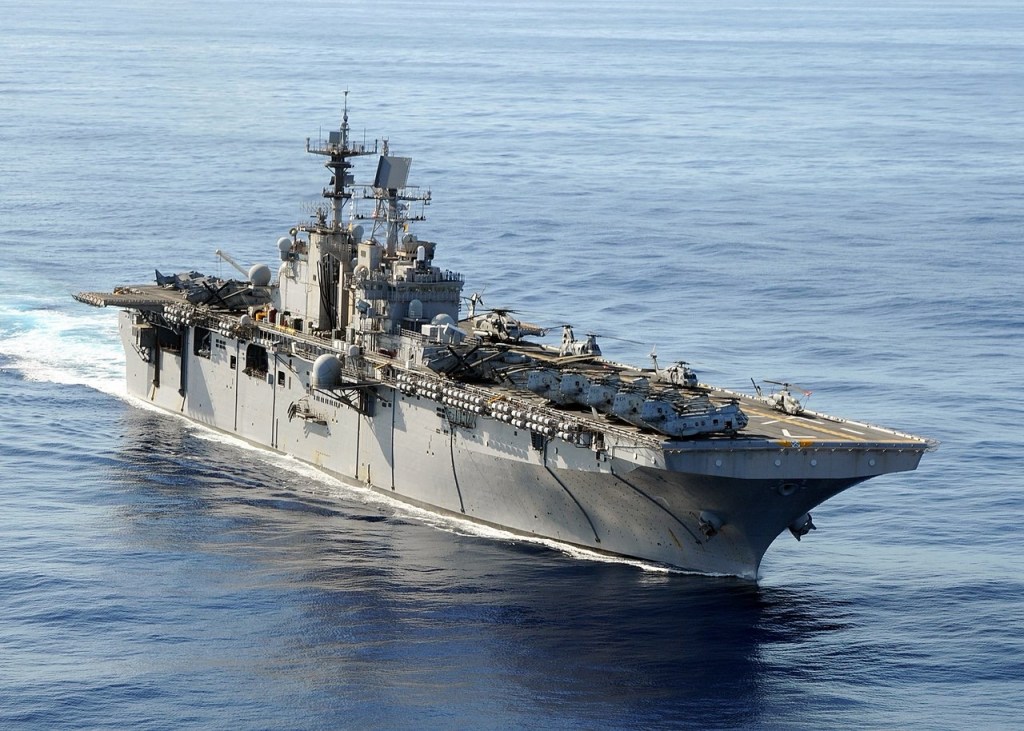
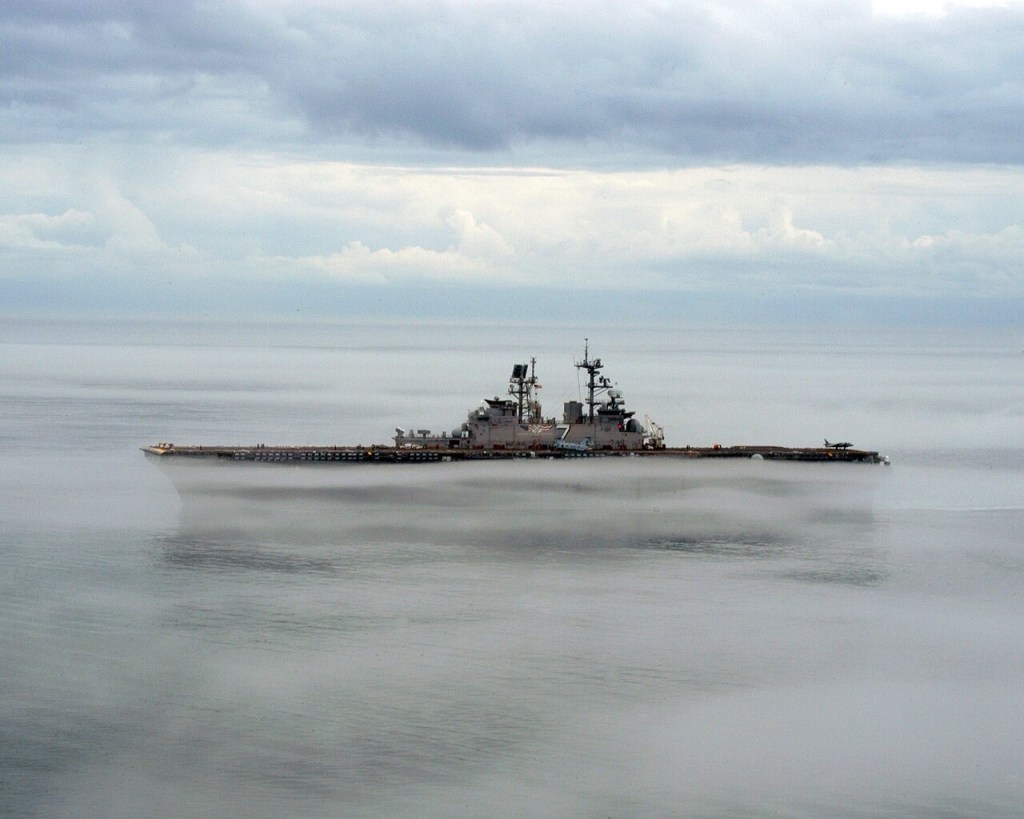
Next is the USS Iwo Jima (LHD-7) classified as a Wasp-Class amphibious assault ship and landing helicopter dock.
USS Iwo Jima (LHD-7) in the Atlantic sometime in 2008.
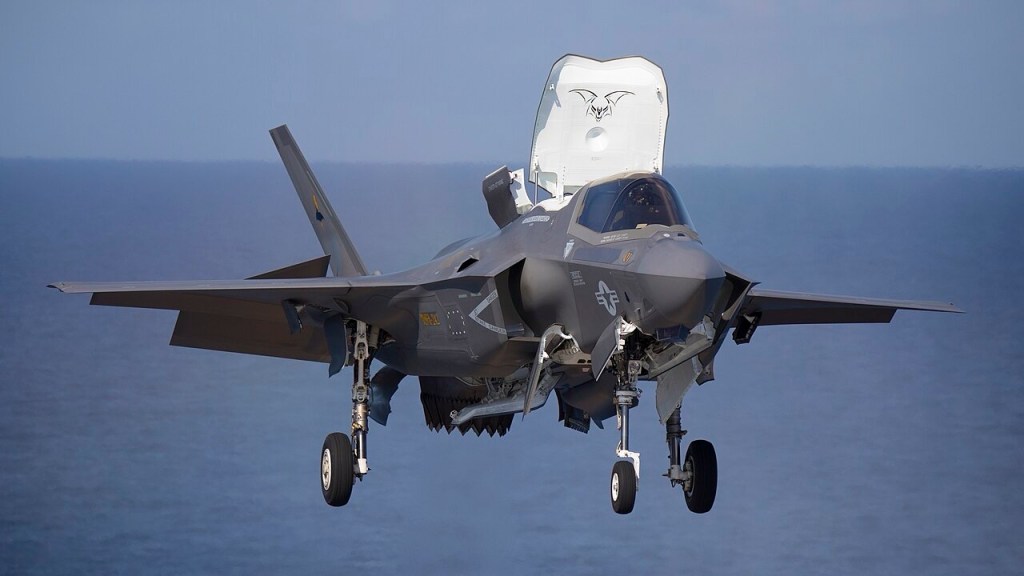
This ship carries various aircraft- mostly helicopters, and a lot of Marines as well as their equipment. This ship is essentially a floating marine base of operations capable of transporting them and their equipment into hostile territory and supporting them the AV-8B Harriers until 2027 when most of the assault ships are switching to F-35B’s. I don’t know if the Iwo Jima currently employs harriers or The F-35 currently.
USS Iwo Jima hiding in the fog.Marine Vertical take off F-35B coming in for a landing.
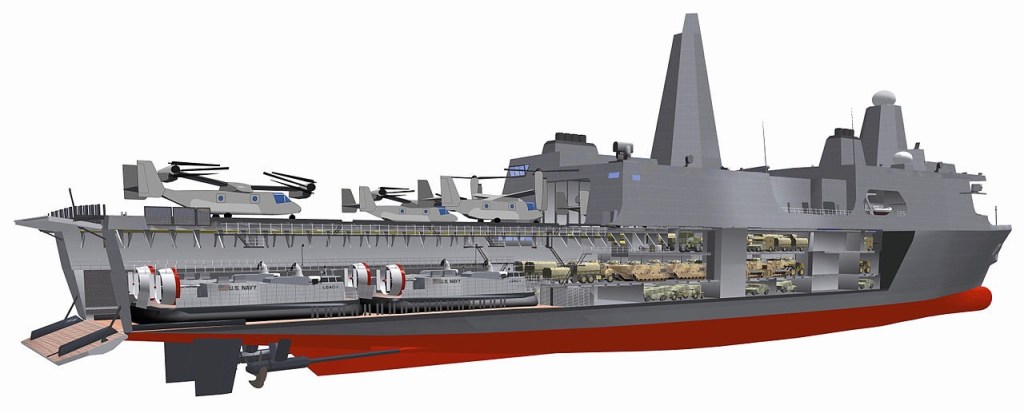
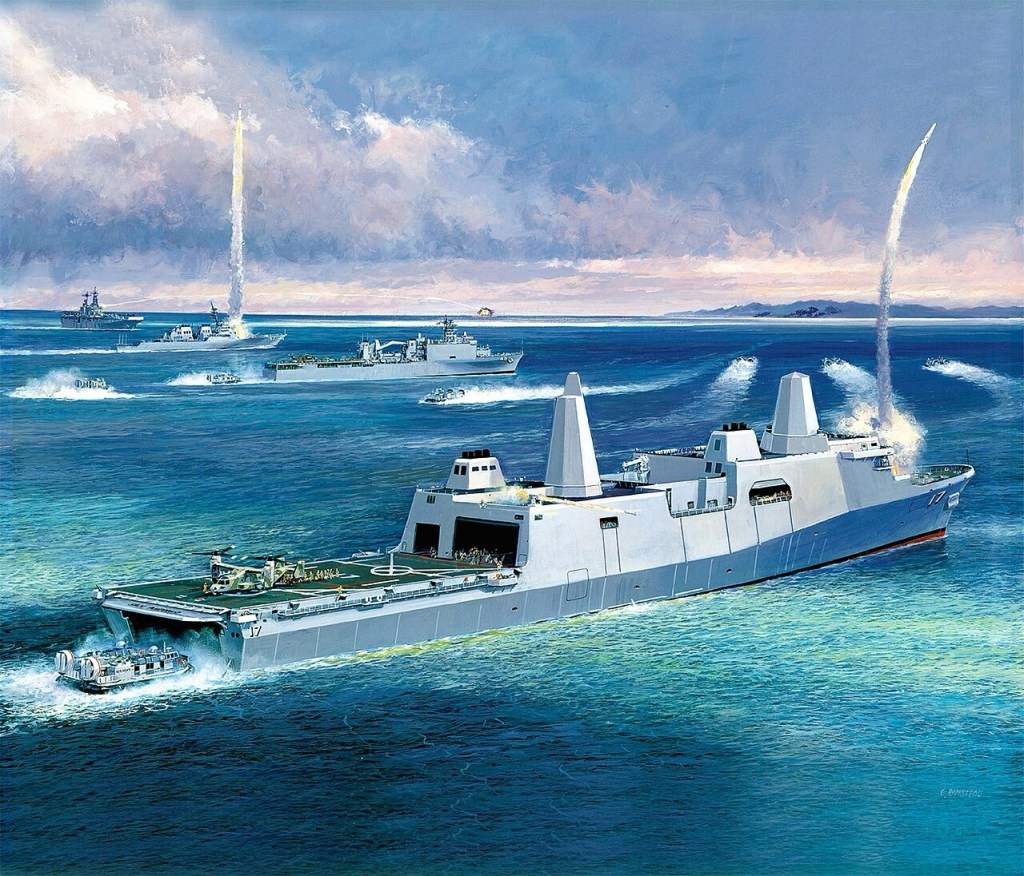
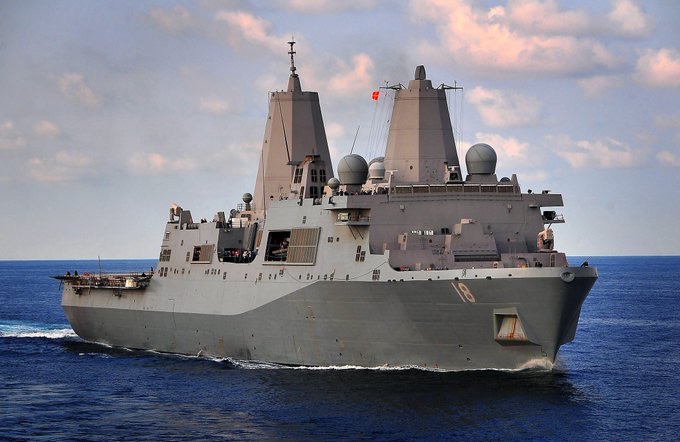
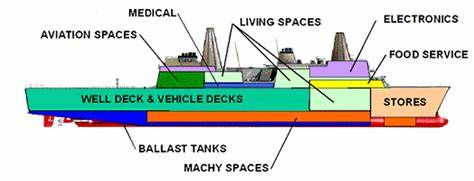
Moving on to the last two ships on our list we have the USS San Antonio (LPD-17) and the USS Fort Lauderdale (LPD-28) both of which are San Antonio-class amphibious transport dock’s. These ships are similar to the Wasp-class in that they are filled with marines and can be used as a launching point for their operations. They have a hanger for helicopters (or Ospreys) but lack the topside deck for planes.
Cut-away view of the San Antonio class. Artist concept of the San Antonio class.
These ships are designed as survivable and stealthy transports for ground forces. As shown in the image above they are also designed around the idea of launching the marines hovercraft to quickly transport massive amounts of marines and their equipment to the shores.
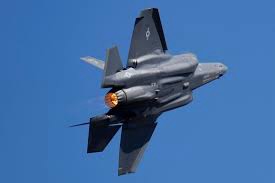
At 12:29PM on January 28th, 2025 a United States Air Force F-35A crashed at Eielson Air Force Base in Alaska. Video released of the incident shows that while on a training flight, the pilot, flying with the 354th Fighter Wing, lost control of his jet and was forced to eject while the jet crashes into the ground moments later.
Video of the incident. F-35 tail number 19-5535
The report going over the investigation into this crash came out today and fully explained the cascade of events that caused the crash. The culprit was water that had contaminated the hydraulic fluid for the nose landing gear. This water caused freezing in the hydraulic system and caused the nose gear to not retract properly and left it cantered 17 degrees to the left.The pilot initially on a call with Lockheed Martin engineers and together over the course of an hour efforts were made to fix the nose gear by doing touch and go landings. After the second touch and go landing the struts on both left and right landing gear had ice form around them causing them not to extend after the takeoff. Because of this, the aircraft’s “weight on wheels” sensors showed the aircraft as being on the ground and the plane automatically flipped to on the ground flight controls, while the plane was airborne. The pilot lost control at this point and made the decision to eject as the jet became uncontrollable . The jet crashed to the grounds of Eielson Air Force immediately after the ejection.
The pilot was treated at the time for minor, non life threatening injuries.
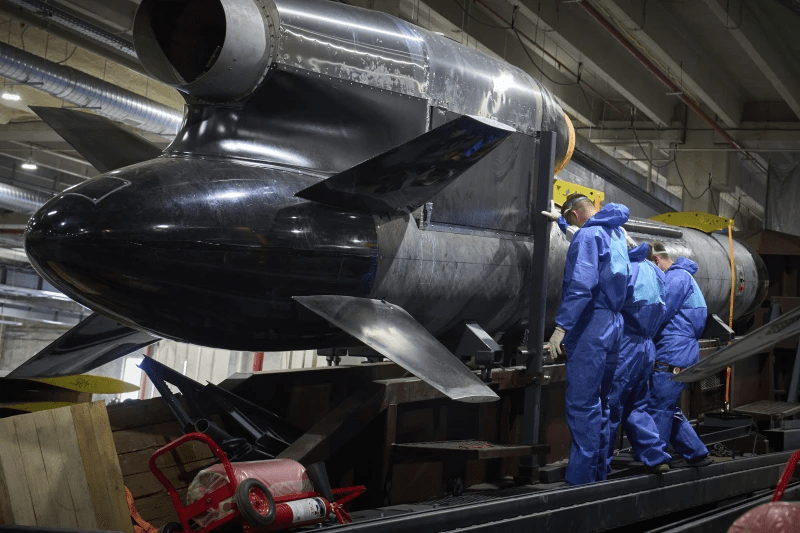
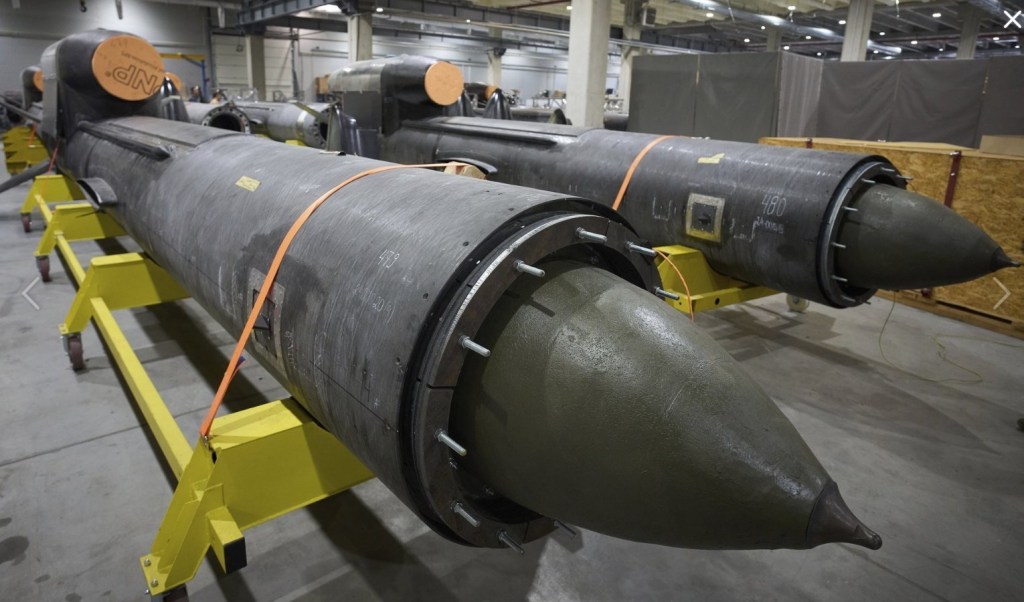
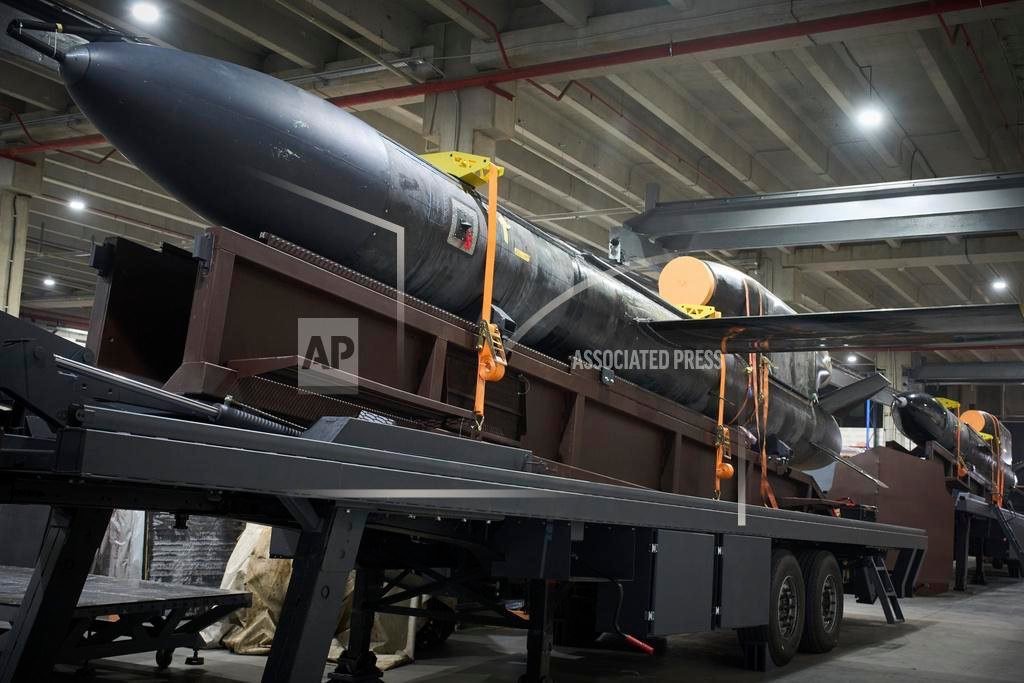
On August 17th, Ukraine’s Yefrem Lukatsky a well known AP photojournalist released images showing the production of Ukraines previously unannounced, ground- launched, long ranged cruise missile, the FP-5 ‘Flamingo’. This Ukrainian produced cruise missile could become a strong contender for Ukraine’s most effective long range weapon systems.
The Flamingo is designed and built by Ukrainian defense company Fire Point. According to, the missile has a six meter wingspan and a takeoff weight of 13,000 lbs on takeoff. The payload capacity is 1,150 lbs. Its publicly started range is 1865 miles.
A look at the tail of the missile showing the engine on top of the weapon, much like designs from the 50s-60s
“We came up with it pretty fast. It took less than nine months to develop it from an idea to its first successful tests on the battlefield. I will not tell you about its exact speed, but I can say it’s faster than all the other missiles we currently have,” said Iryna Terekh the company’s CEO while adding adding: “It is completely Ukrainian-made.
The missile is already casing a stir in Russia, the state run agency TASS put out an article last week downplaying the threat posed by this missile. The article also tried to undercut the Ukrainian achievement by saying the missile was from a British design, which the Ukrainian company Fire Point denies. However the impact of the missile is already being felt on the battlefield.
“We watched Russian reaction to our first missions and I can tell you the more successful the mission was, the more Russians tried to choke all publicity around it,”Terekh said.
The missile is already in production making several units a day. The company claims they can make that 200 a day by the end of the year.
With the number Ukraine’s Fire point company is planning to make along with the range this weapons could vastly shift the course of this war, putting a good percentage of Russia industries, both defense and civilian into range of Ukraines new missiles.
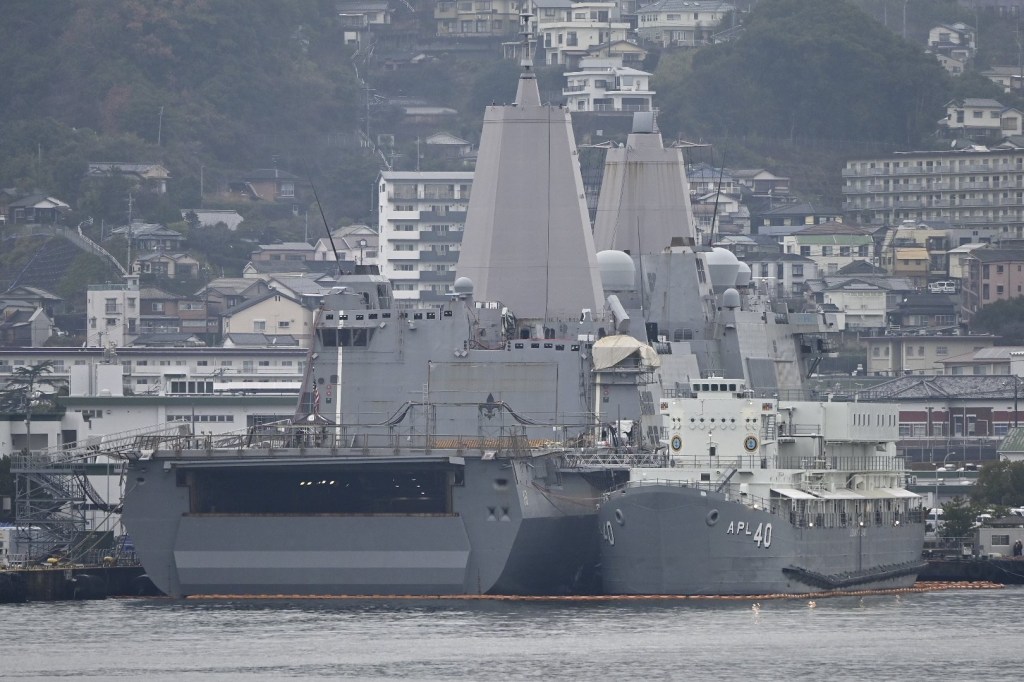
A fire aboard the San Antonio-class amphibious transport ship USS New Orleans (LPD-18) has, after 12 hours, been extinguished according to the U.S. Navy 7th fleet. The ship was anchored in the harbor at Okinawa at the time of the fire and it at least appears that the marines were not currently on the ship, however 2 sailers received minor injuries during the incident and were treated on board.
Video during the efforts to control the fire as tugboats cool down the metal of the hull with water.
The crew fighting the fire was assisted by sailors from another San Antonio-class amphibious transport ship, USS San Diego (LPD-17) which was moored at the White Beach Navel Facility. The crew was also assisted by the Japanese Coast Guard and military.
At this time the cause of the fire is still under investigation. The ship remains in Nakagusuku bay.
The New Orleans is apart of the Navy’s forward-deployed amphibious forces based in Japan.
The fire began at 4:00 PM on August 20th. Judging by where the tugs are spraying it appears the fire started near the living spaces and stores of the ship.
The navy overhauled how it fights fires after a 2020 fire on the big deck amphibious warship, USS Bonhomme Richard (LHD-6) burned for four days and resulted in the total loss of the ship.
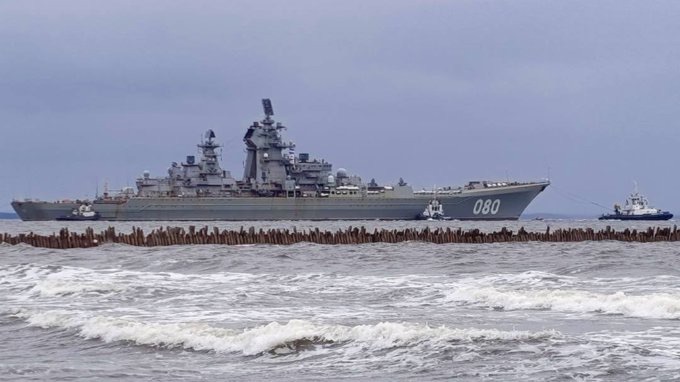
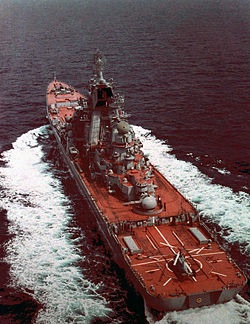
The Project 1144 Orlan Admiral Nakhimov last sailed in 1997. It was brought into the Sevmash shipyard in the port city of Severodvinsk with the intent for a major refit and modernization. The refit took almost 30 years but the time has come and this week the RFS Admiral Nakhimov was seen sailing under her own power as she undergoes sea trials to test its new and old systems. The large cruiser has seen a modernization to its weapons systems and sensors which the Russian leadership hopes will put fear into the enemies of the Russian navy.
Admiral Nakhimov
The Project 1144 battlecruiser (referred to as the Kirov-class by NATO), is a powerhouse of a ship. Called a nuclear-powered guided missile heavy cruiser by the Soviets, and besides aircraft carriers, it is today, the largest surface combatant in the world. At 827 ft long it is as large as some of the dreadnoughts and battleships of the early 20th century. During World War 2, the battleships were the dominant force until aircraft carriers were developed which could sink a battleship without it ever having fired a shot. Battleships spent the rest of the war far away from most combat. The reason battleships are no longer used is simple: big ships are easier to sink and the larger the ship, the larger the loss when they are destroyed, taking with them more men, and more weapons than their smaller peers. A country’s navy could build one large ship or several smaller ships that can do mostly same task and be less of a liability if sunk. The last of the battleships were used by the U.S. as glorified missile platforms and artillery pieces, with 2 modernized Iowa-classes being used in the gulf war. The Kirovs were built around this time during the Cold War as a direct counter to the Benjamin Franklin-class nuclear submarine. For all its anti-sea and air based weaponry the original primary job of this battleship sized cruiser was that of ASW: anti submarine warfare, sometimes called awful slow warfare by its practitioners. The Kirovs all came with ten torpedo tubes which launched torpedoes or anti-submarine missiles. They also had advanced sensors for detecting them and 3 helicopters which could carry ASW weapons.
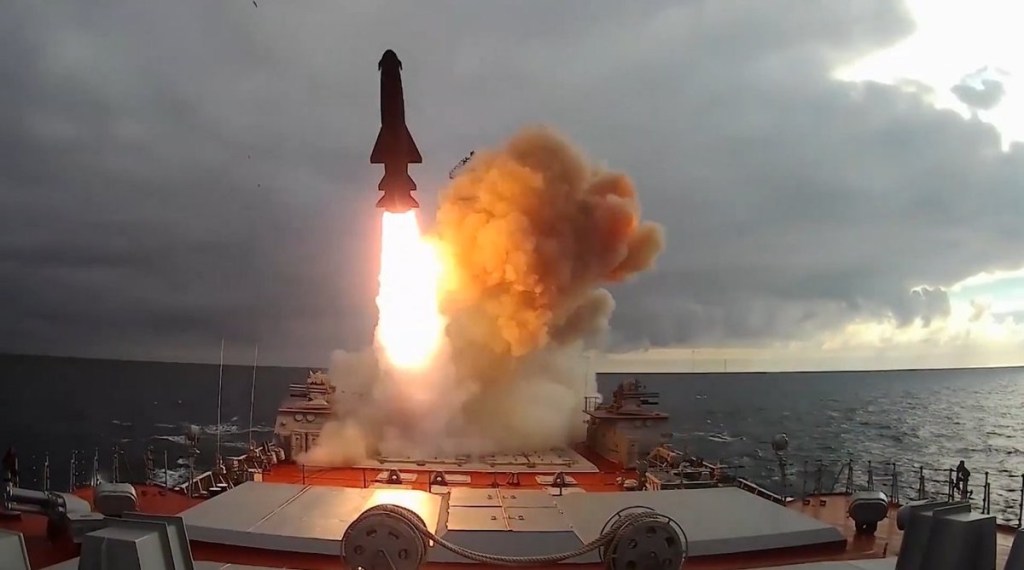
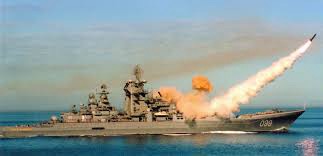
The Admiral Nakhimov other weapons before the modernization included the main weapon, 20 of the P-700 Granit (Shipwreck) anti-ship missiles which could destroy a ship out to 300 miles.This missiles was designed to sink American carriers these missiles outrange the newest American Anti-Ship missiles, the AGM-84H/K SLAM-ER (Standoff Land Attack Missile-Expanded Response) by 100 miles, according to the publicly available data. It’s been claimed that the missile, when fired in a swarm (group of 4–8) has a unique guidance mode. One of the weapons climbs to a higher altitude and designates targets to the group while the others fly low to the sea and keep their onboard sensors in a passive mode, only flipping on active guidance in the final seconds before launch. If the targeting missile is destroyed another will rise to take its place. The missile responsible for target designation climbs in short pop-ups, so as to be harder to intercept. The missiles are linked by data connections, forming a network. The missile’s predecessors, the P-500 and the Bazalt and the P-1000 Vulkan were capable of this guidance technique as well. Now those P-700 missiles have been removed giving space for some of the 176 Vertical Launch Cells 80 of which can hold the subsonic Kalibr cruise missile, the supersonic Oniks anti-ship missile, and the hypersonic Tsirkon cruise missiles. That leaves 96 cells reserved for surface to air missiles. The original Kirov-class ships came with the S-300F systems in rotary tubes below deck however there are some reports that these were replaced with the S-400F system giving them around 250 miles of air defense protection. It layers that protection with the more medium range abilities of 6 Pantsir-M air defense systems as well as a number of AK-630 close-in weapon systems. Additionally, the 130mm AK-130 dual purpose naval gun has been replaced by a modern 130mm AK-192M naval gun.
The 176 launch cells make this ship the most heavily armed capital ship on the planet currently, surpassing the 122 cells on the American Ticonderoga-Class cruisers or the 96 on the Arleigh Burke destroyers. The Chinese Type 055 Renhai-class cruisers carry 112.
The Admiral Nakhimov’s sea trials will take several months at least, with the first stages testing the ships safety, navigation, and propulsion systems and later the weapons and combat effectiveness. After that the vessel will be taken back into the service of the Russian Navy. The earliest estimates for the end of the sea trials put it at the end of the year before the ships return to active service, taking the flagship role with the Northern Fleet and the Russian Navy. At this The RFS Pyotr Velikiy, the current Kirov-class flagship of the Russian Navy is not likely to undergo the same modernization of the Admiral Nakhimov and is more likely to be decommissioned as the cost is simply too great for Russia to foot at this time. The Pyotr Velikiy has also been in service for a good while longer than her sistership, making her more worn down after decades of operation.
Images showing Admiral Nakhimov firing one of its P-700 Granit anti-ahip missiles.
When RFS Admiral Nakhimov replaces the RFS Pyotr Velikiy the Russian navy will only have three cruisers left in their navy, the RFS Marshal Ustanov in the Northern Fleet, and the RFS Varyag in the Pacific Fleet. Both cruisers are part of the Slava-class missile cruisers which are also coming to the end of their service life. It’s possible in the near future the Admiral Nakhimov could become Russia’s only capital warship in the fleet. Russian shipyards are unable to build new large ships for the time being and even repair work is becoming an impossible task. Recently, plans for the repair and refit of Russia’s sole aircraft carrier, the RFS Admiral Kuznetsov, were canceled.
The Admiral Nakhimov will likely take an important role in the Russian surface fleet, with its numerous long range weapons systems, the ship can be used to interdict a large area at sea and provide protection for a Russian fleet during their operations.
Yesterday, the Chinese PLAN (People’s liberation, Army Navy) claimed that they expelled a U.S. Navy Destroyer that entered its territorial waters near the Scarborough Shoals in the South China Sea.
Here’s the facts we know. The U.S. Arleigh Burke-class guided missile destroyer USS Higgins (DDG-76) previously located at Cebu City in the Philippines sailed near the disputed territory around the Scarborough Shoal during a freedom of navigation patrol. This was two days after a Chinese coast guard cutter collided with a Chinese guided missile destroyer while chasing a ship from the Filipino coast guard. USS Higgins came within 12 miles of Huangyan Island (another name for Scarborough Shoal) , a highly disputed territory claimed by China, Taiwan, and the Philippines. It should be noted that the Philippines coast guard said that an Independence-class Littoral combat ship , the USS Cincinnati was also nearby.
The Chinese say that they forced the patrol to leave the area. The U.S. disputes this saying nothing thr Chinese said or did affected them in any way.
“China’s statement about this mission is false,” a spokesperson for U.S. 7th Fleet said in a statement. “USS Higgins (DDG-76) conducted this FONOP in accordance with international law and then continued on to conduct normal operations. The operation reflects our commitment to uphold the freedom of navigation and lawful uses of the sea as a principle. The United States is defending its right to fly, sail and operate wherever international law allows, as USS Higgins did here. Nothing China says otherwise will deter us.”
The spokesperson for U.S. 7th Fleet said that the Freedom of Navigation Operation challenged the prior requirement of a notification and authorization that China and Taiwan seek before a warship makes an innocent passage in their territorial sea.
A FONOP or Freedom of Navigation Operation is a naval operation carried out by the U.S. to assert the right of free transfer through an area. usually, heavily disputed area. “The unilateral imposition of any authorization or advance-notification requirement for innocent passage is unlawful,” the spokesperson for the Japan-based fleet said in the statement.
This video which I believe is filmed by a PLA helicopter or drone shows a Chinese Type-055 guided missile destroyer shadowing the USS Higgins (DDG-76) a U.S. Navy Arleigh Burke-Class destroyer. We also see the USS Cleveland (LCS-31) a Freedom-class Littoral Combat Ship that was also in the region.
A Chinese SU-27 is also briefly shown in the footage.






 Global Conflict Reporting
You must be logged in to post a comment.