September 1, 2026, Jordanian air defenses engaged 13 Iranian ballistic missiles that entered the country’s airspace and destroyed 10 of them. The Jordan Armed Forces said the remaining three landed in remote, unpopulated areas. Jordan reported no injuries, no deaths, and no significant damage to property.
Iran’s Islamic Revolutionary Guard Corps said the barrage was aimed at Camp Titin, a small U.S. Marine training camp south of Aqaba used to train Jordanian forces along the Gulf of Aqaba. Iranian state media claimed the strike destroyed military buildings and helicopters and killed a large number of U.S. personnel. Those claims have not been independently verified. Two U.S. officials told Reuters there were no reported U.S. casualties at facilities in Jordan based on initial information.
This was the second Iranian attack into Jordan in roughly 48 hours. Overnight August 30–31, Iran launched missiles and drones at U.S.-linked sites in the kingdom, including the Muwaffaq Salti / Azraq area, after a U.S. strike on Larak Island in the Strait of Hormuz. The two exchanges are the first major kinetic back-and-forth since the June U.S.–Iran Memorandum of Understanding expired in August.
The latest Iranian fire came after a wave of U.S. strikes on September 1. Iranian media and local reports said explosions were heard in Chabahar, Bandar Abbas, Qeshm Island, Konarak, Jask, Sirik, and Minab. CENTCOM did not name those cities. It said U.S. forces struck IRGC air-defense sites, radar systems, maritime assets and facilities, mine-laying capabilities, and communications sites, following attempted IRGC attacks on commercial shipping in the Strait of Hormuz and on American service members.
Iranian officials say one of those strikes hit a home during a wedding ceremony in Kuhestak, in Sirik County, killing four people, including a child, and wounding 67 others. Reported figures have varied. The United States says it does not target civilians.
Video taken from Sirik and obtained by GCR confirms that a U.S. strike hit the area. It does not confirm what was hit. Precision geolocation is difficult with the footage currently available. A second video shows the building Iranian media identified as the wedding site. The clip shows a damaged structure. It does not, on its own, prove a wedding was underway.
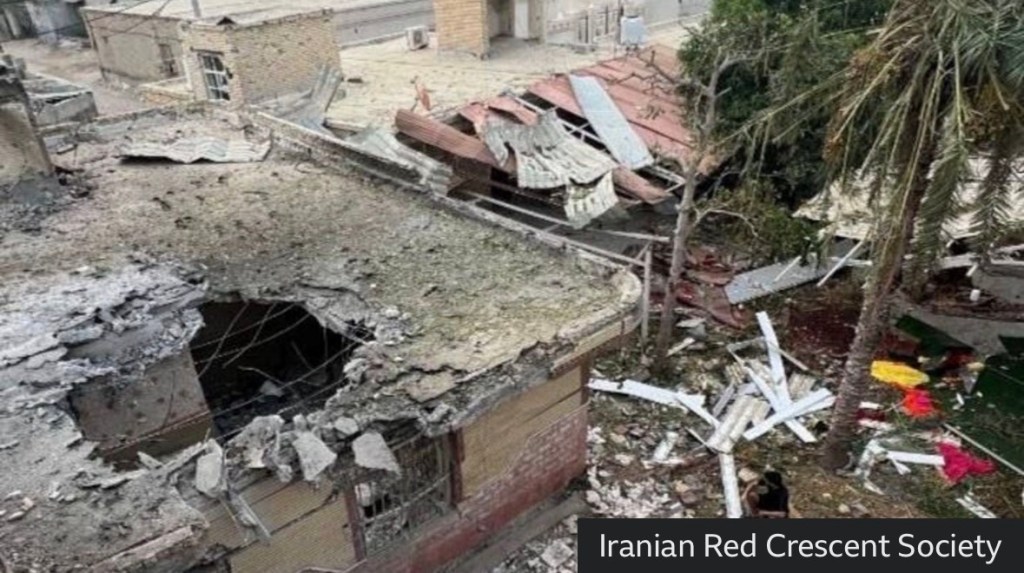
“Unfortunately, this is a residential building. And unfortunately, this happened during my daughter’s wedding ceremony,” Ali Mallahi, father of the bride and owner of the building, said in a video broadcast by Iranian state media.
Looking at maps of the area, the U.S. targeted a telecommunications tower in the vicinity of the house, which was struck.
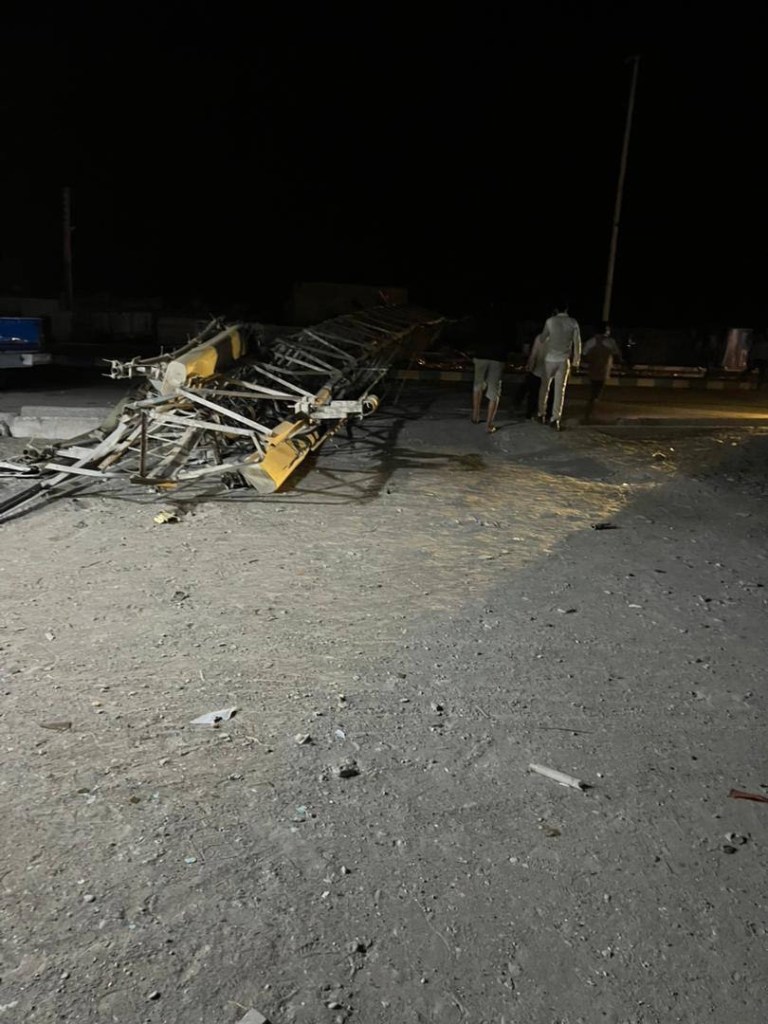
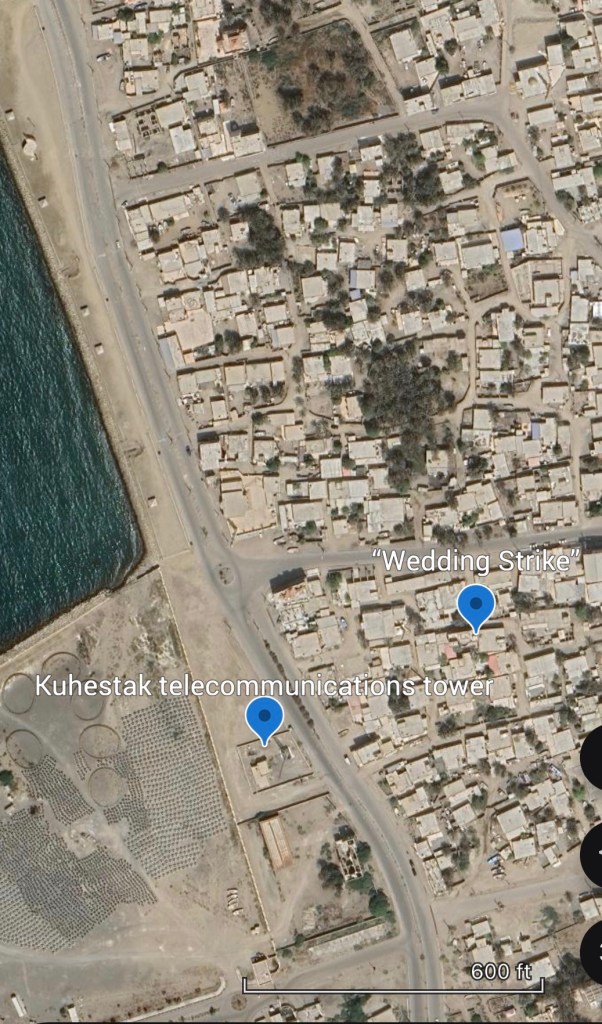
It appears just from looking at the map, the images, and the video from the scene that if the strike on the house wasn’t intentional, it was possibly hit in a U.S. strike that missed its original target, which is only 143 meters away from the house where the wedding celebration was said to be taking place. A tragedy, but one that happens in war often enough. The U.S. faced a similar situation during the raid on Venezuela when one of its upgraded AGM-88 HARM missiles missed its target and hit an apartment.
President Donald Trump said the U.S. operation was a response to Iranian forces attempting to lay more mines in the Strait of Hormuz. Sirik was one of multiple reported aimpoints in that wave, not a standalone strike.
In the hours after the U.S. attacks, IRGC missile forces appear to have targeted Camp Titin in Jordan. Iranian state media presented the camp as a successful hit. Footage obtained by GCR of one incoming missile does not show an intercept and appears to show the weapon striking the side of a mountain rather than a developed part of the camp. That can mean several things: the missile was already going to miss anything that mattered, the air-defense battery chose not to spend an interceptor on it, or the system was occupied with other tracks. Jordan has absorbed a large volume of Iranian fire since the start of hostilities. The more likely reading of this particular clip is that the missile was heading into the high ground around Aqaba and was not assessed as enough of a threat to engage. That is what the video appears to show. It does not prove a successful strike on the camp, and it does not prove Jordanian or U.S. air defenses were out of ammunition.
Today’s exchange is a return to open kinetic strikes. That is a sharp contrast with late August, when U.S. officials leaned hard on economic pressure — including the “Economic Outcast” / “economic D-Day” track and talked as if large new bombing campaigns were no longer the main tool. Limited strikes and intercepts are not the same thing as a full restart of the February war. They are also not the pause Washington had been describing.
Military actions are often used in conjunction with economic pressure to reach a goal. In most cases, military action, nor economic action alone, is enough. Using them together adds extra pressure. It also appears that the military strikes are supporting the economic strikes by targeting radars, air defense, and missile sites near the coast that Iran has tried to use to maintain control over the strait.
CENTCOM said after the strikes:
“U.S. forces struck Islamic Revolutionary Guard Corps (IRGC) targets including air defense sites, radar systems, maritime assets and facilities, mine laying capabilities, and communications sites.
The strikes follow recent attempted attacks by the IRGC against commercial shipping in the Strait of Hormuz and against American service members.
More than 50,000 U.S. service members are currently operating across the Middle East and remain vigilant, lethal, and prepared to continue executing operations directed by the Commander in Chief.”
In the following days, Iran is claiming that the U.S. strike on the wedding is a war crime, a claim being repeated by many in Iran, including Iranian foreign ministry spokesman Esmaeil Baqaei. Iranian authorities say another 14 people were killed in separate attacks that took place at the same time.
CENTCOM video
Author note.
I know this strike was several days before I posted about it. In some cases, I’m not able to verify the footage I’m sent or that I find, and it takes me a while to go through my steps to verify that footage is what it is claiming to be. While GCR does often cover breaking news, its mission is more about analysis and verification. Thank you always for all the support.
Please feel free to comment. I always want to do better. I’m not trained in any of this stuff. Writing, conflict reporting, and analysis is something I’ve taught myself how to do, and I know there are areas I can improve, so please, if you have a question, comment, or anything that can help me improve. Message me on Facebook or I can be reached through the email found on the contact me page.
-Scott


You must be logged in to post a comment.