Tag: Carrier Air Wing

  • U.S. Aircraft carrier adds to the growing amount of forces in the Middle East

    By. Scott Jackson


    01/30/2026

    A week after the USS Abraham Lincoln Carrier Strike Group (CSG) was redirected from the South China Sea the warships arrived in the Arabian Sea. US Central Command (US CENTCOM) confirmed the redeployment of the ship to the Middle East on social media on the 26th of January and located the ship as being somewhere in the Indian Ocean.

    The Carrier Strike Group was dispatched to the region by the U.S. President Donald Trump after he made warning threats to Iran to stop their crackdown on anti-regime protests. The regime’s security forces have opened fire on protesters resulting in thousands of deaths according to human rights watch groups. The carrier strike group that’s moving into the region  is made up of the USS Abraham Lincoln  as well as three Arleigh Burke-Class Guided Missile Destroyers (as well as a suspected Fast-Attack submarine that would usually accompany a CSG).

    “We have a big force going toward Iran. I’d rather not see anything happen, but we’re watching them very closely.” Donald Trump to reporters aboard Air Force One. 

    While it’s unclear how long the CSG will remain in the region irs addition to the forces slowly building in the region enhances the striking capabilities of the United States. 
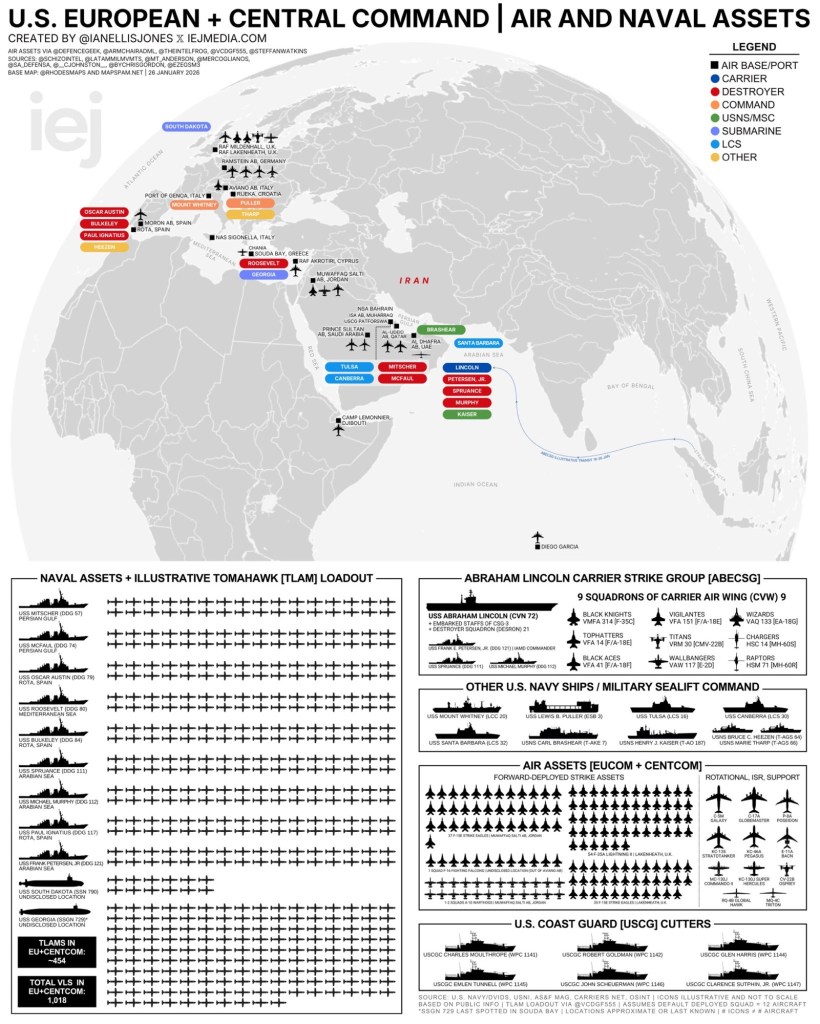
    This map, posted by Twitter user and INDOPAC expert  @IanEllisJones shows all of the forces that have been recently moved to the Middle East/CENTCOM region. This map only shows what has been reported publicly and focuses mostly on air and sea assets of CENTCOM and nearby involved units in EUCOM. Both US Commands have a large pool of ground forces however their involvement in any potential strikes on Iran would be minimal if any at all. 
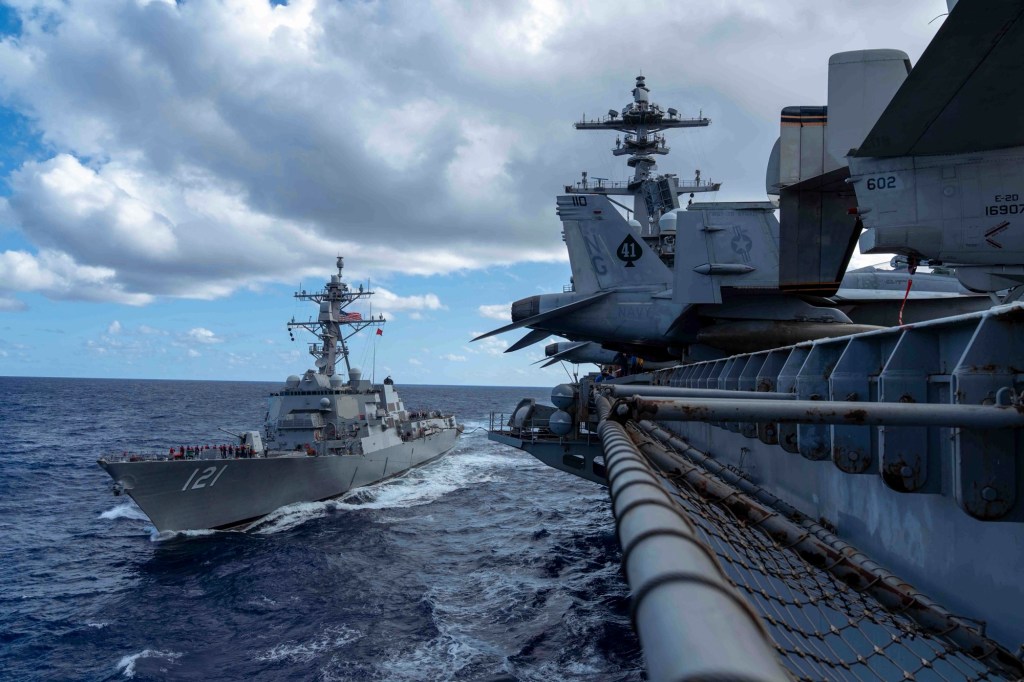
    USS Frank E Peterson, JR sails alongside the USS Abraham Lincoln in the Pacific Ocean.

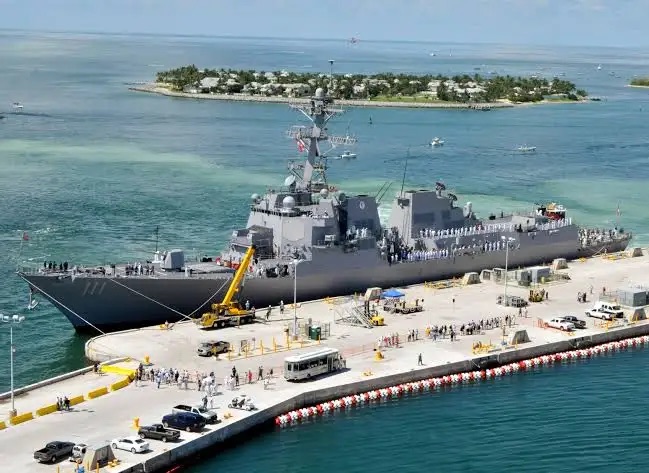
    Starting off let’s look closer at the newest addition to the region, the USS Abraham Lincoln and it’s CSG. The carrier is escorted by three Arleigh Burke-Class Guided Missile Destroyers. The USS Frank E Peterson, JR. (DDG 121) operating as the Air Defense Commander. This ship integrates all the radar and defense systems of the other ships and takes charge during an attack on the ship being able to remotely use the other connected ships systems to detect,  track and destroy incoming air and missile threats to the CSG. The other two destroyers make up Destroyer Squadron (DESRON)21, the USS Michael Murphy (DDG-112), and the USS Spruance (DDG-111). These ships are going to carry a variety of anti-ship, air, and ground attack missiles. The map has them all three carrying 32 Tomahawk Land Attack Missiles (TLAM’s) a piece. That number is just an estimate, the ships true loadout won’t be known but I don’t think 96 TLAM’s for the whole CSG is too far outside of the realm of possibility. 
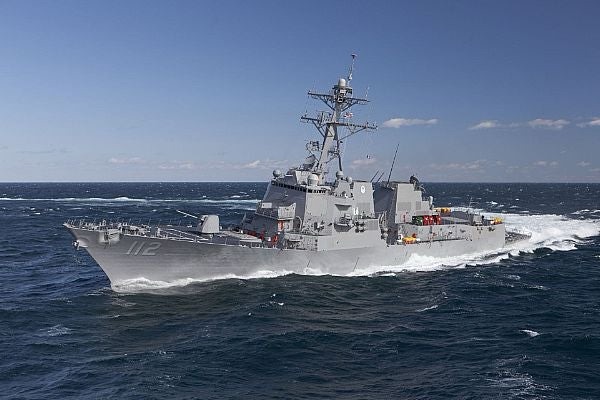
    USS Michael Murphy (DDG-112)

    The destroyers carry a variety of missiles but a typical loadout for a flight II and up Arleigh Burke goes something like this. 

    Air Defense Heavy: 72 SM-2MR, 16 ESSM, 4 VLA, 10 Tomahawks

    Strike Heavy: 56 Tomahawks, 24 SM-2MR, 12-16 ESSM, 4 VLA. 

    Lastly, any carrier strike group is likely to be escorted by at least one of the Navy’s fast attack sub’s. These submarines are usually not brought up in any sort of reporting or public releases from the navy but we know the carriers almost always have one nearby just for anti-submarine work as well as their ability to strike ground targets using TLAM’s. 
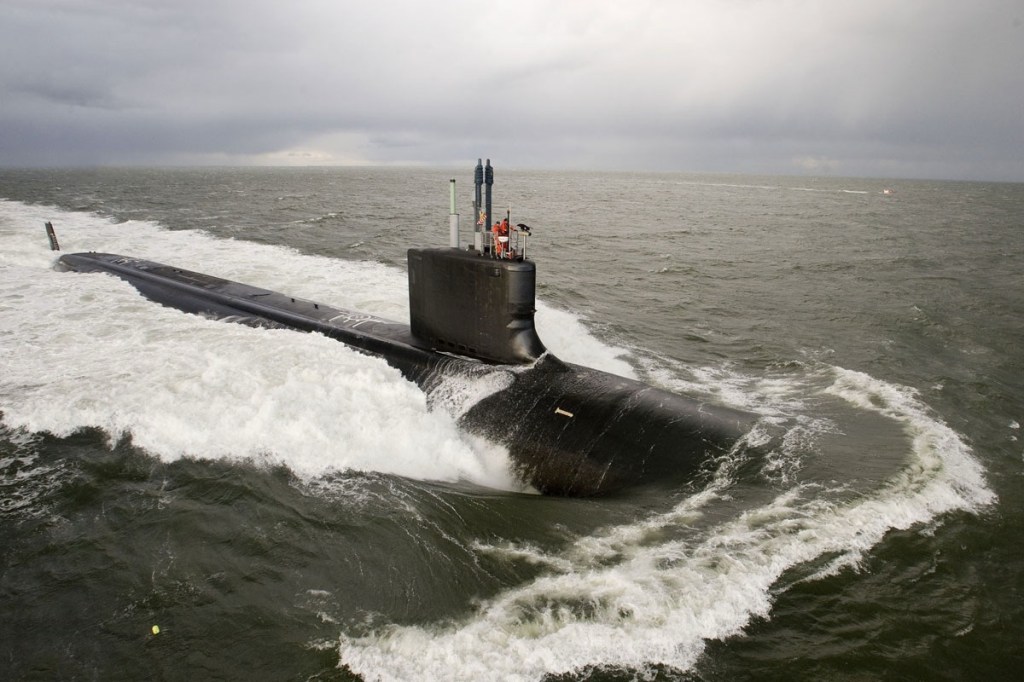
    Virginia-Class Submarine

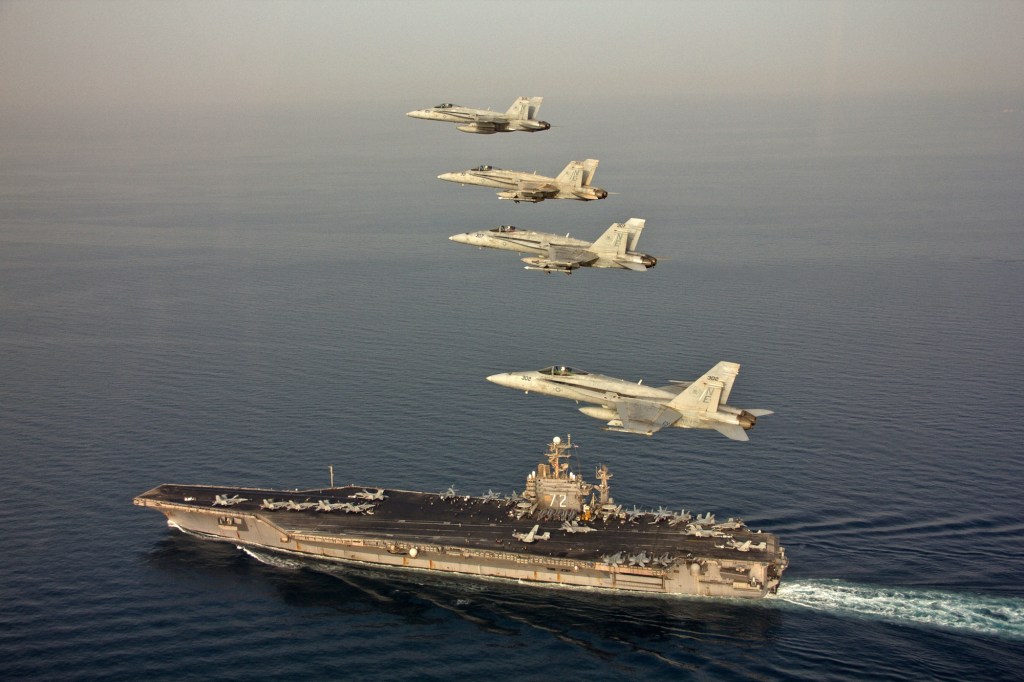
    Looking specifically at the carrier, USS Abraham Lincoln (CVN-72) is a Nimitz-class aircraft carrier. The deck and hangar of the ship is filled with Carrier Air Wing 9 (CVW-9). The current list of squadrons and aircraft is as follows. 

    CVW-9 aboard the USS Abraham Lincoln. 

    The “Tophatters” of Strike Fighter Squadron (VFA) 14, flying F/A-18E Super Hornet multirole fighter jets. 

    The “Black Aces” of VFA 41, flying F/A-18FSuper Hornet multirole fighter jets. 

    The “Vigilantes” of VFA 151,  flying F/A-18E Super Hornets multirole fighter jets. 
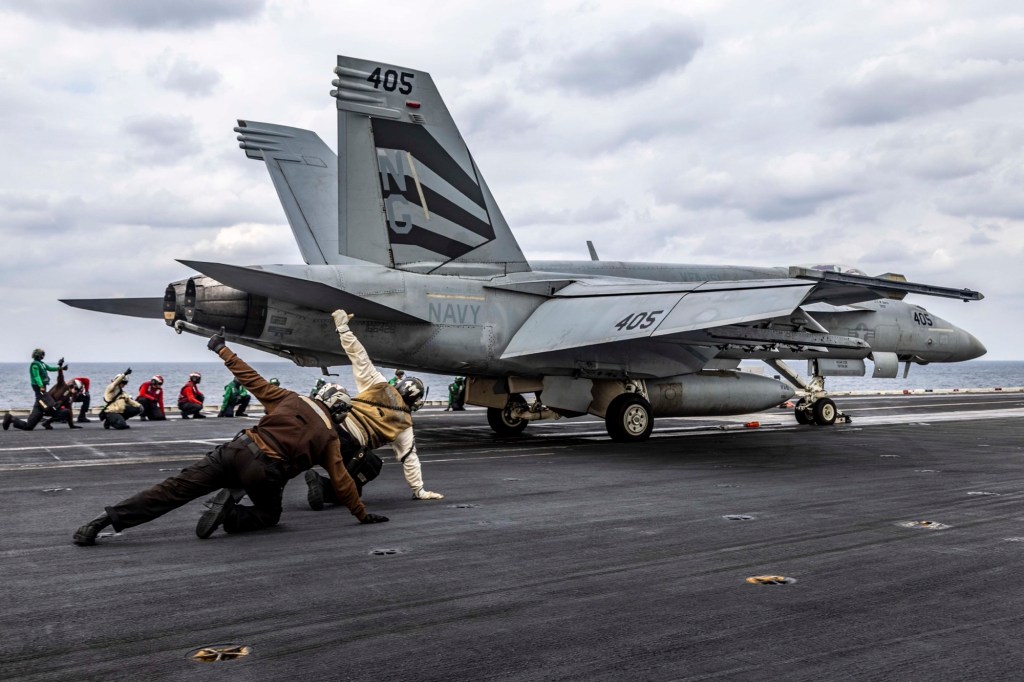
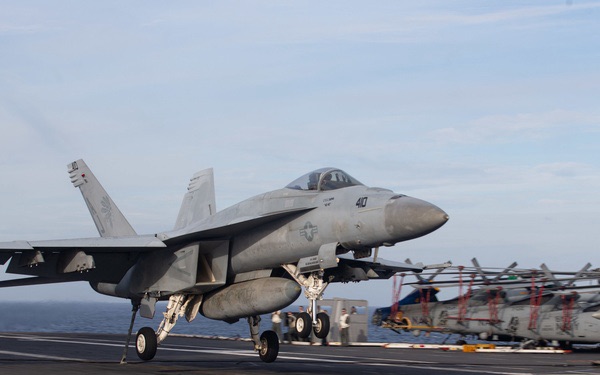
    An F/A-18E Super Hornet, attached to Strike Fighter Squadron 151, launches from the flight deck of the USS Abraham Lincoln (CVN 72) while conducting routine flight operations in the Arabian Sea. Abraham Lincoln is deployed to support security and stability within the Middle East region. – CENTCOM Social Media post January 30th 2026.

    The “Black Knights” of Marine Fighter Attack Squadron (VMFA) 314 flying F-35C Lightning II’s. 
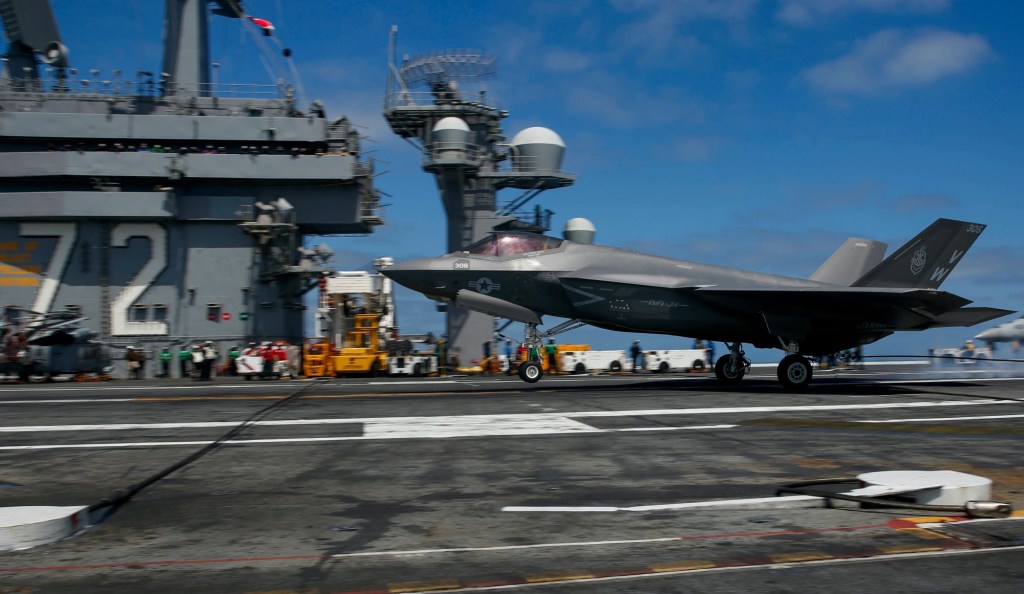
    F-35C from the “Black Knights“ of VFMA 314.

    The “Wizards” of Electronic Attack Squadron (VAQ) 133, flying EA-18G Growler Electronic Warfare Aircraft. 
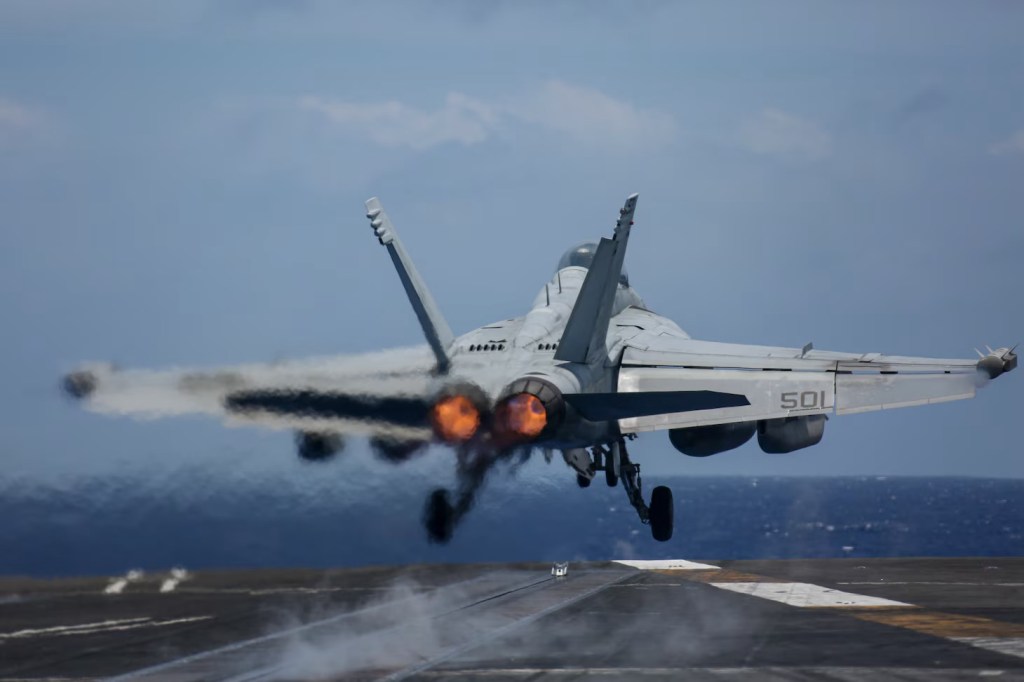
    EA-18G Growler from VAQ 133 jumping from the Abraham Lincoln back in 2024. These recently received the upgraded ALQ-249 Next-Generation Jammer (NGJ) pods.

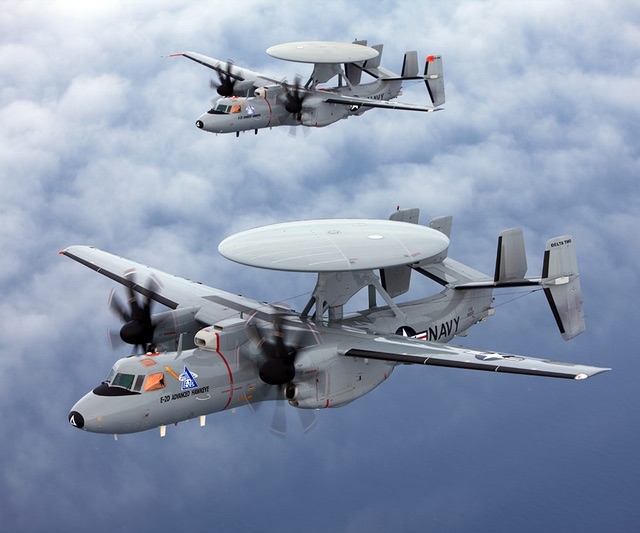
    The “Wallbangers” of Carrier Airborne Early Warning Squadron (VAW) 117 flying  E-2D Hawkeye Airborne Early Warning aircraft. 

    The “Titans” of Fleet Logistics Multi-Mission Squadron 30 (VRM-30) CMV-22B Osprey Multiuse Tiltrotor aircraft. 

    The “Raptors” of Helicopter Maritime Strike Squadron (HSM) 71, flying MH-60R Seahawk Helicopters. 
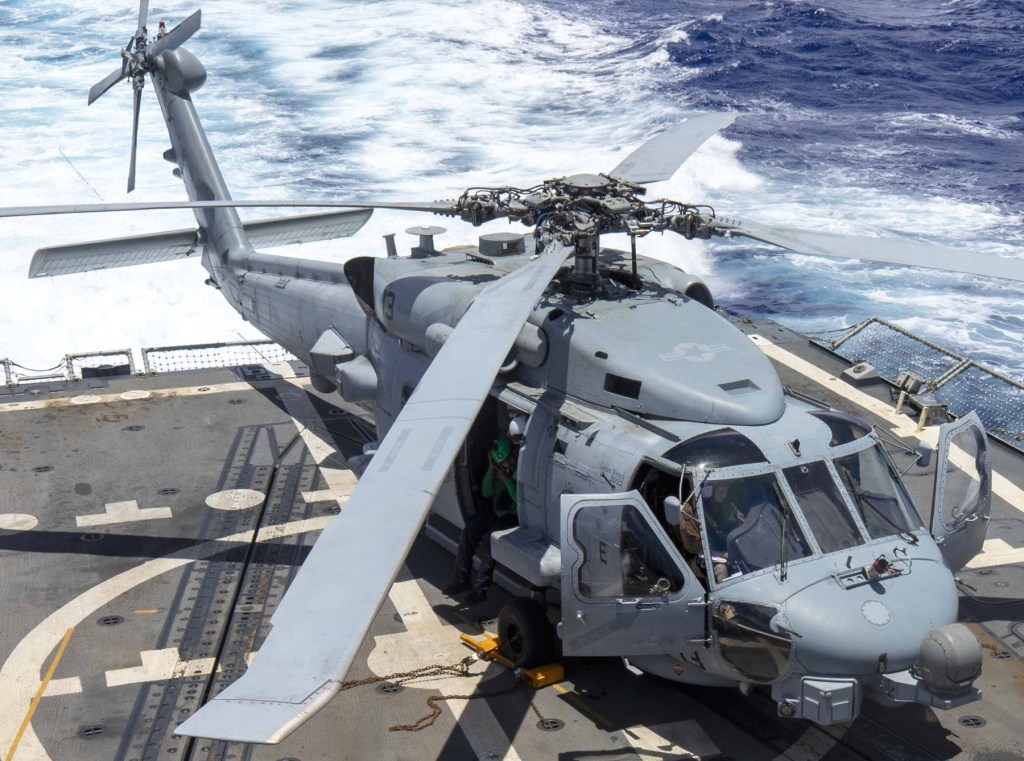
    MH-60R Seahawk (HSM-71 / CVW-9) aboard USS Spruance (DDG 111) – July 2024

    The “Chargers” of Helicopter Sea Combat Squadron (HSC) 14 flying  MH-60S Seahawk Helicopters. 

    These squadrons give the USS Abraham Lincoln its main offensive capability as well as add some flexibility to any strike plans, and add support for the whole ship. The F/A-18’s especially are capable of carrying and deploying a wide array of munitions, making them one of the most versatile multirole jets in operation. Able to carry a variety of munitions like the JDAM’s, Small Diameter Bombs, as well as rockets, anti-ship, and anti-radar missiles. These multi-role titans, aided by the stealthy F-35c and the Electronic Warfare capabilities of the EA-18G you would be hard pressed to find a job this carrier air wing couldn’t handle. 
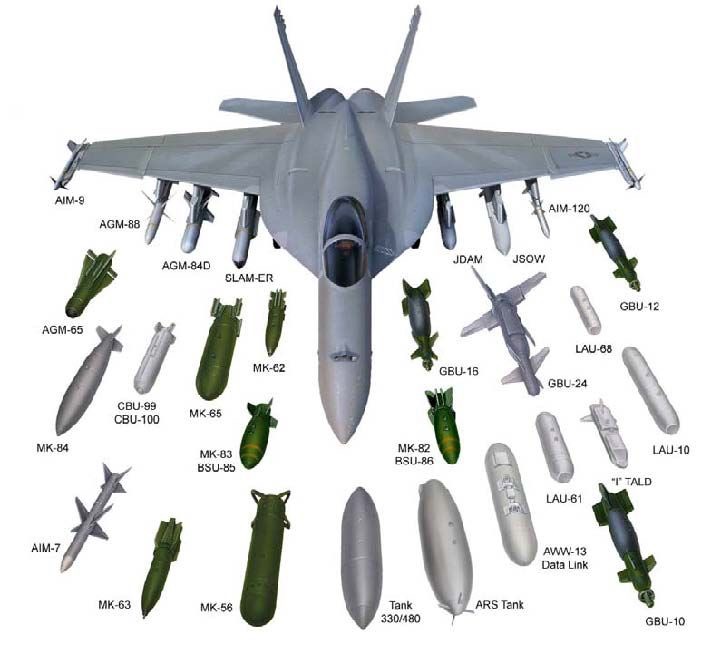
    The weapons able to be deployed by the Super Hornet.

    Now looking back at the map from Mr. Ellis. Multiple sources have confirmed the 37 F-15E Strike Eagles arriving into Jordan. CENTCOM themselves released images showing their arrival into the midddle east. 

    The post does give a location but the location was geolocated fairly quickly to the Muwaffaq Salti Air base in Jordan. The map mentions a number of A-10’s being present at that base and while evidence exists of their presence in the Middle East, the exact location is unknown. Elsewhere in the CENTCOM AOR is a squad of F-16’s originally from Aviano AB. The map also shows the large number of F-35’s and F-15’s currently stationed in the UK which could be used if any strikes are carried out in Iran. 

    Several more ships are operating in the Persian gulf area. USS Mitscher (DDG-57) and USS McFaul (DDG-74), are both operating independently in the region. Littoral Combat Ships USS Canberra (LCS-30), USS Tulsa (LCS-16) and USS Santa Barbara (LCS-32) are additionally operating with a mine countermeasure mission package. The newest addition is USS Delbert Black (DDG-119) which was reported entering the Red Sea today. 

    USS Roosevelt (DDG-80) is close by, operating in the Mediterranean but could quickly be called to action. 

    Much of this map shows assets not exactly in theater but very nearby, assets that could very quickly be moved if need be. On top of all of this you have the U.S. Air Force bomber fleet which can be anywhere in the world in less than 24 hours. 
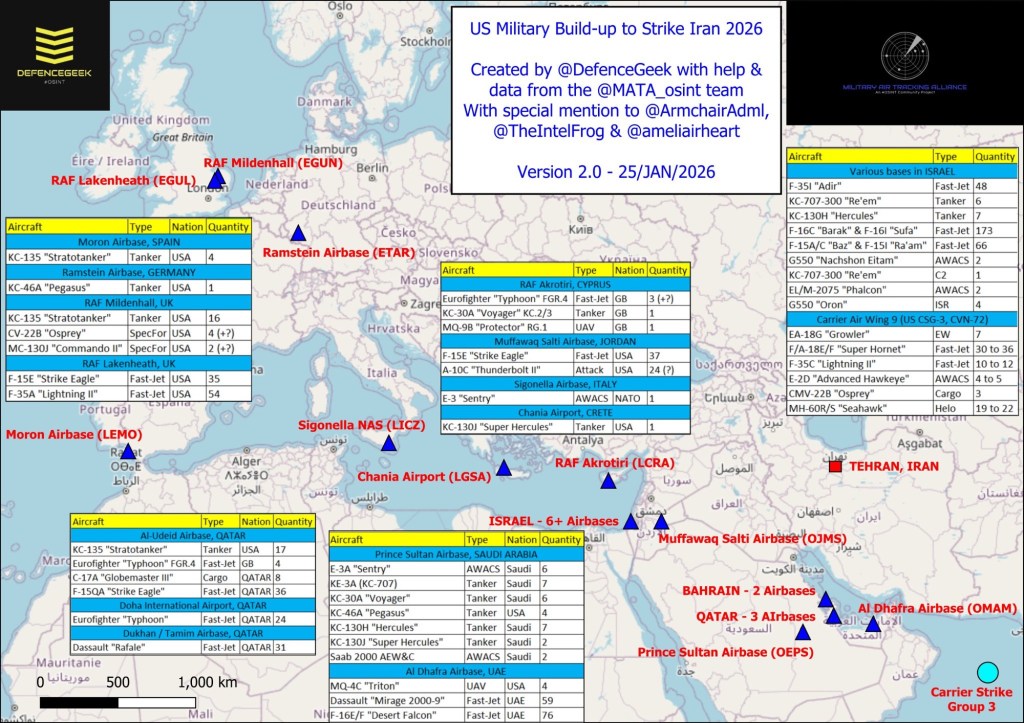
    This map above, posted by investigative research user Defensegeek shows flight movements for the past couple days. The map shows recent arrivals of not only strike fighters, but logistics and recon assets as well. 

    As of the conclusion of this article on the 29th, reports are starting to circulate that the White House is now deciding what to do about Iran. A media outlet based in London, Iran international is claiming that a joint U.S./Israel will be carried out with the intent of completely collapsing the current Iranian government and that only the timing is being considered at this stage. President Trumps himself, on January 30th claimed that he directly laid out a deadline for some sort of agreement between the US and Iran.

    This is a continuing story and will be covered here fully by GCR.
  •  White House announces the names of two new Ford Class aircraft carrier. 

    The White House on Monday annonced that it would be naming two of its future planned Gerald R. Ford-class nuclear powered aircraft carriers after former presidents. The USS William J. Clinton and USS George W. Bush, after the 42nd and 43rd U.S. presidents.

    “Their legacies will endure through these aircraft carriers, which serve as formidable platforms dedicated to safeguarding our national security and strengthening our resolve to protect this nation against any who would threaten our freedoms and way of life,“ said Secretary of the Navy Carlos Del Toro. 

    These ships will be the 5th and 6th of the Ford-class. As of writing this only one of the class exists which is the lead ship in the series USS Gerald R. Ford. Ford was named after the 38th president of the United States, who served on the light aircraft carrier Monterey in WW2 in the Pacific. The Ford-Class carrier to this day remains the largest carrier/warship ever created. 


    Evolution of Power : Ford-Class carrier upgrades and capabilities.

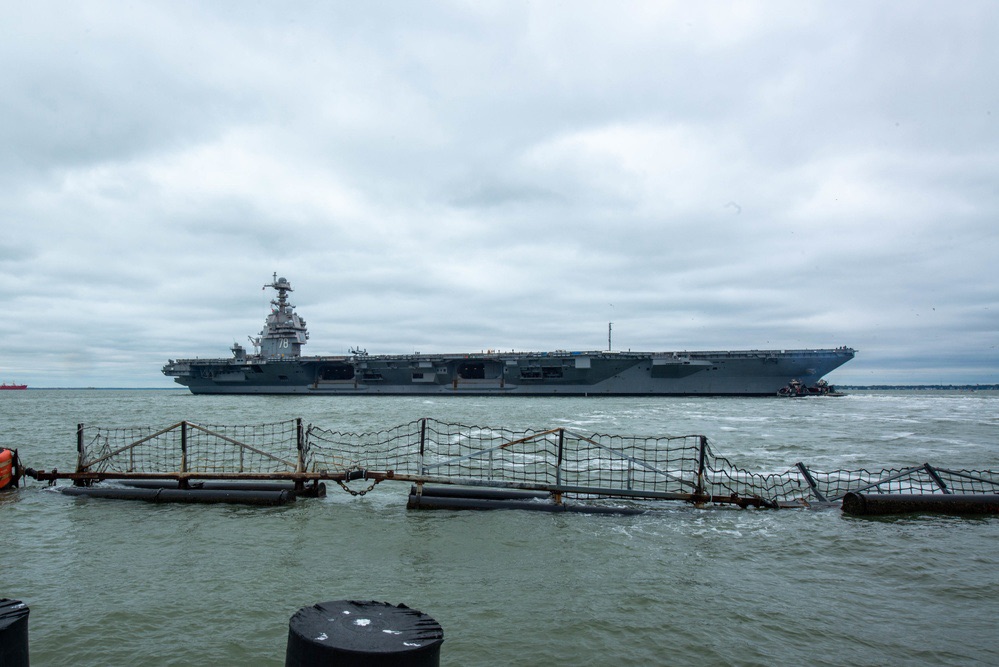
    USS Gerald R. Ford departs Navel Station Norfolk for its first deployment.
    Photo by Petty Officer First Class William Spears.

    What makes the Ford-class Special? 

    The Ford-class was created to offer a number of improvements over the Nimitz-class carrier which had been the standard for 40 years and is now being phased out, replaced by the Ford-class.What improvements make the Ford-class so special? Well let’s talk about it. Most of this info comes from testing on the only Current Ford class in use, the USS Gerald R. Ford (CVN 78)

    Cmdr. Robert Kurrle, the commanding officer of the “Golden Warriors” of Strike Fighter Squadron (VFA) 87, conducts his final carrier landing on the first-in-class aircraft carrier USS Gerald R. Ford’s (CVN 78) flight deck. Photo by Petty Officer 2nd Class Zackery Guth.

    Improved aircraft launch and recovery systems. Specifically the EMALS or Electromagnetic Aircraft Launch System replace the steam powered catapults used in the past giving fighter pilots a smoother takeoff with less maintenance. On the landing side we have the AAG or Advanced Arresting Gear which in testing so far with the Gerald R Ford has shown an increased smoothness with landing as well as the capability to catch heavier aircraft and UAVs (more in those in a bit).

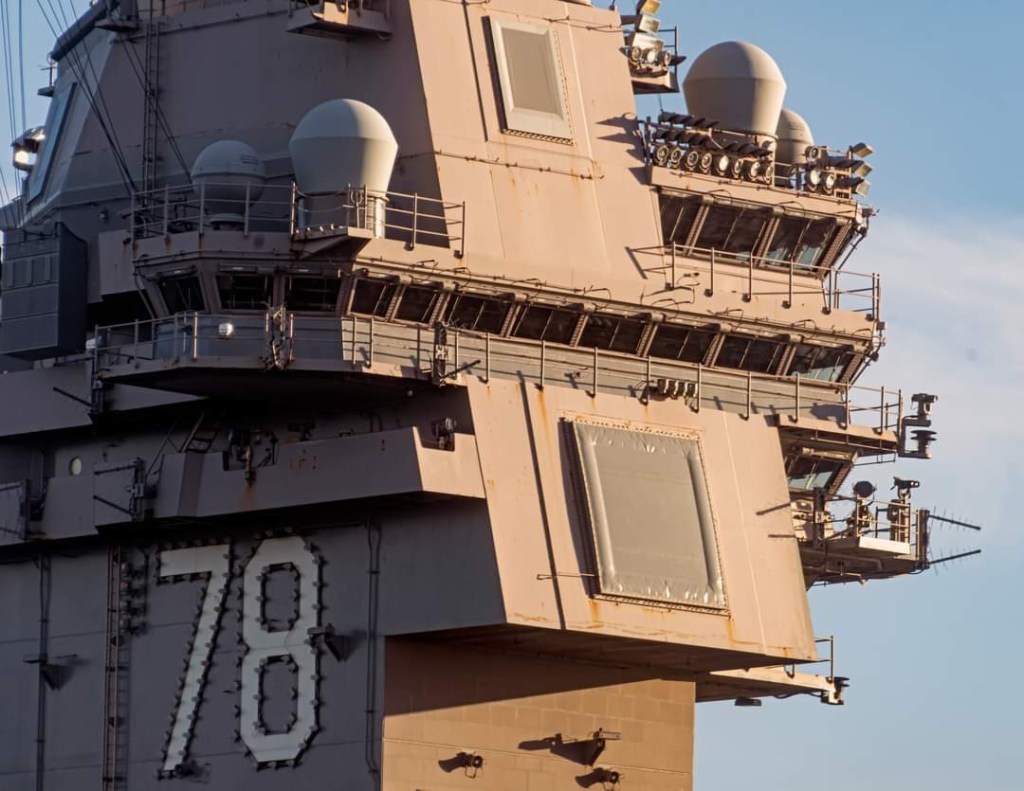
    Island of USS Gerald R. Ford (CVN 78). You can see its radar here. Unknown photograph.

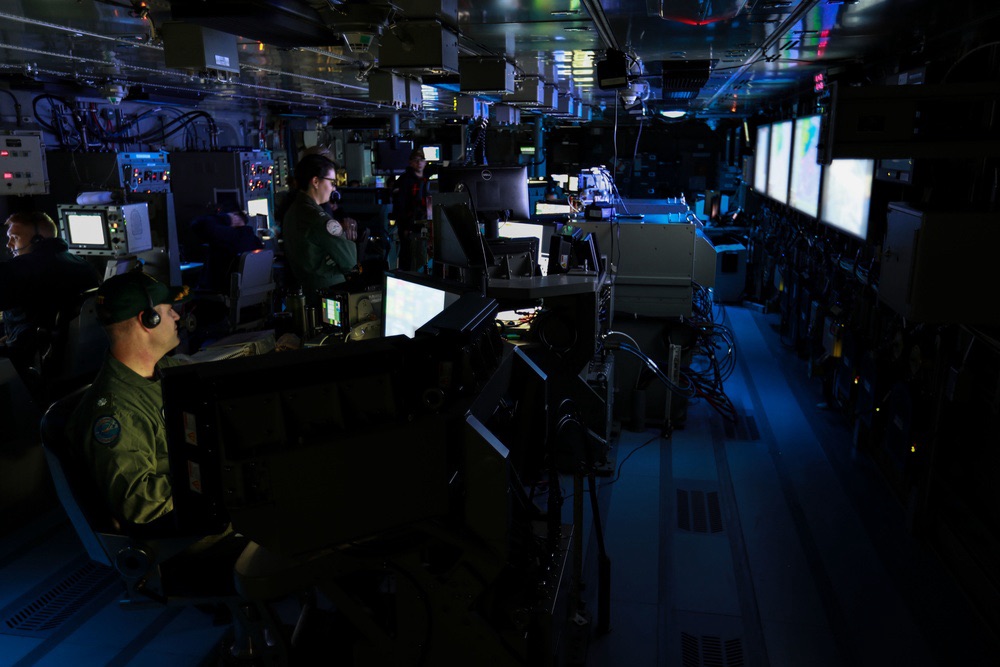
    To help with protecting the airspace around the carrier and its strike group the Ford Class Carriers all for the most part come equipped with the AN/SPY-/6(V)4 radar. SPY-6 for short. While the USS Gerald R. Ford has an older model and will be upgraded the future ships in the class will receive the upgraded SPY-6. This radar is one of the strongest parts of the ship giving the carrier the ability to defend against multiple threats from 360 degrees at the same time, including Hypersonic, Cruise, and ballistic missiles. It’s also highly resistant to enemy jamming efforts. The data collected can all be shared between the battle group and aircraft like the F-35 and EC-2 Hawkeye, further strengthen the groups defenses and offensive capabilities during battle. Info collected from the carrier battle groups radar and other sensors can be filtered through several different systems and processed and sent to whoever needs the info at the time. For example every CSG (carrier strike group) is going to have an Air Warfare Commander that will usually be the captain of an Aegis equipped Ticonderoga-Class Guided Missile Cruiser. His teams mission is obvious, to protect the Strike group from all manned aerial units and missiles and is one of the most important jobs in the CSG. The information taken from the carriers Radar on the Ford-class carriers can be transmitted instantly to the CIC (Combat Information Center)aboard the designated Air Warfare cruiser where the commander and his team can quickly make decisions based on that data to protect the CSG.

    Combat Information Center on the Gerald R. Ford

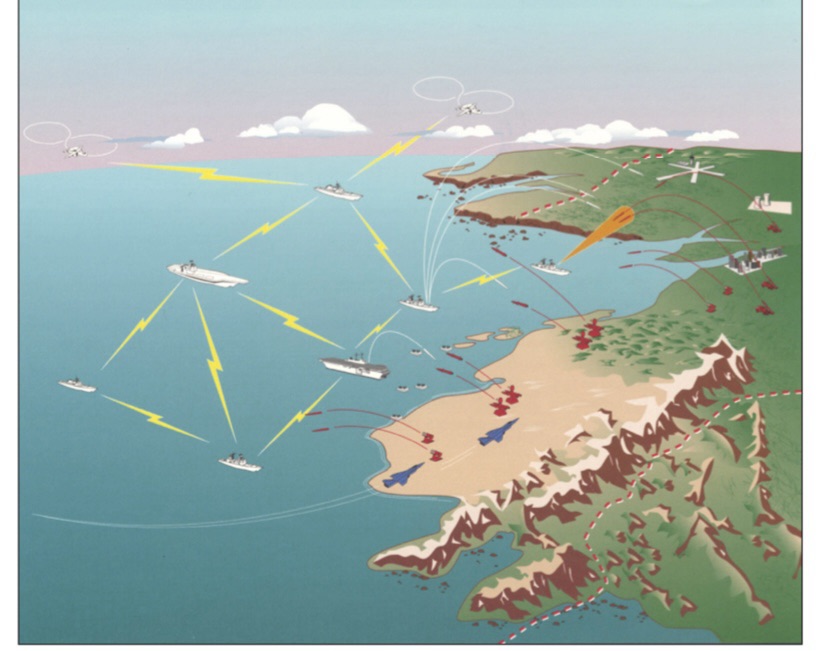
    I mentioned above that data could be shared between the CSG and I’d like to highlight this for a moment because I think it’s important. These systems are used throughout the navy. CEC or Cooperative Engagement Capability is a network of sensors and fire control systems all working together towards a complete battlefield picture for all aircraft and surface ships. Think about a computer network. The computers can all transmit data to one another through a high speed, encrypted, wireless connection allowing all these systems to operate together towards a unified goal. 

    A littoral battle underway as multiple hostile and friendly targets need to be identified and tracked.

    This would include systems like Aegis. Aegis is a series of radar,computers and different weapons systems that all work together be an effective missile defense system. While the carrier itself is not technically considered aegis its radar can be used to in the process to help shooting down threats. The last system I’ll mention is Link 16. Link 16 is a tactical data exchange network that allows ships and aircraft and ground forces to share a tactical picture in near real time. It supports text messages,imagery, voice through digital channel frequencies that operate using radio waves.  Link 16 is being used throughout NATO for the different nations to all be able to share their view of the battlefield.this system allows,for example- the stealthy F-35C lightning with its upgraded radar to communicate with the E2-D Advanced Hawkeye who can relay the signal to the 

    F/A-18 (and surface ships) allowing the Lightnings to act as a sort forward observer, tracking enemy’s and preselecting targets. 

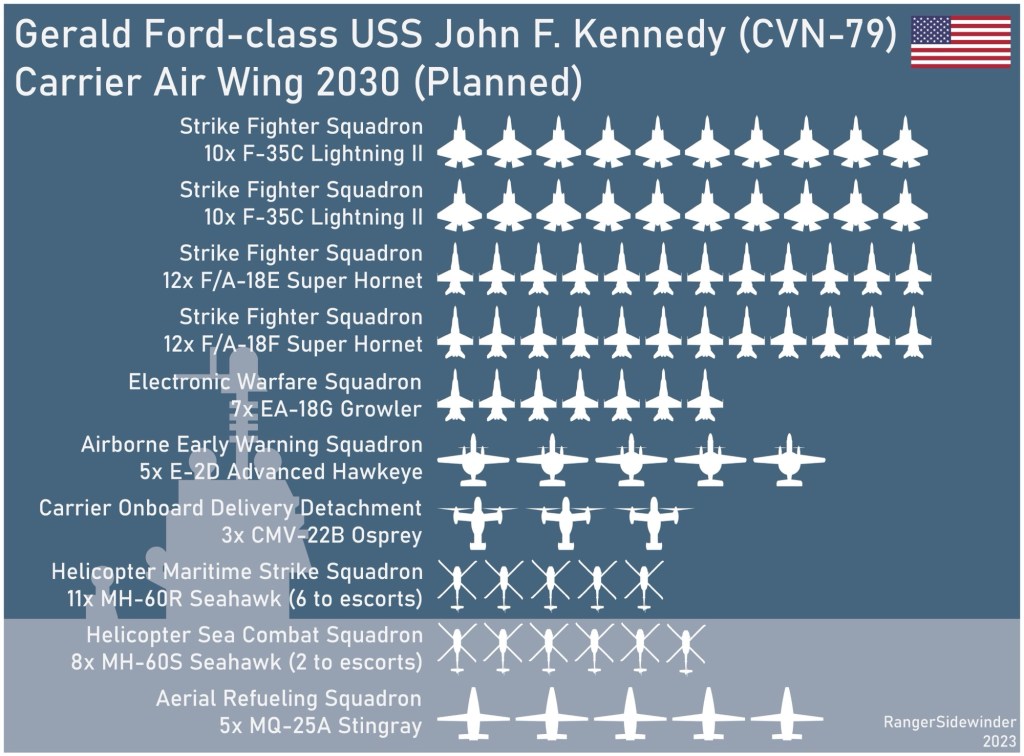
    Planned air wing of the USS John F. Kennedy, The next Ford Class Carrier.

    Moving on. Let’s look at the main role of the carrier which is power projection through its air power. Its hanger capacity has been extended allowing it to support up to 90 aircraft of the current carrier air wing makeup. The future will likely see the navy’s workhorse F/A- 18 Super Hornet all replaced by F-35c Lightnings but for now it appears that they are running a mixture of the two mostly as a way to keep cost down if I had to guess. 

    Other aircraft operating from the Ford Class will be fairly standard except for a few instances. E/A-18 Growlers will remain a huge part of the carrier air wing being the electronic Warfare and SEAD/DEAD (Suppression/Destruction Enemy Air Defense) of Master that it is. The command and control E-2D Advanced Hawkeyes are the shiny big brother to the Hawkeye of olden days. Northrop Grumman took an “if it isn’t broke don’t fix it” approach to the beefed up Hawkeyes and instead of changing anything they just made it better in almost every way. The same is true for the SH-60 Seahawks which will cover helicopter operations. 

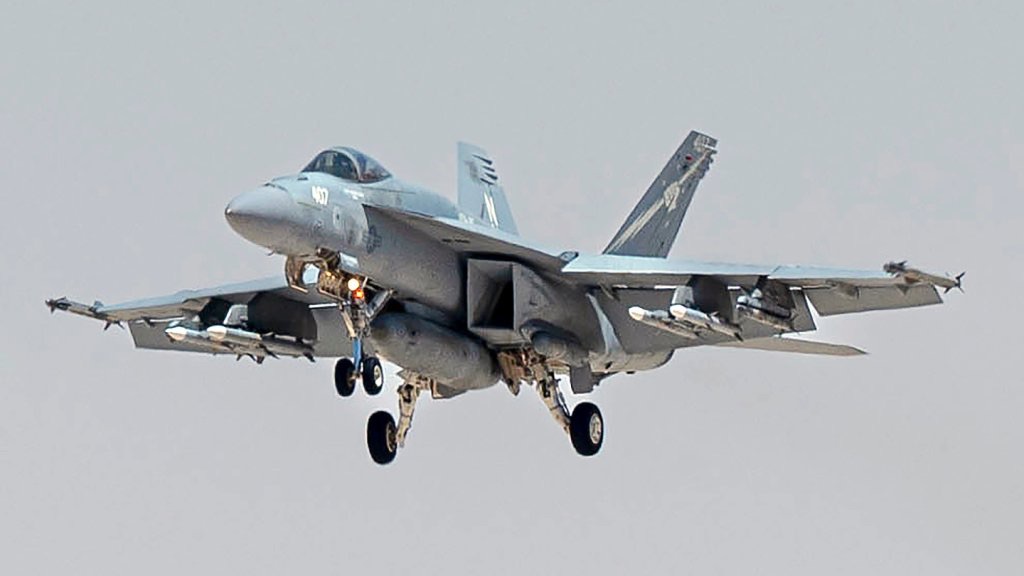
    F/A-18 Super hornet. No introduction needed. These are the ground strikers and air to air defenders of the fleet.
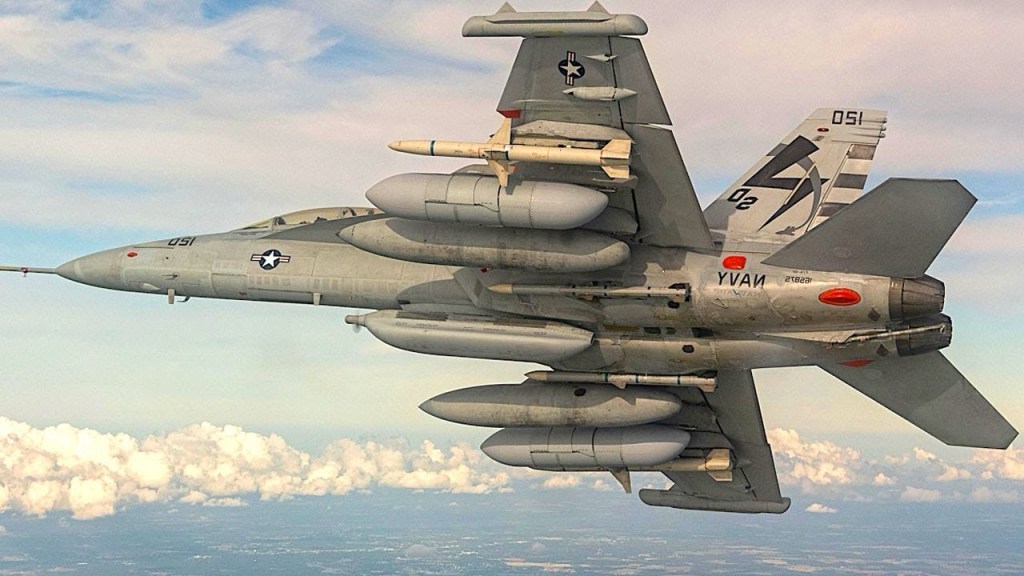
    E/A-18 Growler. The SEAD/DEAD powerhouse and the reason why the enemy’s never see what hit them.
    E-2D Advanced Hawkeye. Airborne radar as well as Command and Control. These guys are the Taskmasters. They make sure everybody is in the right place doing what they need to do.

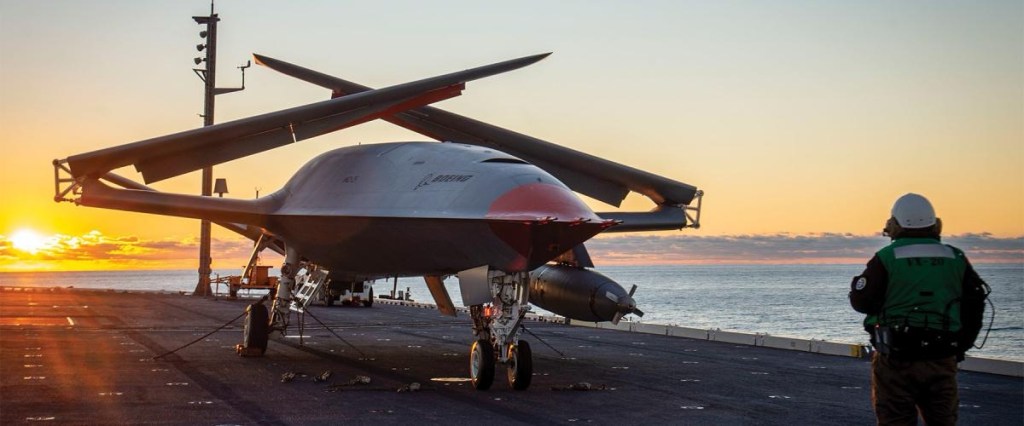
    There is one other addition to be added to all Ford class carriers. The addition of an unmanned warfare center to operate any and all unmanned drones deployed by the CSG. The one major planned unmanned system is the MQ-25 Stingray. The Stingray is still in development but is expected to make its way to the fleet in the next couple years. The Stingray will handle all the carrier aerial refueling needs. 

    MQ-25 Stingray aerial refueling isn’t sexy, until you really need gas.

    All in all the Ford Class carriers will provide a net positive in war-fighting ability to the US  navy in a time when politics and budget constraints in the acquisition department have yielded several platforms that failed to meet expectations. The next Ford Class Carrier is set to be delivered to the Navy this year as long as there are no delays.