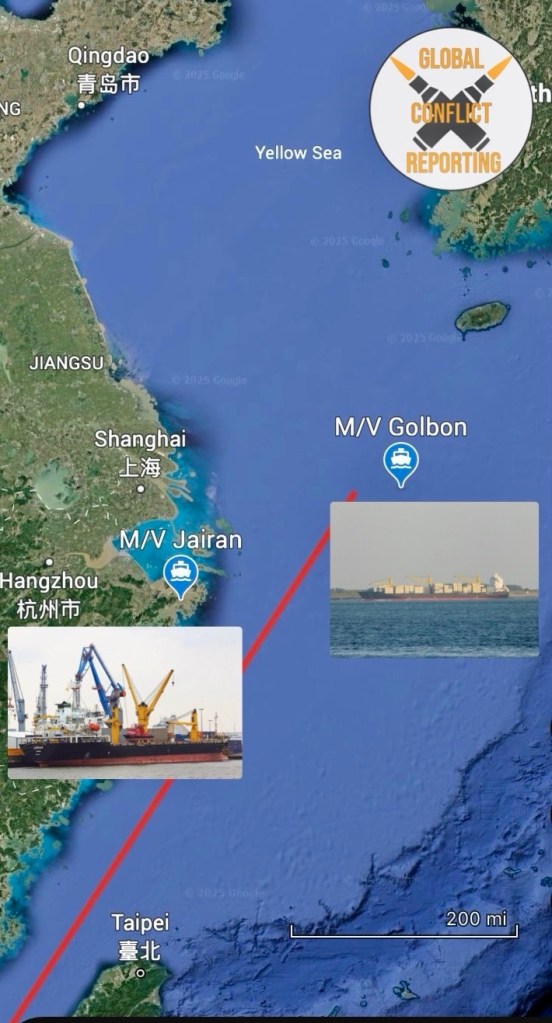
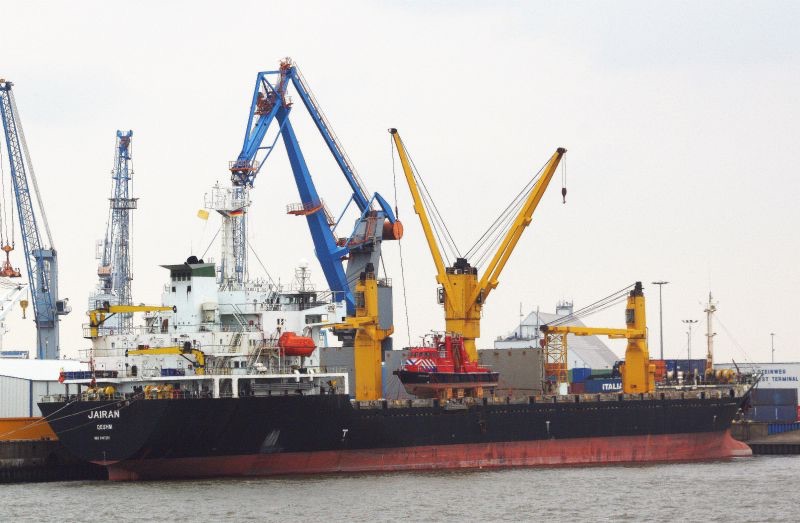
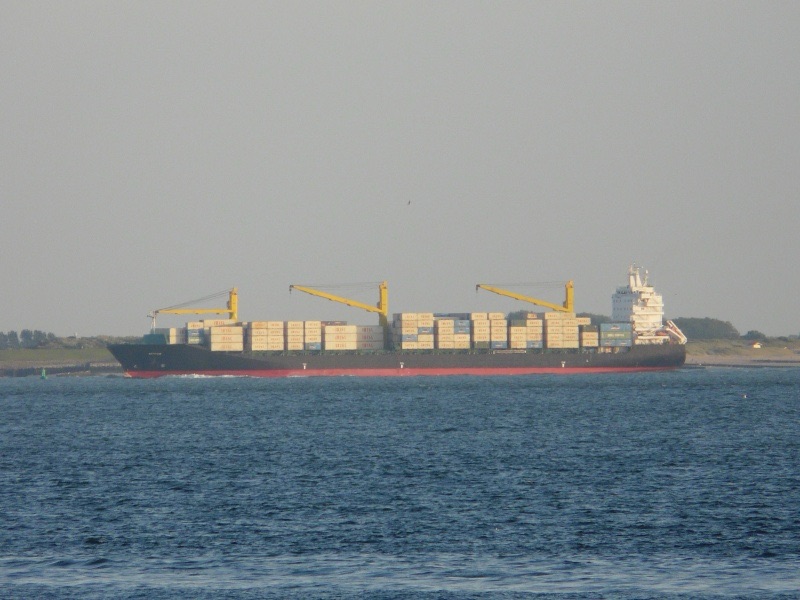
M/V Golbon and M/V Jairan, Two Iranian flagged containerships have reportedly been loaded with over 1000 tonnes of sodium perchlorate at a Chinese port over the past several days.
M/V JairanM/V Golbon
Sodium perchlorate is used to make ammonium perchlorate which can be used as a solid propellant in ballistic missiles and is controlled under the Missile Technology Control Regime, an international Anti- Proliferation group.
Good afternoon. This is the return of the GCR Daily Briefing. For those who are new this is a daily article I used to do where I pick a couple headlines from around the world and I do a little write up on it. The world is increasingly turbulent and it’s more important than ever to stay up to date in the events taking place in our world.
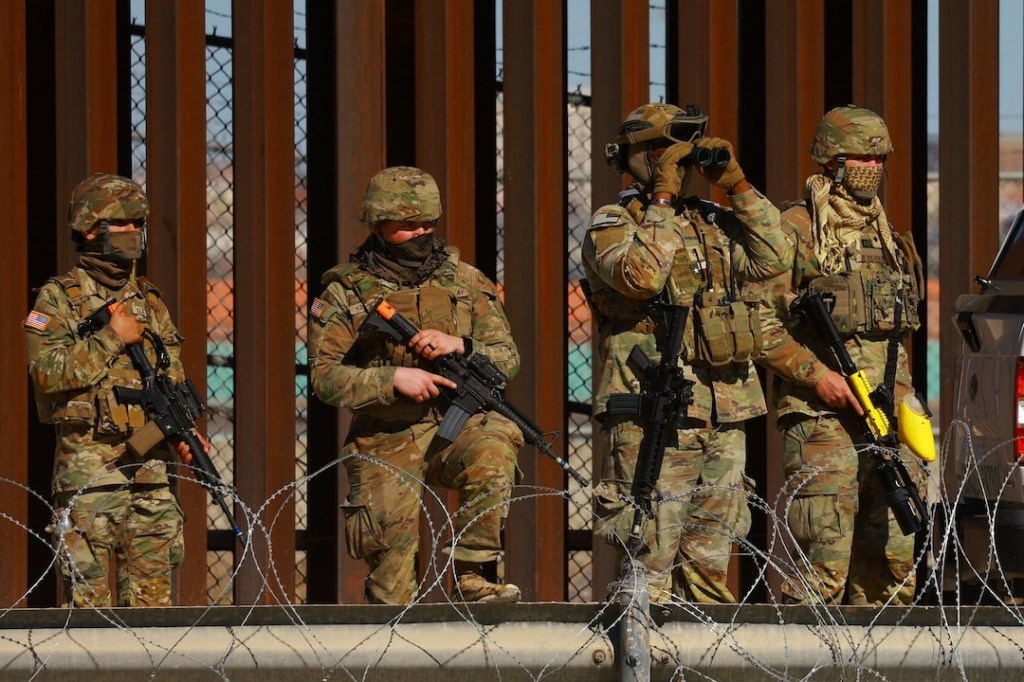
US President Trump orders 1000 national guard to the border.
The Pentagon-on the orders of President Donald Trump, has ordered 1,500 troops to join the already 2,500 soldiers to the US and Mexican border.These forces are ordered to “to support the activities of the Secretary of Homeland Security in obtaining complete operational control” and provide troops and supplies. The soldiers will also help build border fortifications and walls. These troops are apart of a larger force of 10,000 that will eventually make it to the border to help Customs and Border Protection (CBP) according to a leaked CBP memo being reported in the press.
This is all apart of a larger immigration policy put in place on the Trumps administrations first day in office. Surging troops to the border as well as using DoD bases as makeshift “holding facilities” until ICE can build more facilities. The above mentioned memos show that ICE will be drastically increasing the number of ICE holding facilities.
Trumps plan is to use the military to completely seal the border from migrants and asylum seekers. Migrants, who have long come to the U.S. to work in the farm industry will be picked up crossing into the US and deported before being able to ask for asylum or any sort of hearing.
At this point the southern border is effectively closed. Even those trying to enter the country legally have been turned away. This policy is likely to affect food prices for a time as the USDA Economic Research Service reported that in agriculture the number of migrant laborers was 59 percent and another 45% in the animal farm industry.
//UK
UK navy shadows Russian spy ship through the English Channel.
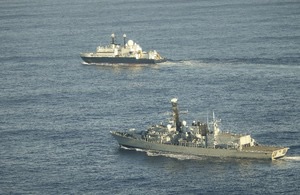
HMS Somerset shadows Russian Spy ship Yantar.
This week a Russia Spy ship (technically an oceanography ship),Yantar (also know as Cruys) has been shadowed by the UK Navy this week as the ship made its way through the English Channel.
In November this ship had been loitering above the area where several undersea cables were but was surprised by a Royal Navy Submarine when it surfaced near them to let the Yantar crew know that they were being closely monitored and warned them off. The ship left the area for the Mediterranean but returned this week and has been shadowed by the HMS Somerset(F82), a Type 23 Frigate.
The Russian Spy Zship Yantar.
Russian ships have even connected to sabotage of undersea cables in the recent past in the Baltic so no chances are being given in in the English Channel.. The Yantar is equipped with a small submersible that can be used to go down to the ocean floor and tamper with communications and power cables, potentially adding devices to the cables so Russia can access the data.
The UK has taken a lead role in countering the threat of Russian attacks on critical undersea infrastructure in the European seas and oceans. They have announced they will send several P-8 Poseidon and Rivet Joint maritime patrol and surveillance aircraft for the Baltic Sentry activity announced after the damage to the ESTLINK2 cable. Baltic Sentry is a NATO mission that aims to bring different maritime and aerial assets into the Baltic area and integrate them into the protection of the area.
The White House on Monday annonced that it would be naming two of its future planned Gerald R. Ford-class nuclear powered aircraft carriers after former presidents. The USS William J. Clinton and USS George W. Bush, after the 42nd and 43rd U.S. presidents.
“Their legacies will endure through these aircraft carriers, which serve as formidable platforms dedicated to safeguarding our national security and strengthening our resolve to protect this nation against any who would threaten our freedoms and way of life,“ said Secretary of the Navy Carlos Del Toro.
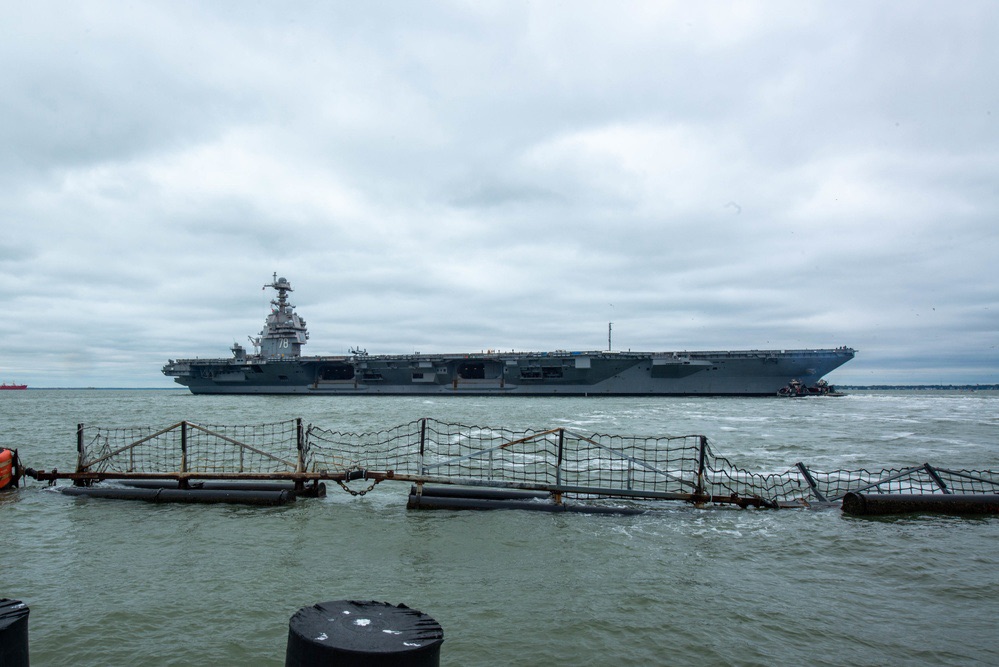
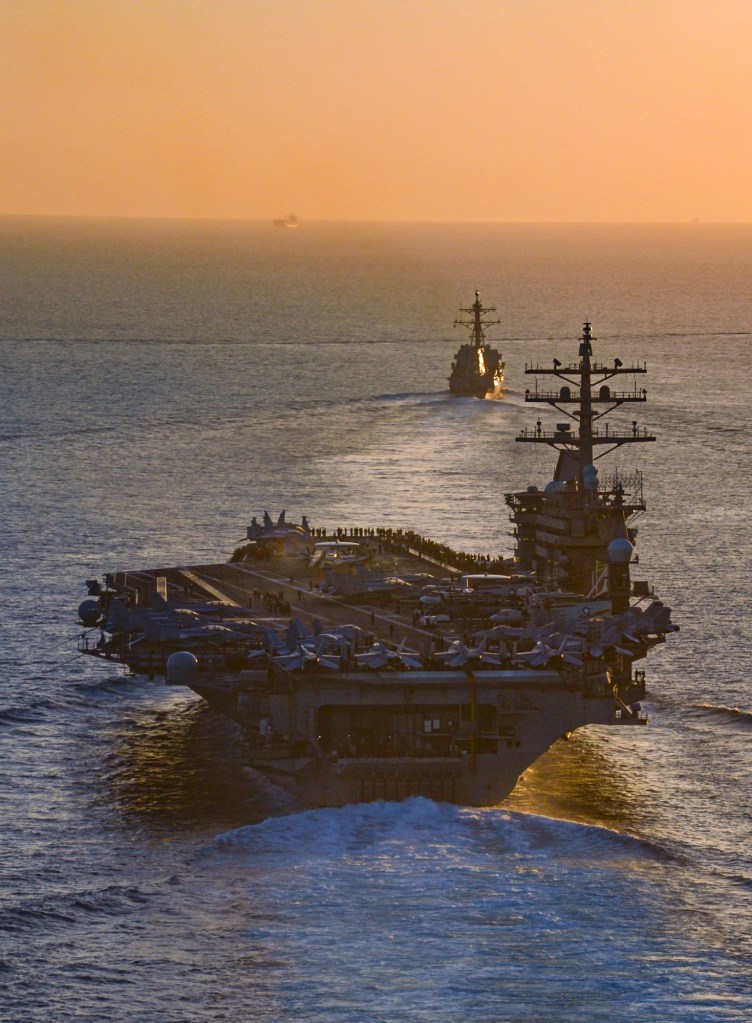
These ships will be the 5th and 6th of the Ford-class. As of writing this only one of the class exists which is the lead ship in the series USS Gerald R. Ford. Ford was named after the 38th president of the United States, who served on the light aircraft carrier Monterey in WW2 in the Pacific. The Ford-Class carrier to this day remains the largest carrier/warship ever created.
Evolution of Power : Ford-Class carrier upgrades and capabilities.
USS Gerald R. Ford departs Navel Station Norfolk for its first deployment. Photo by Petty Officer First Class William Spears.
What makes the Ford-class Special?
The Ford-class was created to offer a number of improvements over the Nimitz-class carrier which had been the standard for 40 years and is now being phased out, replaced by the Ford-class.What improvements make the Ford-class so special? Well let’s talk about it. Most of this info comes from testing on the only Current Ford class in use, the USS Gerald R. Ford (CVN 78)
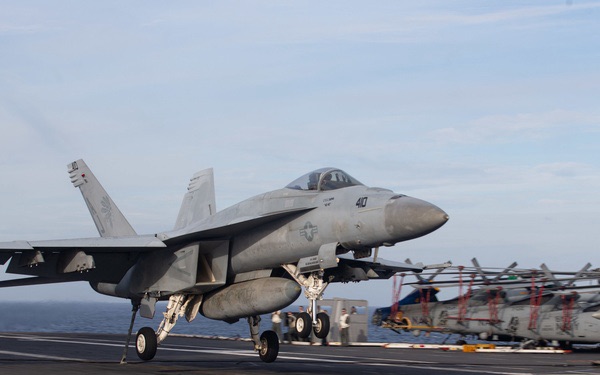
Cmdr. Robert Kurrle, the commanding officer of the “Golden Warriors” of Strike Fighter Squadron (VFA) 87, conducts his final carrier landing on the first-in-class aircraft carrier USS Gerald R. Ford’s (CVN 78) flight deck. Photo by Petty Officer 2nd Class Zackery Guth.
Improved aircraft launch and recovery systems. Specifically the EMALS or Electromagnetic Aircraft Launch System replace the steam powered catapults used in the past giving fighter pilots a smoother takeoff with less maintenance. On the landing side we have the AAG or Advanced Arresting Gear which in testing so far with the Gerald R Ford has shown an increased smoothness with landing as well as the capability to catch heavier aircraft and UAVs (more in those in a bit).
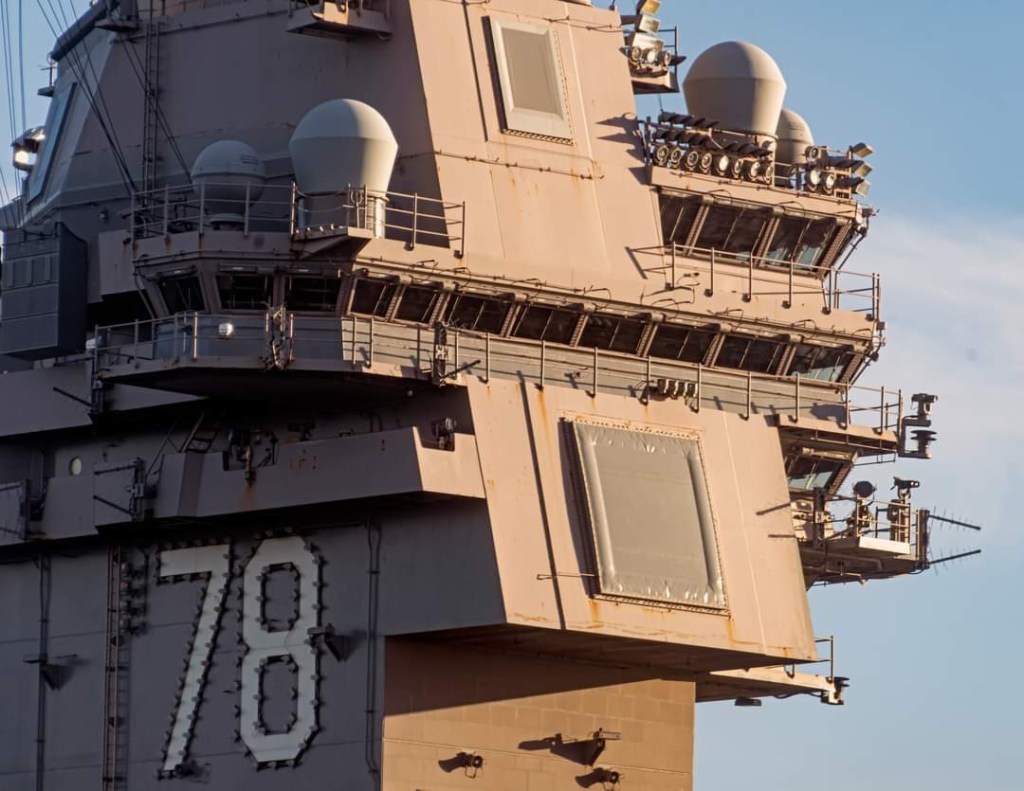
Island of USS Gerald R. Ford (CVN 78). You can see its radar here. Unknown photograph.
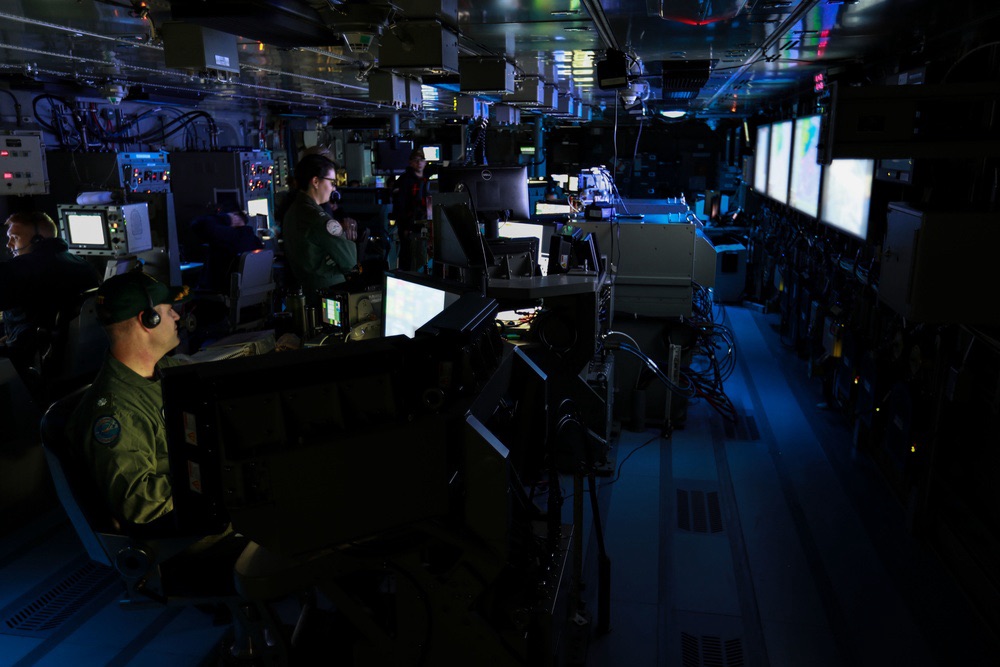
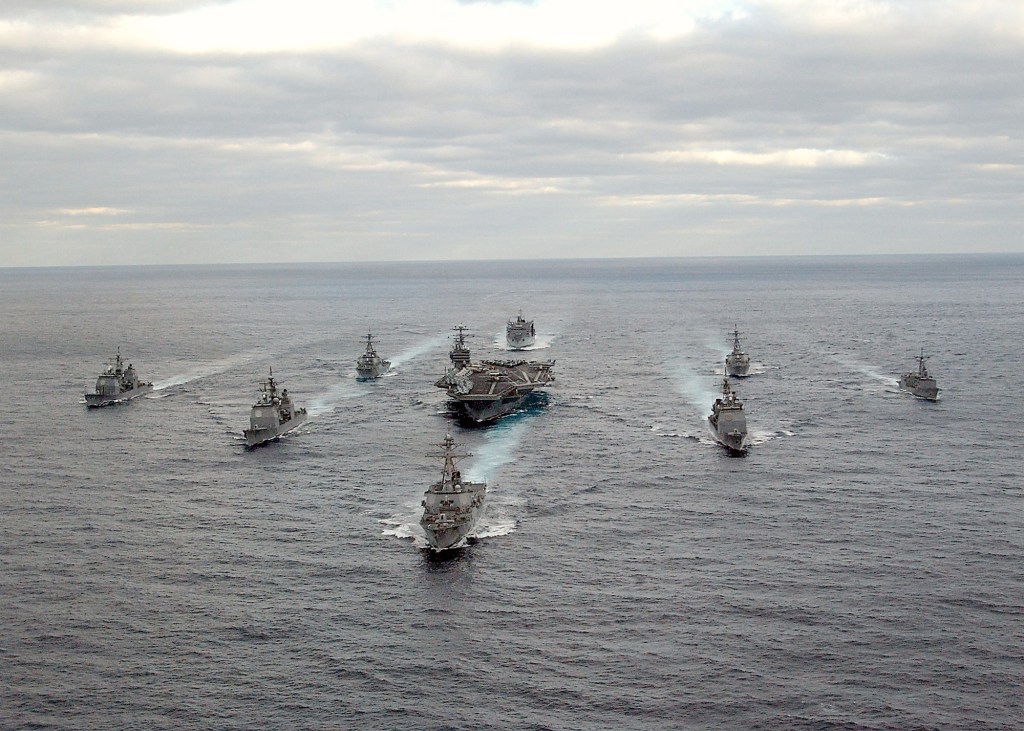
To help with protecting the airspace around the carrier and its strike group the Ford Class Carriers all for the most part come equipped with the AN/SPY-/6(V)4 radar. SPY-6 for short. While the USS Gerald R. Ford has an older model and will be upgraded the future ships in the class will receive the upgraded SPY-6. This radar is one of the strongest parts of the ship giving the carrier the ability to defend against multiple threats from 360 degrees at the same time, including Hypersonic, Cruise, and ballistic missiles. It’s also highly resistant to enemy jamming efforts. The data collected can all be shared between the battle group and aircraft like the F-35 and EC-2 Hawkeye, further strengthen the groups defenses and offensive capabilities during battle. Info collected from the carrier battle groups radar and other sensors can be filtered through several different systems and processed and sent to whoever needs the info at the time. For example every CSG (carrier strike group) is going to have an Air Warfare Commander that will usually be the captain of an Aegis equipped Ticonderoga-Class Guided Missile Cruiser. His teams mission is obvious, to protect the Strike group from all manned aerial units and missiles and is one of the most important jobs in the CSG. The information taken from the carriers Radar on the Ford-class carriers can be transmitted instantly to the CIC (Combat Information Center)aboard the designated Air Warfare cruiser where the commander and his team can quickly make decisions based on that data to protect the CSG.
Combat Information Center on the Gerald R. Ford
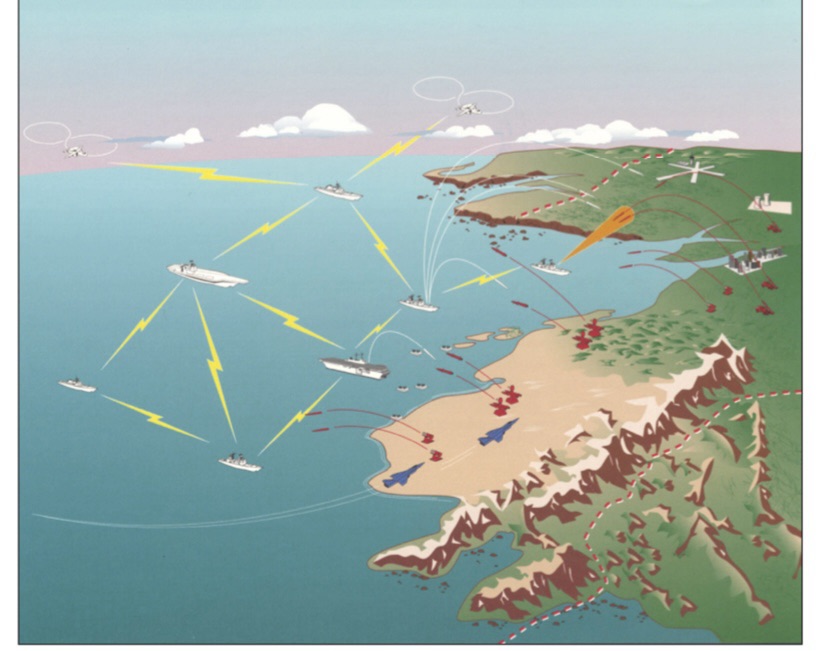
I mentioned above that data could be shared between the CSG and I’d like to highlight this for a moment because I think it’s important. These systems are used throughout the navy. CEC or Cooperative Engagement Capability is a network of sensors and fire control systems all working together towards a complete battlefield picture for all aircraft and surface ships. Think about a computer network. The computers can all transmit data to one another through a high speed, encrypted, wireless connection allowing all these systems to operate together towards a unified goal.
A littoral battle underway as multiple hostile and friendly targets need to be identified and tracked.
This would include systems like Aegis. Aegis is a series of radar,computers and different weapons systems that all work together be an effective missile defense system. While the carrier itself is not technically considered aegis its radar can be used to in the process to help shooting down threats. The last system I’ll mention is Link 16. Link 16 is a tactical data exchange network that allows ships and aircraft and ground forces to share a tactical picture in near real time. It supports text messages,imagery, voice through digital channel frequencies that operate using radio waves. Link 16 is being used throughout NATO for the different nations to all be able to share their view of the battlefield.this system allows,for example- the stealthy F-35C lightning with its upgraded radar to communicate with the E2-D Advanced Hawkeye who can relay the signal to the
F/A-18 (and surface ships) allowing the Lightnings to act as a sort forward observer, tracking enemy’s and preselecting targets.
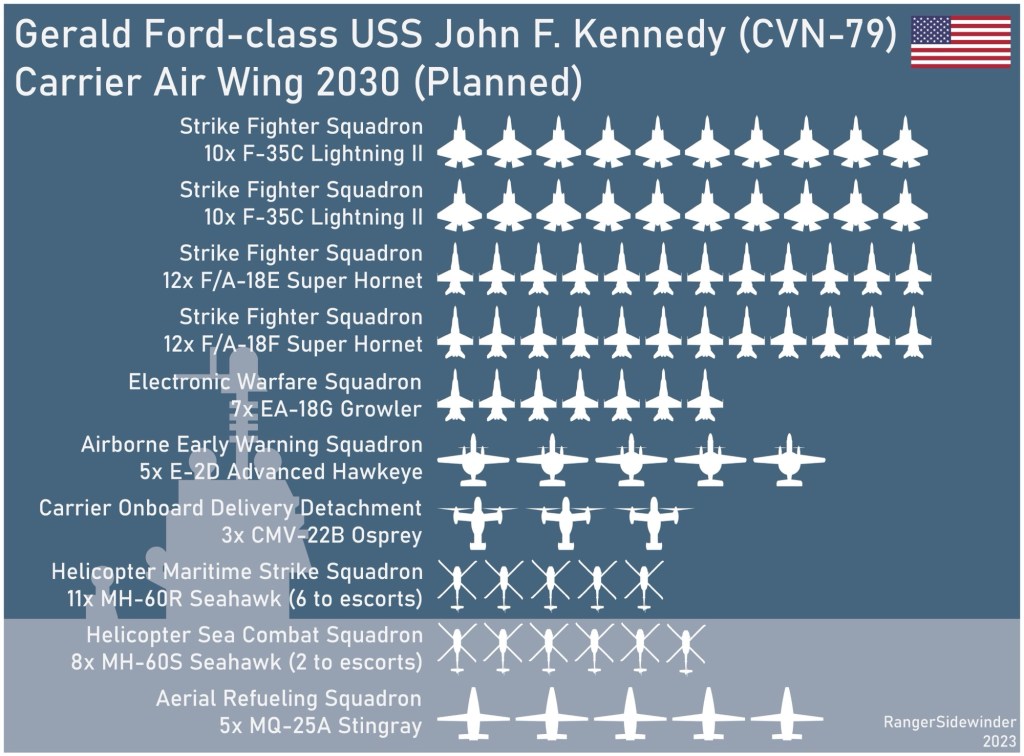
Planned air wing of the USS John F. Kennedy, The next Ford Class Carrier.
Moving on. Let’s look at the main role of the carrier which is power projection through its air power. Its hanger capacity has been extended allowing it to support up to 90 aircraft of the current carrier air wing makeup. The future will likely see the navy’s workhorse F/A- 18 Super Hornet all replaced by F-35c Lightnings but for now it appears that they are running a mixture of the two mostly as a way to keep cost down if I had to guess.
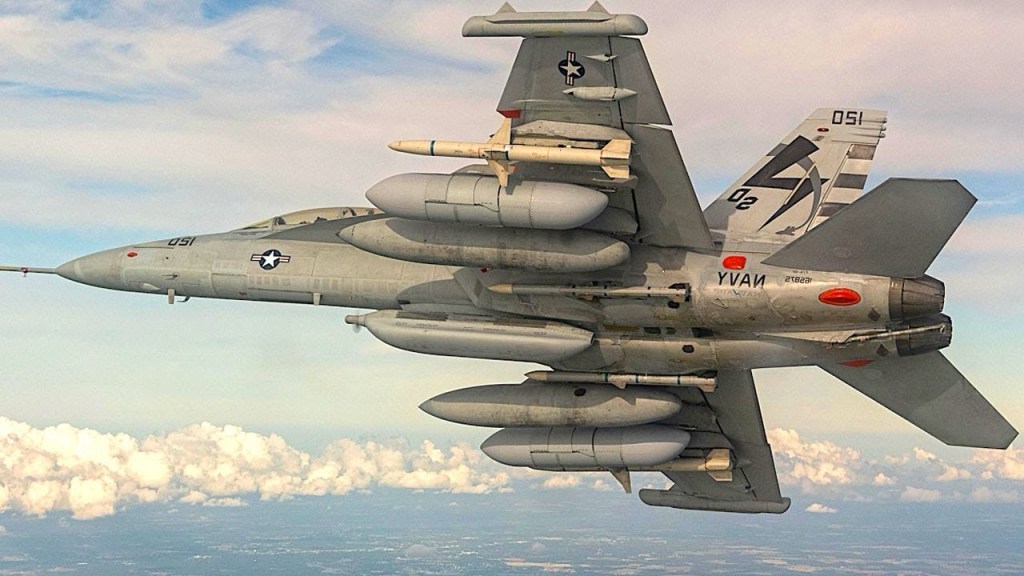
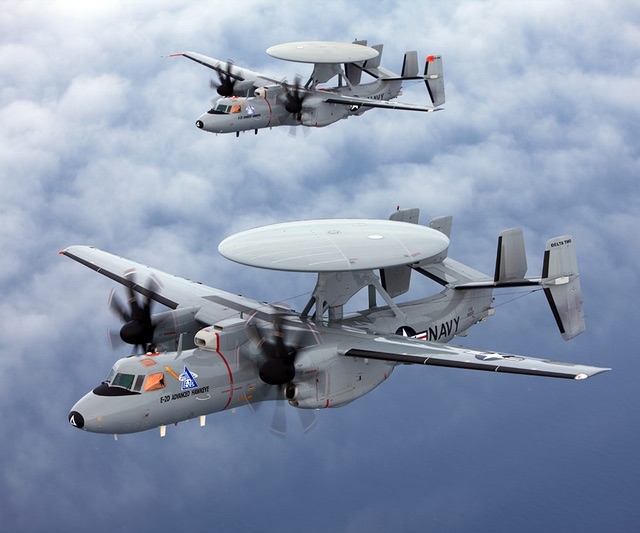
Other aircraft operating from the Ford Class will be fairly standard except for a few instances. E/A-18 Growlers will remain a huge part of the carrier air wing being the electronic Warfare and SEAD/DEAD (Suppression/Destruction Enemy Air Defense) of Master that it is. The command and control E-2D Advanced Hawkeyes are the shiny big brother to the Hawkeye of olden days. Northrop Grumman took an “if it isn’t broke don’t fix it” approach to the beefed up Hawkeyes and instead of changing anything they just made it better in almost every way. The same is true for the SH-60 Seahawks which will cover helicopter operations.
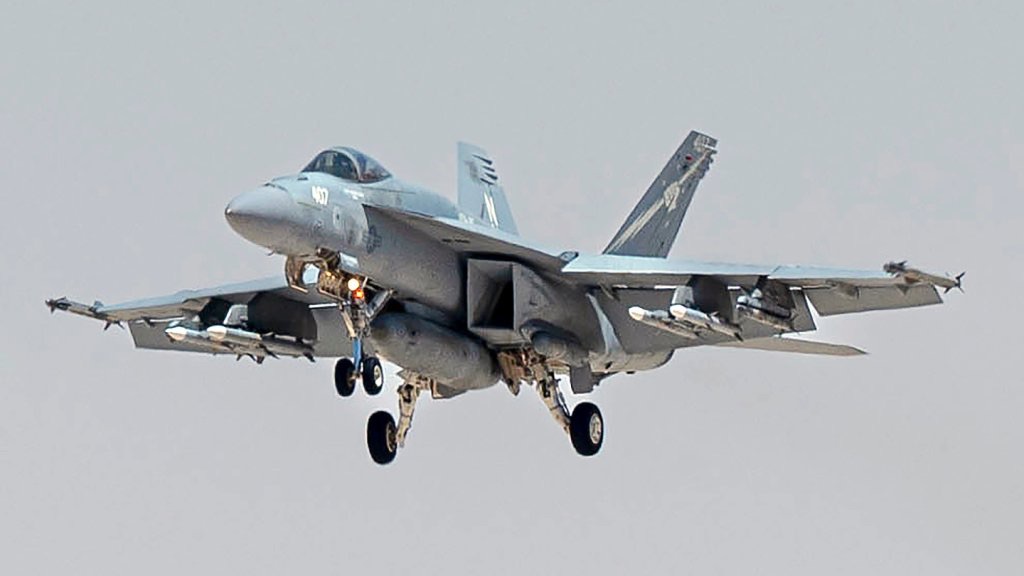
F/A-18 Super hornet. No introduction needed. These are the ground strikers and air to air defenders of the fleet. E/A-18 Growler. The SEAD/DEAD powerhouse and the reason why the enemy’s never see what hit them. E-2D Advanced Hawkeye. Airborne radar as well as Command and Control. These guys are the Taskmasters. They make sure everybody is in the right place doing what they need to do.
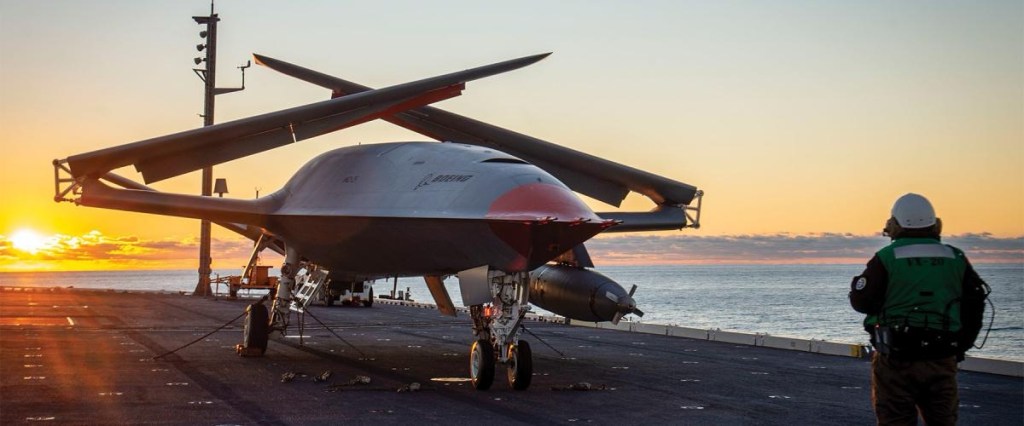
There is one other addition to be added to all Ford class carriers. The addition of an unmanned warfare center to operate any and all unmanned drones deployed by the CSG. The one major planned unmanned system is the MQ-25 Stingray. The Stingray is still in development but is expected to make its way to the fleet in the next couple years. The Stingray will handle all the carrier aerial refueling needs.
MQ-25 Stingray aerial refueling isn’t sexy, until you really need gas.
All in all the Ford Class carriers will provide a net positive in war-fighting ability to the US navy in a time when politics and budget constraints in the acquisition department have yielded several platforms that failed to meet expectations. The next Ford Class Carrier is set to be delivered to the Navy this year as long as there are no delays.
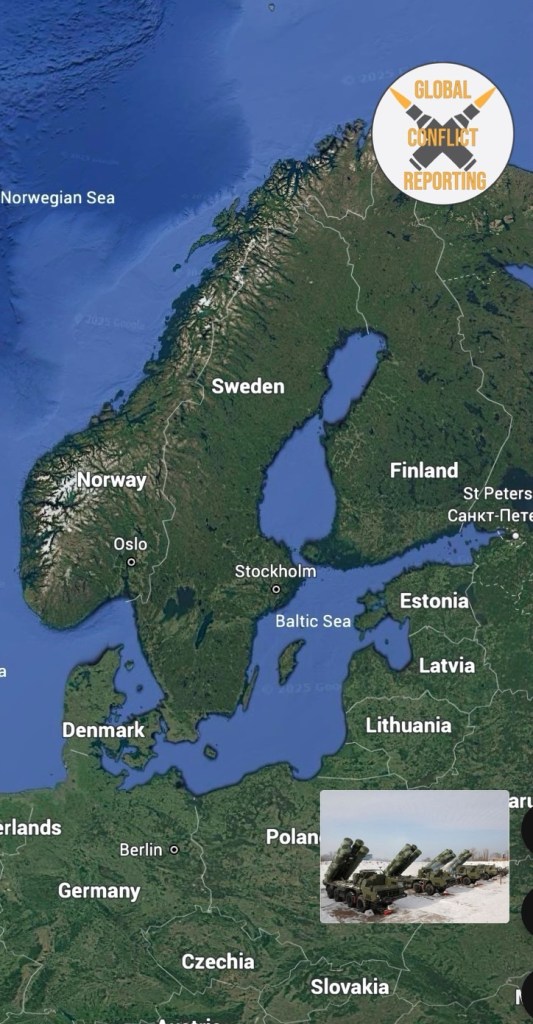
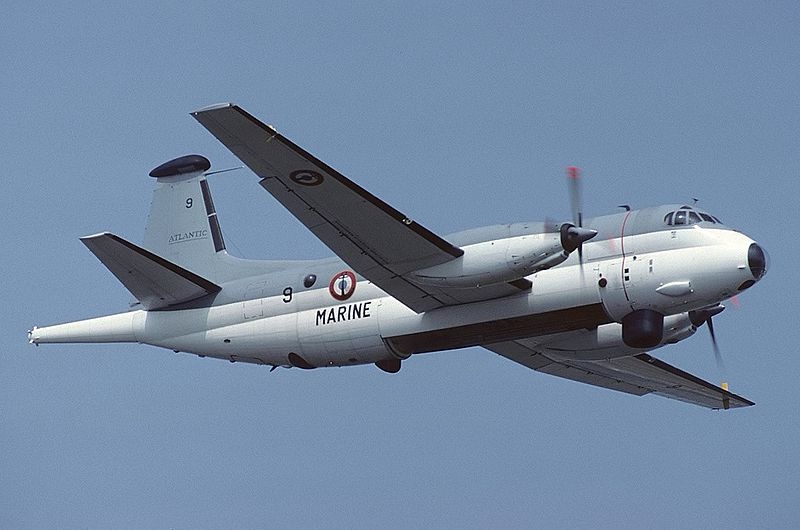
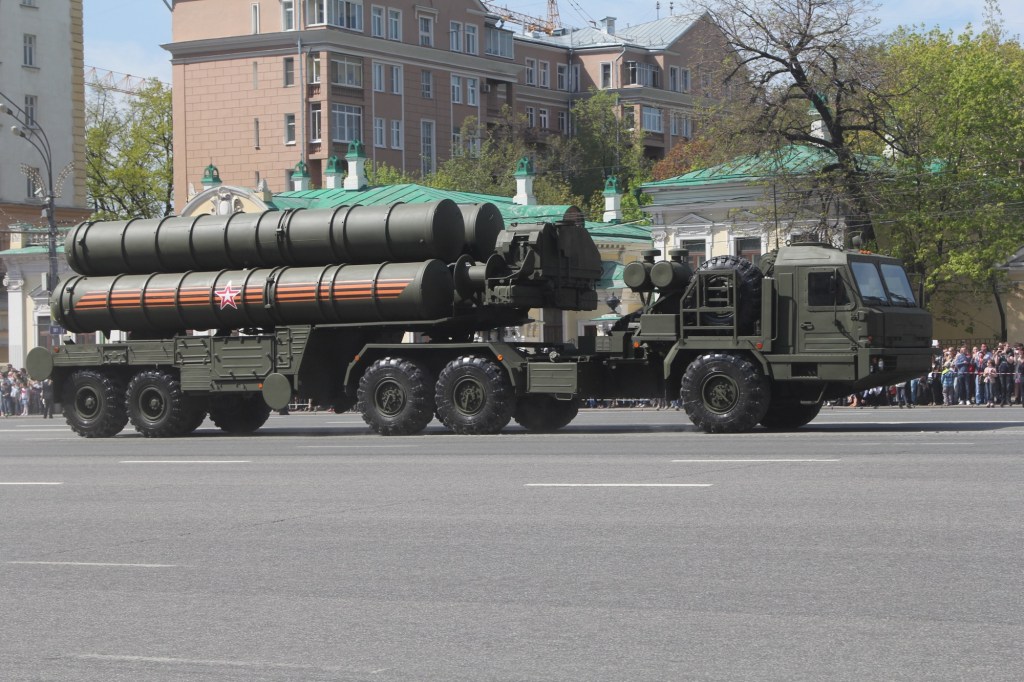
French media reported that last Thursday night while patrolling in international airspace over the Baltic Sea a Atlantique 2 French MPA (Maritime Patrol Aircraft) was targeted by the radar of a S-400 air defense system. This aircraft additionally had its radar jammed, a constant problem around the Kaliningrad area for commercial as well as military flight, but added with that the fact it was lit up by a S-400s fire control radar at the same time shows a clear case of aggression and attempted intimidation on the side of the Russians.
Atlantique 2 MPA
The French military viewed this for the hostile act it was with Colonel Guillaume Vernet, the spokesperson for the French armed forces saying “Illuminating our aircraft in international waters with radar is an aggressive action. The professional attitude of the crew prevented any escalation“.
S-400 Triumf (NATO reporting name: SA-21 Growler)
While the French navy regularly sends Maritime patrol aircraft into the Baltic for the NATO mission to ensure safety of navigation and air and sea policing as well as surveillance of Russian forces. Recently the deployment of these assets have been increased in response to several recent incidents in the past several months where underwater electric and data cables have been damaged or cut.
The EstLink 2 cable carried electricity between Estonia and Finland before December when if was damaged by a ship, the EagleS which had allegedly dragged its anchor across it and several other cables damaging them. The ship and crew have been impounded since that incident pending investigation. EagleS is believed to be apart of the Russian shadow fleet, a fleet of cargo and oil transport ships using ships flagged in other countries but being used to circumvent sanctions on Russia.
Allied Command Operations (ACO) which is responsible for planning and carrying out all NATO operations has announced Baltic Sentry.
“Baltic Sentry will deliver focused deterrence throughout the Baltic Sea and counter destabilizing acts like those observed last month,” said U.S. Army General Christopher G. Cavoli, Supreme Allied Commander Europe. “It is indicative of the Alliance’s ability to rapidly respond to such destabilization, and shows the strength of our unity in the face of any challenge.”
Baltic Sentry is described as a “multi-domain mission taken forth by NATO in the Baltic Sea to deter any future attempts by a state or non-state actor to damage critical undersea infrastructure there. NATO views the undersea links as critically important to the defense of these nations.
The US military has been engaged in defensive operations against the Yemeni Houthis for the past 15 months in the waters of the Red Sea and in the Arabian Sea as well as the sky’s above Yemen. Several different US carrier strike groups have been deployed into the area to protect the billions of dollars of international commerce that moves through the Red Sea daily heading to and from the Suez Canal. The Houthis have targeted any ship they believe is connected in any way to America or Israel as a way to show support for Palestinian terror group Hamas and their war with Israel in Gaza.
The Head of Naval Surface Forces Vice Admiral Brendan McLane revealed at a Surface Navy Association conference that was attended by journalists from The War Zone( TWZ is great, I always recommend them when they come up) just how many munitions had been expended in the operation. Statements made by the Vice Admiral also give us a more detailed look at how the operation has been going and what US forces as well as their European allies have been dealing with. US CENTCOM which is the United States military command over The Middle East region regularly puts out reports and social media post however they can sometimes be sparse with the details.
The U.S. Navy Surface Fleet has expended 400 individual munitions against the Iranian backed Houthis.
The Vice Admiral also gave an example of the current state of modern surface warfare by talking about a recent engagement that the sailers aboard the Arleigh Burke class destroyer USS Spruance (DDG 111).
“They were in a fight where they shot down 3 anti-ship ballistic missiles(ASBM), 3 anti-ship cruise missile (ASCM) and 7 one-way [unmanned aerial vehicles, or UAVs],” McLane said. “So that’s how it kind of rolls up.”
USS Spruance (DDG 111) after its return to its homeport, Naval Base San Diego, Cali
I’d like to break down the specific munitions, what they are used for, and maybe most importantly- the cost to the American taxpayers.
USS Chung-Hoon (DDG 93) fires an SM-2 missile.
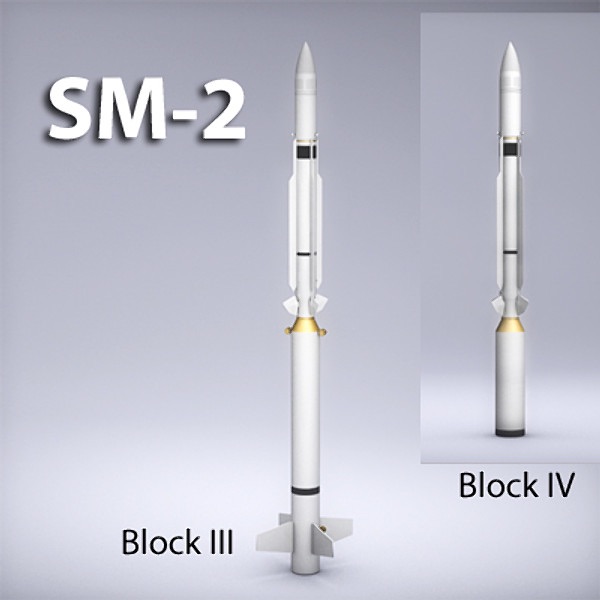
SM-2 missiles (RIM-66)
120 expended. This missile is the workhorse of US navy air defense, being used to take out incoming anti ship missiles as well as other
missiles and incoming enemy jet fighters.. High speed-highly maneuverable and considered one of the best in the world at what it does. The Sm-2 has a reported range of 90 nautical miles and can reach an altitude of 65,000 ft. A cornerstone of the fleets layered air defense systems.
SM-2
Cost vary on specific missile block but these come in at roughly $2 million USD per.
The U.S. is reported to have around 12,000 of these in its stocks.
US Aegis Destroyer intercepts Medium-Range Ballistic Missile with new SM-6 SWUP Missile.
SM-6 missiles (RIM-174)
80 expended
This is a newer addition to the fleet and the navy has a more limited stock of these missile with only 500 being reported to have been delivered according to the Raytheon website.
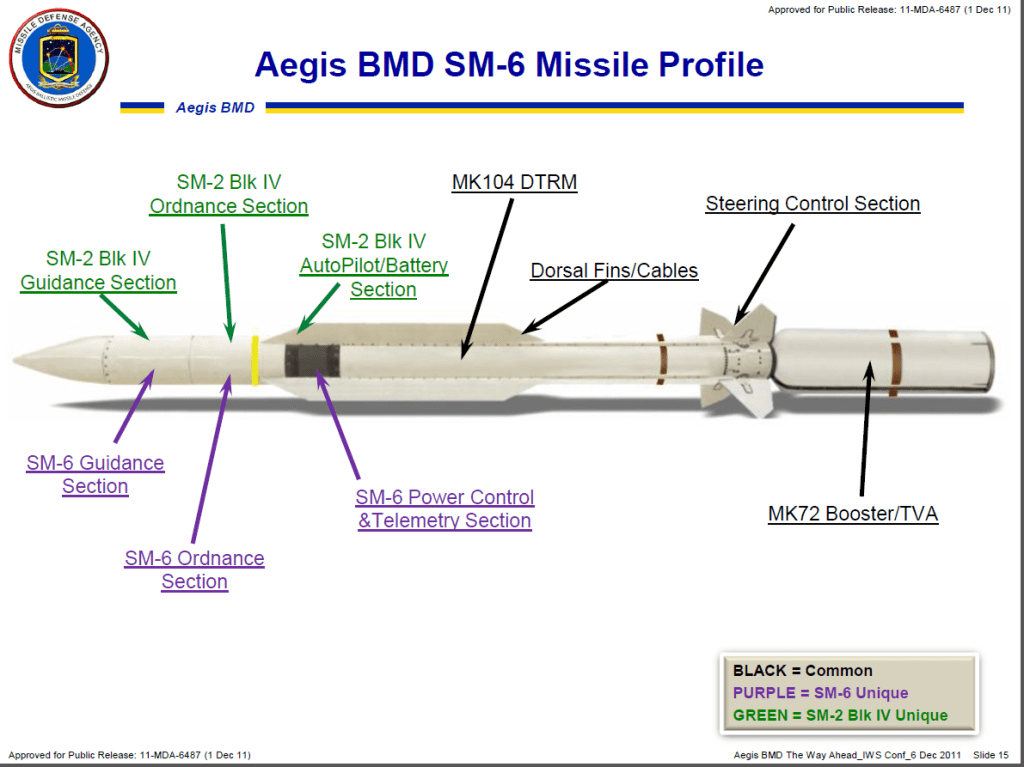
Coming equipped with the active radar seeker found in the Air-to-air AIM-120C AMRAAM, This missile is capable of a wide range of task being capable of defensive anti air against missile (including ballistic missile in their final terminal phase) as well as manned and unmanned air units. Its high speed also makes it a useful anti surface weapons although it’s high cost makes other weapons better choices. The thought behind this missile was warship today have limited space and a weapon that can effectively do everything is a benefit. The explosive warhead as opposed to a hit-to-kill style missile makes this missile capable of potentially defeating the Chinese DF-21D and DF-25B anti-ship ballistic missiles.
SM-6 missile profile.
Cost average around $3.9 million per.
A combined 20 expended from the
Sea sparrow and the SM-3.
Sea Sparrow launch
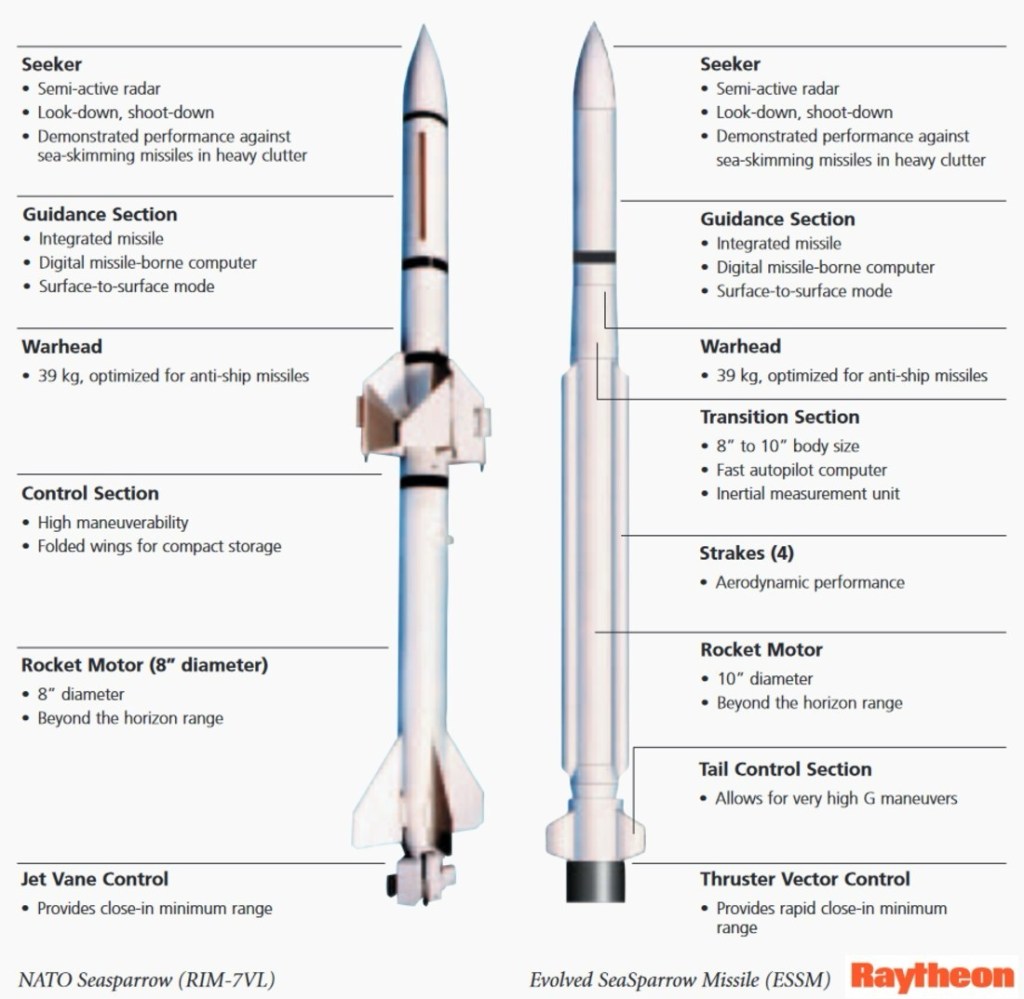
Sea Sparrow ESSM
Medium-range, semi-active homing missile that makes flight corrections via radar and midcourse data uplinks. The missile provides reliable ship self-defense capability against agile, high-speed, low-altitude anti-ship cruise missiles (ASCMs), low velocity air threats (LVATs), such as helicopters, and high-speed, maneuverable surface threats
Sea Sparrow Profile
$787K – $972K depending on configuration
SM-3 launched from the USS McCampbell (DDG 85) intercepts ballistic missile .
SM-3 (RIM-161)
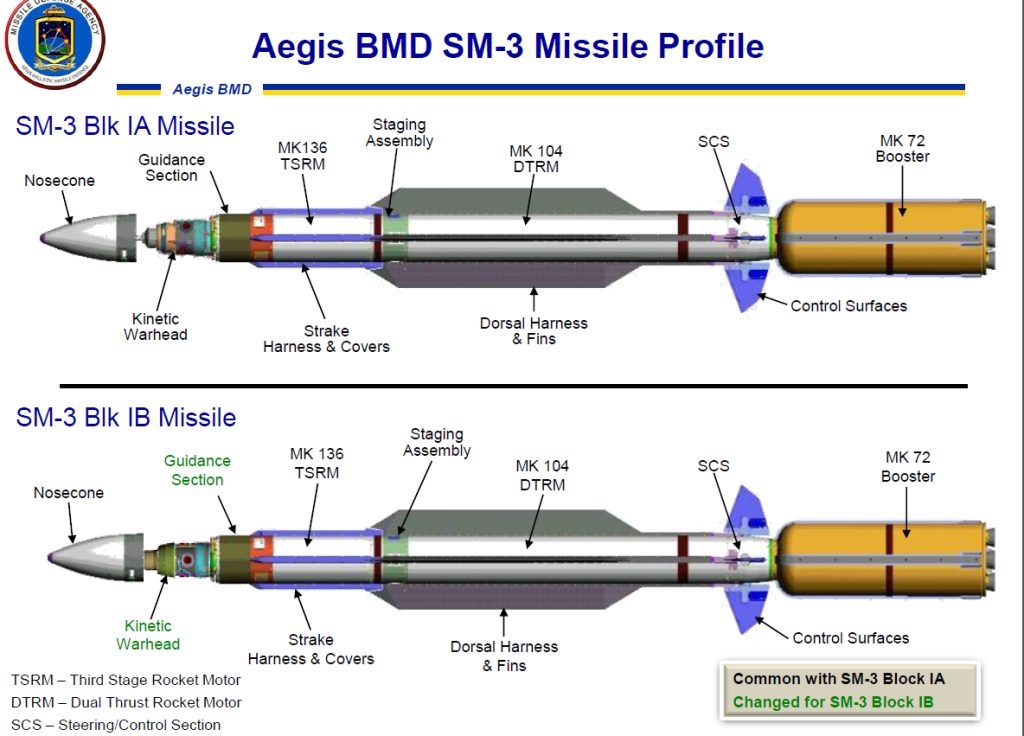
The SM-3 is the main ballistic missile defense of the fleet. It uses its powerful kinetic energy to utilize a hit-to-kill method of attack. It has a lower production rate than everything else on the list which also puts a heavy cost on these missile, especially if you have to fire more than one at a time.
SM-3 missile profile
Anywhere from $10 million to $30 million (this price likely to come down some as missile production is ramped up as announced earlier today.
While the expenditure of these weapons is something to be concerned about it only highlights the logistical issues that the US would have in a near peer, great power conflict when the amount of munitions expended in the Red Sea over the past year would equal only several days of fighting in say the pacific against China. Addressing these procurement and cost issues is paramount if the US is to remain a dominant force on the world’s stage.
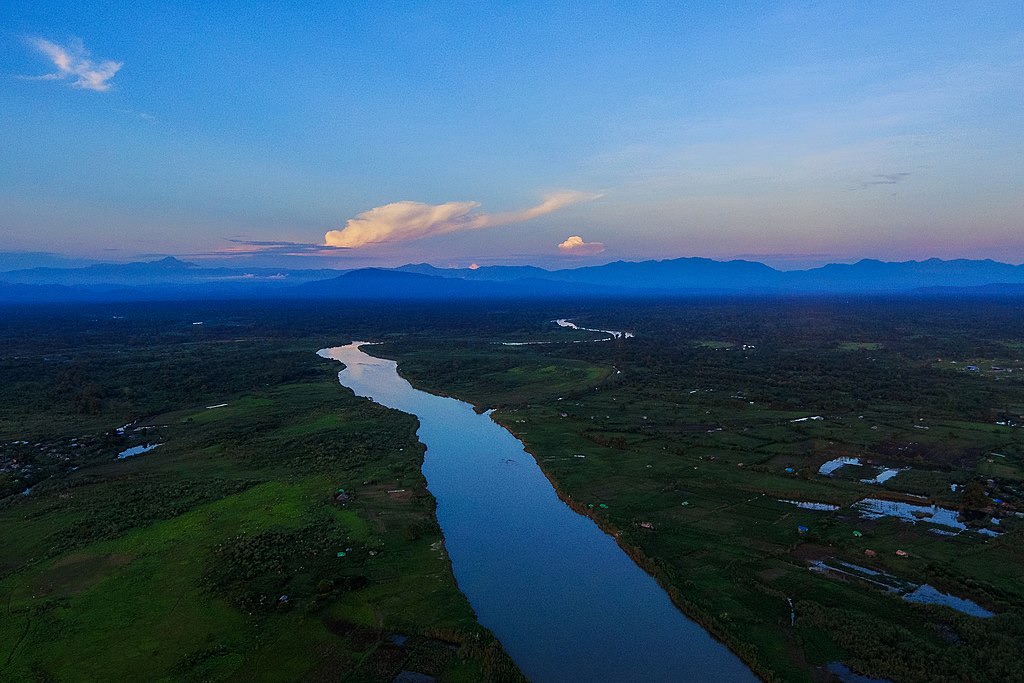
Once hailed as a beacon of hope for democracy in Southeast Asia ,Myanmar has descended into chaos and violence. Two years after a military coup toppled the elected government of Aung San Suu Kyi, the country teeters on the brink of collapse.An ongoing crackdown on civilians and ethnic minorities by the military Junta has claimed the lives of at least 5,000,(according to a report from the Untied Nations)imprisoned thousands and sparked a humanitarian crisis-and a civil war.
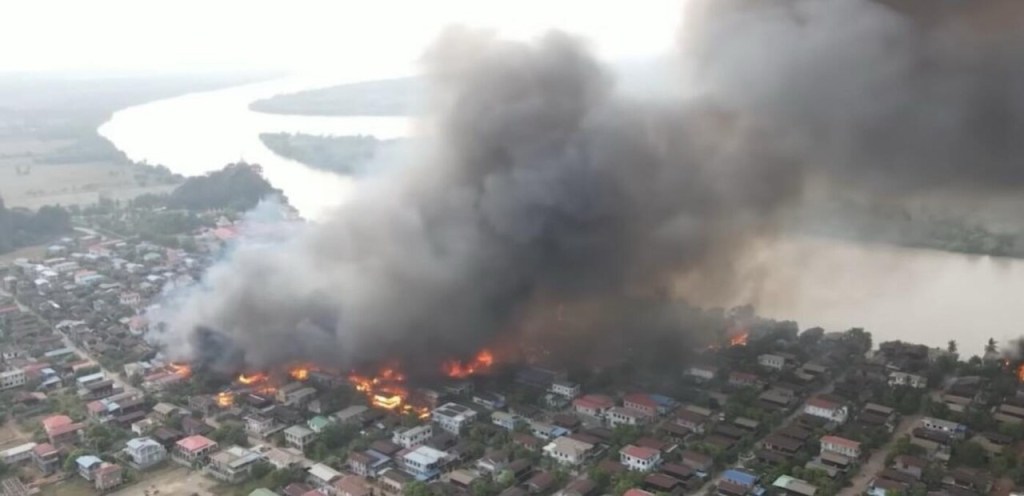
Myanmar’s military crackdowns have intensified with attacks on ethnic minority groups and towns of late. These attacks have caused widespread destruction. Town such as Kale, in Sagaing Region and Loikaw in Kayah state have been bombed and burned by junta airstrikes and artillery attacks.
The communities of ethnic Shan, Rohingya and Chin minorities have also faced sporadic targeted violence and displacement. The accusations against the military towards these groups are grim and include extrajudicial killings, gang rapes, arson and infanticides.
Since 2021, the Kyat (Myanmar currency) has fallen by 60% and has caused hyperinflation. The Kyat, today is worth 2101 Kyat compared to 1 US dollar. This inflation has caused banks and services based on currency to struggle with cash shortages.Some in the country have struggled because their bank accounts have been frozen.
International corporations and businesses have moved their business away from Myanmar and Trade in the country has also been affected with exports down 30% and imports down 40% year over year. Food and fuel prices have skyrocketed to unbelievable prices.
All of this has left the economy gasping for air and contributed vastly to an ongoing humanitarian crisis with 46% of the population estimated to be beneath the poverty line.
The coup was carried out on the orders of one man. Former Burmese Army General and chief of the Bureau of Special Operations, Min Aung Hlaing. Hlaing, before the coup has been the leader of the Tatmadaw (the armed forces of Myanmar) officially called the Commander-In-Chief of Defense Services since March of 2011. He was born in 1956 which makes him 69 this year. That will come up later.
In January of 2021 Hlaing, as the commander in chief of defense services approached the different political parties of the country and hints at their being “instability” in Myanmar. In Myanmar, even before this latest takeover the Tatmadaw held a considerable of power in the government. A clause in the 2008 constitution (that the military wrote) lets the military hold up to 25% of the legislative seats. Another clause(known as the coup-i-waiting clause) allows the president to declare an emergency and hand power to the military leadership.
The instability brought up to the Myanmar political party’s (some of them being just the military) was likely just the election of parliament chancellor Aung San Sui Kyi in 2020 who is noted as being a “dissident”. The old guard of military political generals didn’t like that their military political party lost some of its power Min who was being forced from his position because of his age (told you it would come up) he had already delayed his retirement by 5 years and had presidential ambitions for after his military service but his party’s loss in the 2020 election ruined this plans. At this point the military took power on the day parliament was set to open, arresting Aung and the president and giving control to General Min- now Prime minister Min.
Since then the military has responded harshly to both peaceful protest and armed resistance with no sign of any return to democracy. The international response (besides Russia and China) condemn the military of Myanmar and have levied sanctions against them however there is no end in sight and no rescue for the citizens of this tragedy. However. It does seem the tide is somewhat turning as various ethnic militias who in the past have fought against each other in Open combat have come together and picked up arms against the military who have been losing ground steady since the start of the coup.
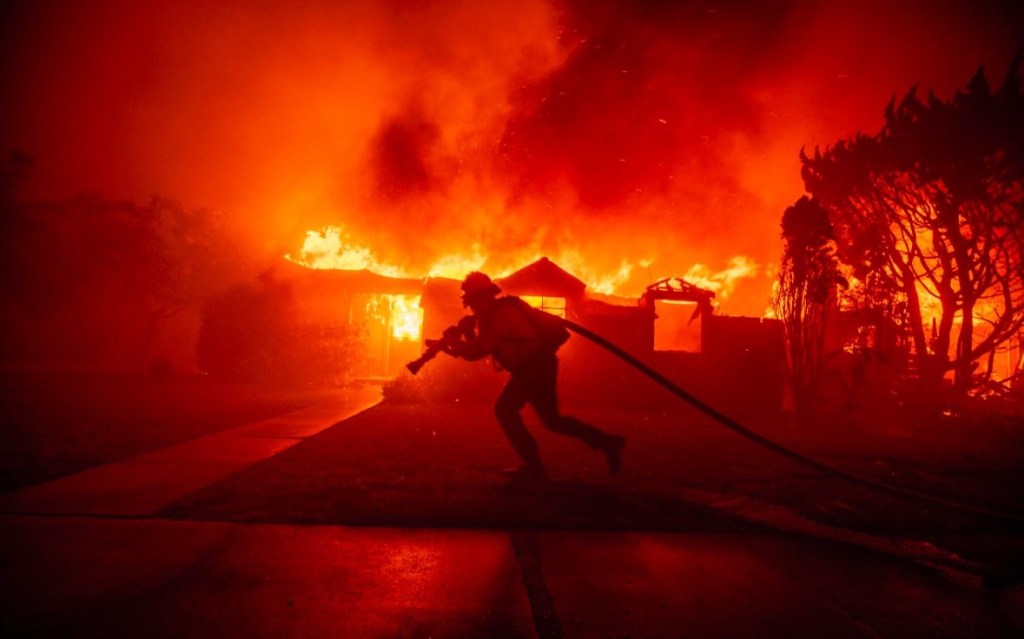
The past several days firefighters from multiple departments across different states and nations have aided the city of Los Angeles California as they battle a number of apocalyptic wildfires raging across parts of the city and the hills surrounding the city of angels.
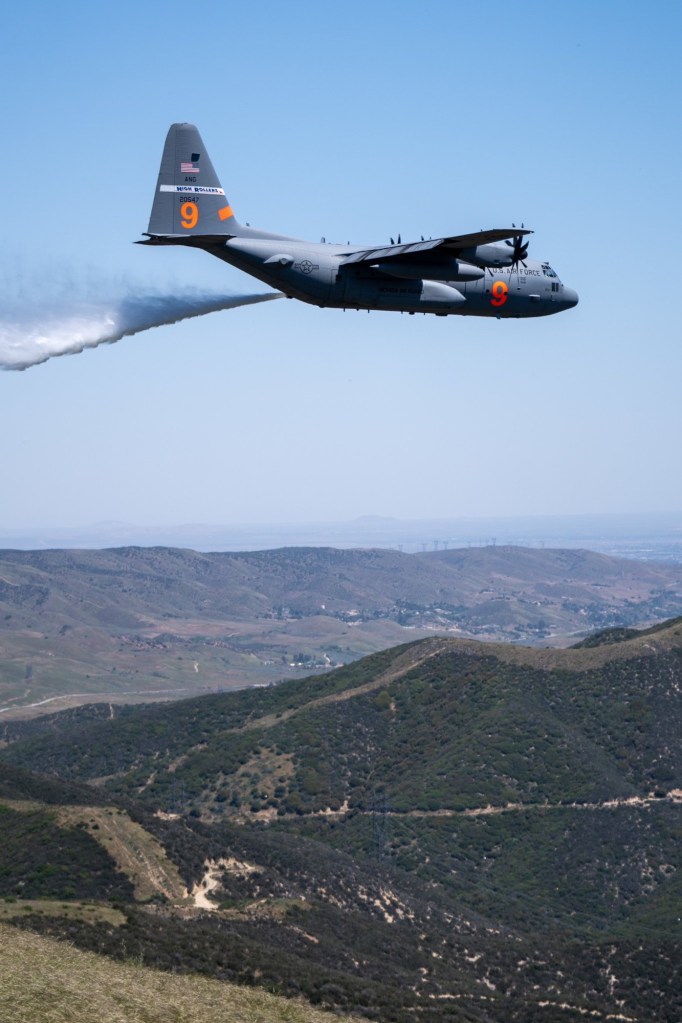
Video shows a one part of those efforts a C-130H ‘Hercules’ equipped with Modular Aerial Fire Fighting Systems (MAFFS) and used to drop fire retardant chemicals on the fires. This one is owned and operated by The Department of Forestry and Fire Protection however MAFFS equipment can also quickly be installed in other C-130s (supplied by the Department of Defense)if a situation overwhelms firefighters and extra surge aerial units are required. Which is whats happening in California. The C-130 equipped with MAGFS can water bomb almost 14 tons of fire retardant in less than 5 seconds making this a valuable asset in a situation like this where the combined fires have ate up tens of thousands of acres of land.
US military units have been arriving since yesterday to assist the exhausted fire fighting crews. US NORTHCOM specifically sent 8 C-130s to assist.
These units were sent to the Channel Islands in Southern California. March Air Reserve Base has been designated a FEMA incident support base and being used for the forward logistics of the firefighting operation.
The condition in Los Angeles is dire with crews working nonstop to contain all 4 of the major fires currently destroying parts of the city. The Palisades fire is currently estimated to be around 11% contained however it’s now moving inland towards Brentwood and other communities.
Latest reports from city officials puts the total deaths caused at 16 although that number is likely to be higher yet when all is said and done. A number of people are reported missing during all of this as they never showed up to safety after staying behind to protect their properties.
Multiple factors led to this specific outbreak of fires being as devastating as it is. Hurricane level winds that reached around 100MPH kept air crews grounded at the start of the fire which could have played a huge role in minimizing its damage. Another issue was water as firefighters could be heard calling “we got dry hydrants” on the radio last Wednesday. While improved water pressure in the Pacific Palisades region would have helped it still wouldn’t have been enough to battle a wildfire in its own, the city’s water system isn’t designed for that kind of strain all at once.
Another huge issue being talked about is funding for the fire department itself. Los Angeles is no stranger to wildfires and it’s reckless and almost criminal to defund these guys when the rate of wildfires per year is growing yearly. The lack of humidity for this time of year in the area played a huge role creating a bunch of fried up trees and overgrown but dry brush.
-Scott
Please bear with me as I learn how to operate the website. I know things are a little wonky right now but I wanted to get things running sooner rather than later. I hope you all enjoy!






 Global Conflict Reporting
You must be logged in to post a comment.