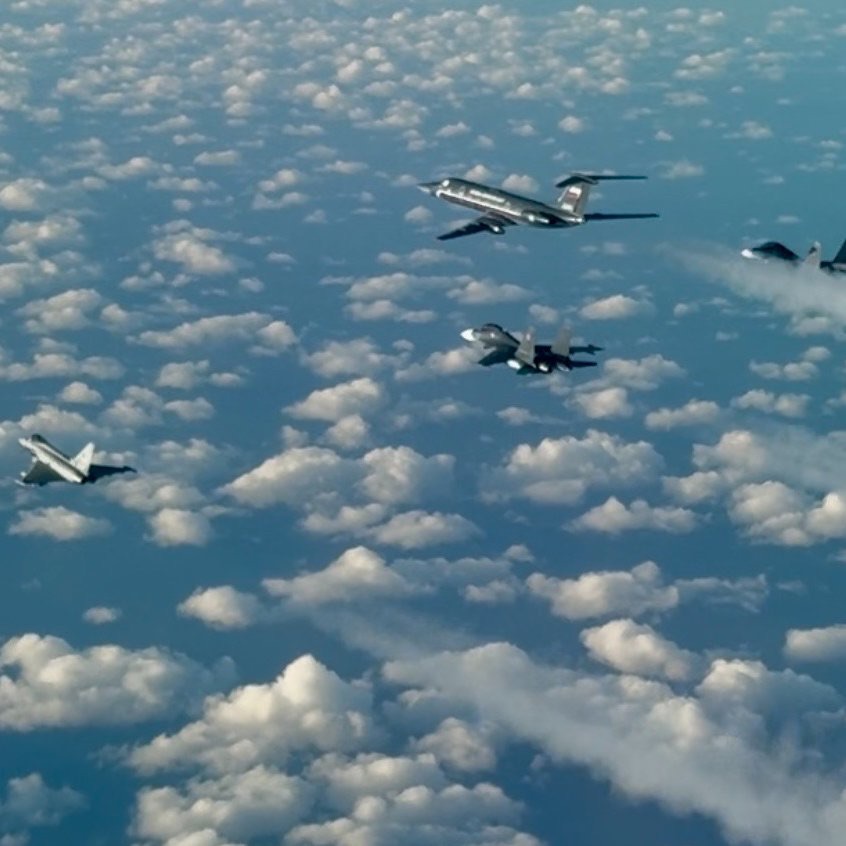
Last week, Italian Aeronautica Militare Eurofighter Typhoons intercepted a TU-134 “Black Pearl” over the Baltic Sea while taking part in their routine Baltic Air Policing (BAP). The Black Pearl is a pretty rare sight only spotted in the Baltic twice since 2020. “Black Pearl” is the name given to the plane by western military analysts, its actual NATO designation is “Crusty-B”.
The Typhoons were stationed at Ämari Air Base in Estonia. They recently replaced the Italian F-35’s that were stationed at the same base. The Italians are taking part in the multinational NATO operation Eastern Sentry.
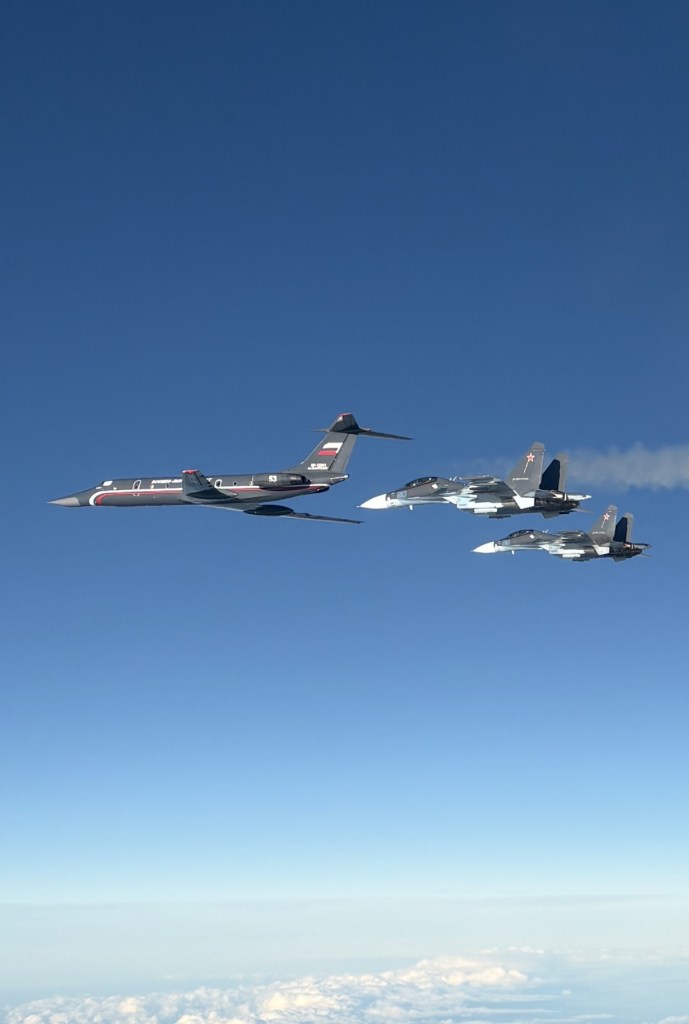
The TU-134 “Black Pearl” accompanied by two Su-30SM2 and a SU-24.
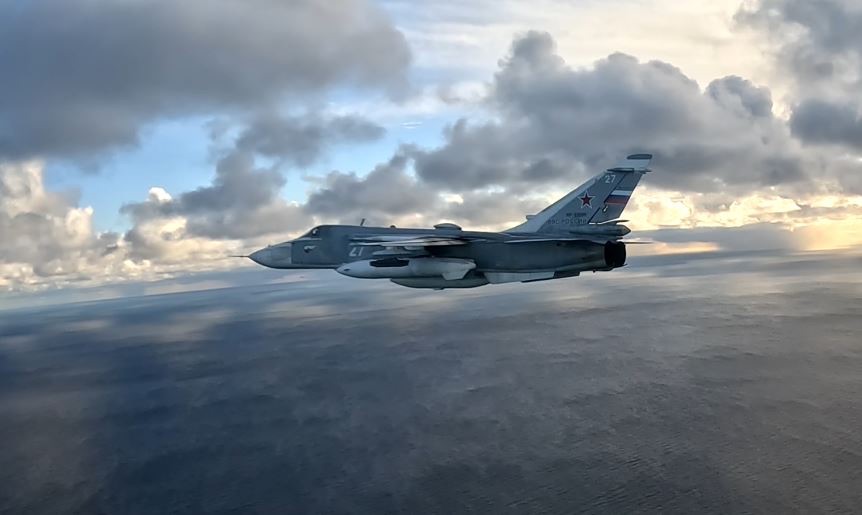
At the time of interception of “The Black Pearl”, a modified version of the civilian Tupolev TU-134, the district plane was being accompanied by two Sukhoi Su-30SM2 “Flankers” and what is believed to be a Su-24MR “Fencer”. The “Flankers” are operated by the Russian Navy, while the “Fencer” is from the Russian Air Force.
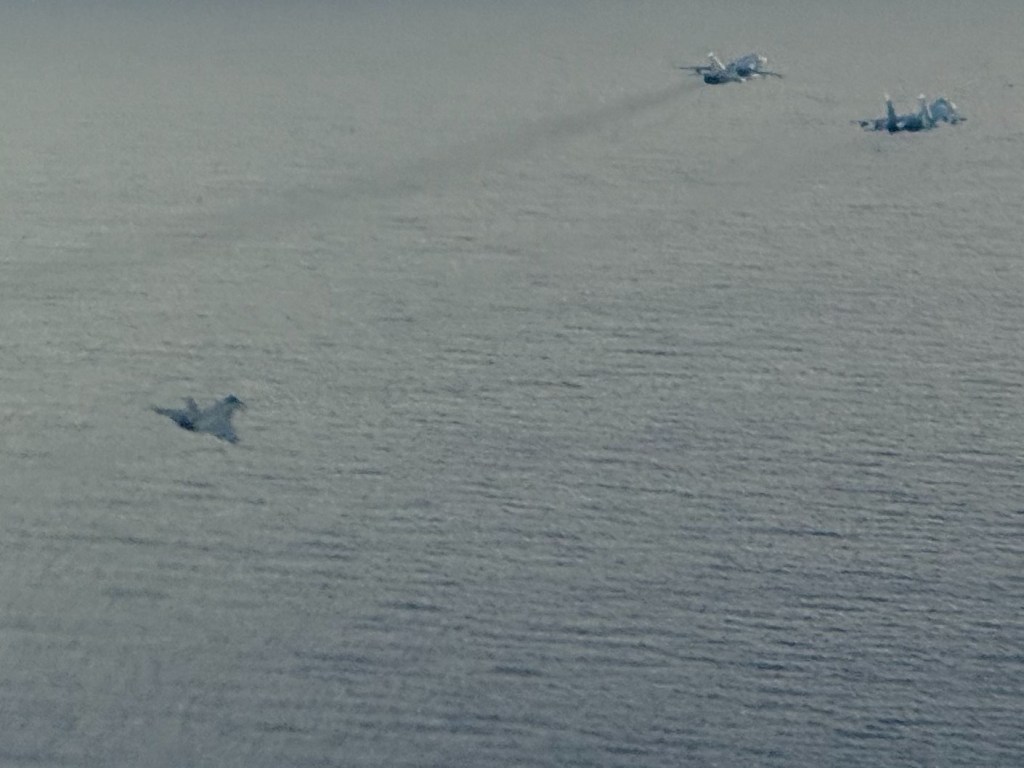
Sukhoi Su-24 Flanker. Italian Typhoon tailing the two SU-30’s.
The Black Pearl is a Tu-134UBL (now Tu-134A-4 VIP transport) that was at one time used to train pilots and navigators of Russia’s strategic bomber forces. Anything from the Tu- 160’s to the Tu-22M3 and Tu-95MS. The Russians added a very sharply pointed, bomber-like nose and a black paint job. The jet is now mostly used as a VIP transport. As it was encountered over the Baltic it’s likely it was hauling Russian VIPs to the Russian enclave in Kaliningrade.
NATO air command shared the images on November 21st, but implied that the images weren’t taken that day.
Over the last week 🇮🇹 jets deployed at Amari 🇪🇪scrambled to intercept multiple 🇷🇺 assets. NATO Air Policing in the Baltic region ensures security of @NATO airspace under Eastern Sentry#EasternSentry is enhancing flexibility and strength to NATO's posture on the eastern flank pic.twitter.com/UElLnTi7VJ
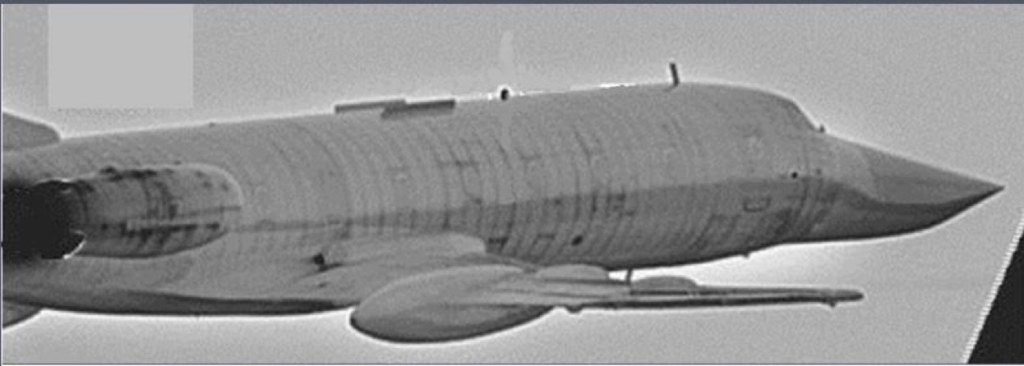
The plane was intercepted in 2020 by F-16’s from the Belgium Air Force that were also conducting a BAP. They managed to capture an inferred image of the plane from the F-16’s Sniper Advanced Targeting Pod.
IR imagery of the Black Pearl taken from the Sniper pod of a Bulgarian F-16.
The Black Pearl is an interesting variant of an aircraft that you don’t see very much anynore.
It’s believed the Black Pearl was shepherding the fighters for delivery to the 4th Guards Naval Assault Aviation Regiment of the 34th Mixed Aviation Division, assigned to Baltic Fleet Aviation and based at Chernyakhovsk Air Base in Kaliningrad, according to KEY.AERO.
Russian President Vladimir Putin has acknowledged that the Russian federation is responsible for the downing of the Azerbaijani Airlines, Flight 8243 on Christmas Day 2024.
The plane, an Embaer 190 took off from Heydar Aliyev International Airport carrying 62 passengers and 5 crew.
The flight first experienced issues about 40 minutes after takeoff when it first entered the Russian airspace around Grozny. The pilots reported losing GPS navigational systems, due to jamming. The plane continued its approach at the Kadyrov Grozny International Airport in the Chechen capital. At this time the pilots reported twice tried to land at Grozny but were ultimately diverted due to fog. 81 minutes into the flight, and while the plane was still over Grozny, passengers at this time reported an explosion and shrapnel striking the aircraft. The pilots thought they had experienced a bird strike and proceeded to initiate emergency protocols and squawked 7700, which signals to others that the flight is experiencing an emergency. They then turned back towards the Caspian Sea.
The plane made it across the Caspian and back to Azerbaijan but the pilots were not able to maintain control of the aircraft while trying to put it down in Baku. Video from the ground showed the plane changing altitude at a very quick rate as the plane pitched up and down as the pilots fought to bring the plane down with increasingly unresponsive controls.
Video from the crash of Azerbaijani Airlines Flight 8243.
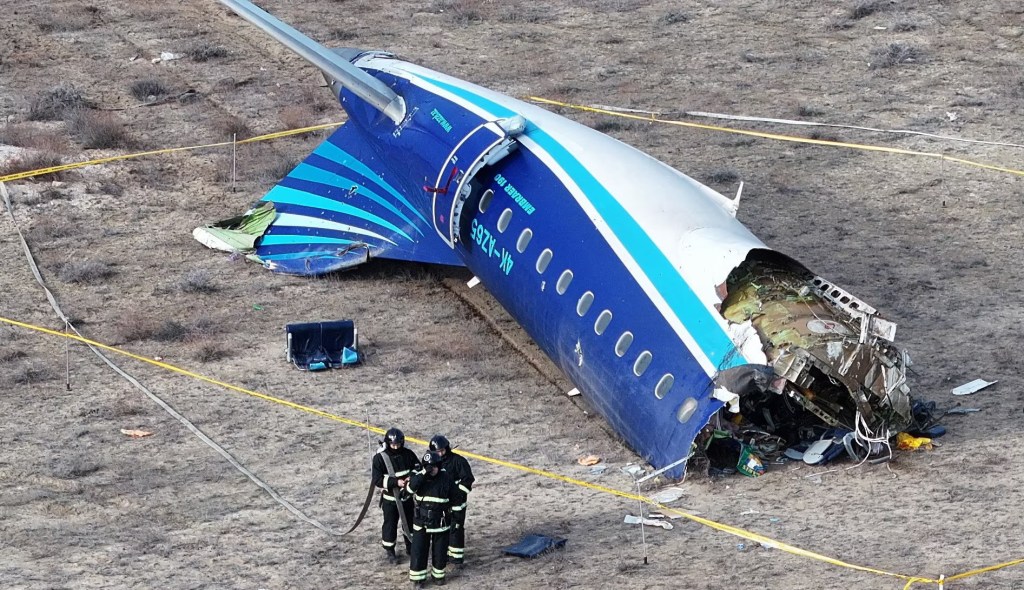
The plane ultimately crashed, bursting into a large fireball and split in half. Of the 67 people on board, 38 were killed. Almost immediately after the crash there were questions. What actually happened to flight 8243?
Photos from the crash showed damage not consistent with a bird strike. Damage to the tail looked more like the damage from the explosion of an air defense missile. In fact, several passengers had been injured from shrapnel from the explosion.
An image from the crash. The tail of the plane shows shrapnel damage.
Russia right away denied that this had happened. Several days later The New York Times put out a report which stated that Azerbaijani investigators believed that a Russian Pantsir S-1 had actually shot the plane. On February 4th, investigators found fragments from a Pantsir S-1 missile inside the airplane’s fuselage.
At the time the plane was attempting to land the city was under warning as Ukrainian drones had been spotted in the area and shot down.
On December 28th Russian President Vladimir Putin apologized to the Azerbaijani President Ilham Aliyev for the “tragic incident” although he didn’t elaborate further on the incident.
Today the Russian president, speaking with the Azerbaijani leader Ilham Aliyev, admitted to him that Russian air defense was responsible for the crash and that two Russian air defense missiles had exploded near the plane.
The Russian President very rarely admits to mistakes by his military. More than a decade after a Malaysian flight was brought down over Ukraine by Russian defense systems, Putin still denies Russian involvement.
The previous denial of the Russian involvement in the Azerbaijani airlines flight has caused some tension between Russian and Azerbaijan causing Aliyev to become increasingly critical of Moscow, even offering support to Ukraine and condemning what he called the “soviet occupation” of Azerbaijan. Some in the country were even calling for the relationship between Russia and Azerbaijan to be cut. It’s likely this admission of guilt by the Russian leadership is more about saving the relationship with an increasingly strong ally.
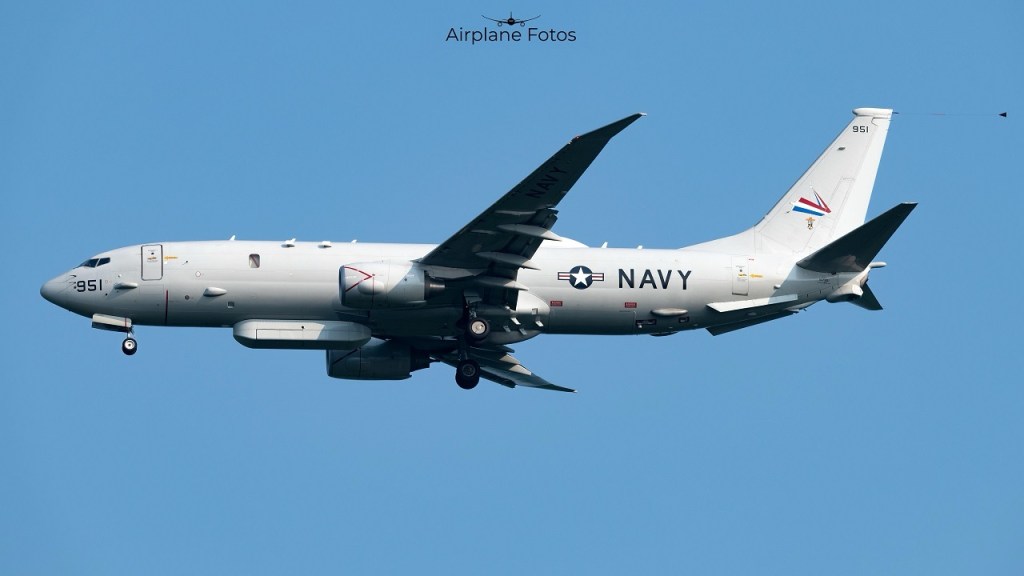
The U.S. Navy Boeing P-8 Poseidon has been in service with the United States Navy since 2012 when it replaced the fleets aging and legendary P-3 Orions. The P-8 is a heavily modified version of a Boeing 737-800 passenger airliner. Swapping out the passengers and the passenger comforts with the equipment needed to preform the arduous and often overlooked task of Maritime Patrol and Anti- Submarine Warfare (ASW).
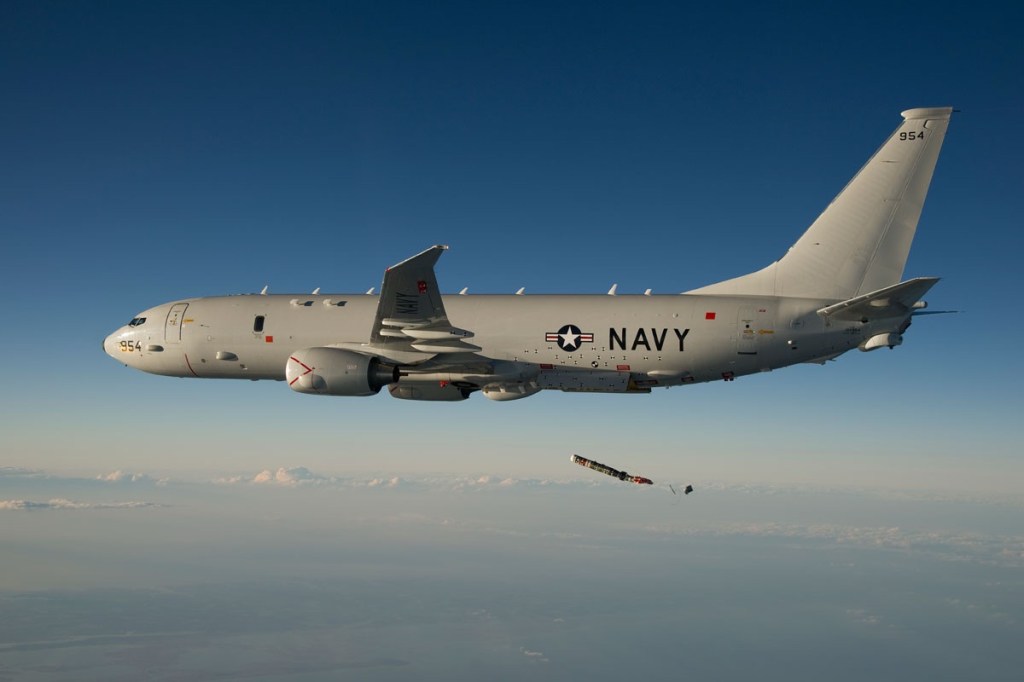
United States Navy P-8A Poseidon dropping one of its Mark 54 torpedo.
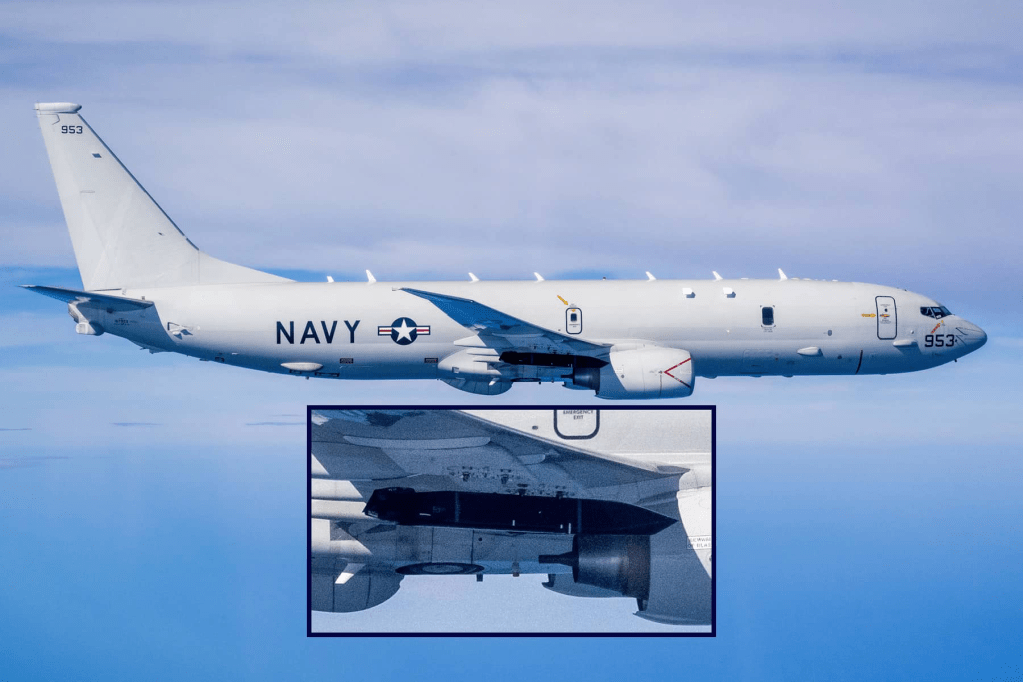
Featuring advanced sensors for tracking surface ships and submarines, including air-dropped sonar bouys and its AN/APY-10 surface search radar. In addition to detection and tracking systems, the P-8 can carry several weapons. Mostly the MK-54 airdropped torpedoes for ASW work but also the AGM-84 Harpoon Anti-Ship missile. That was until the navy released the photo below showing something new. But back to that in a minute.
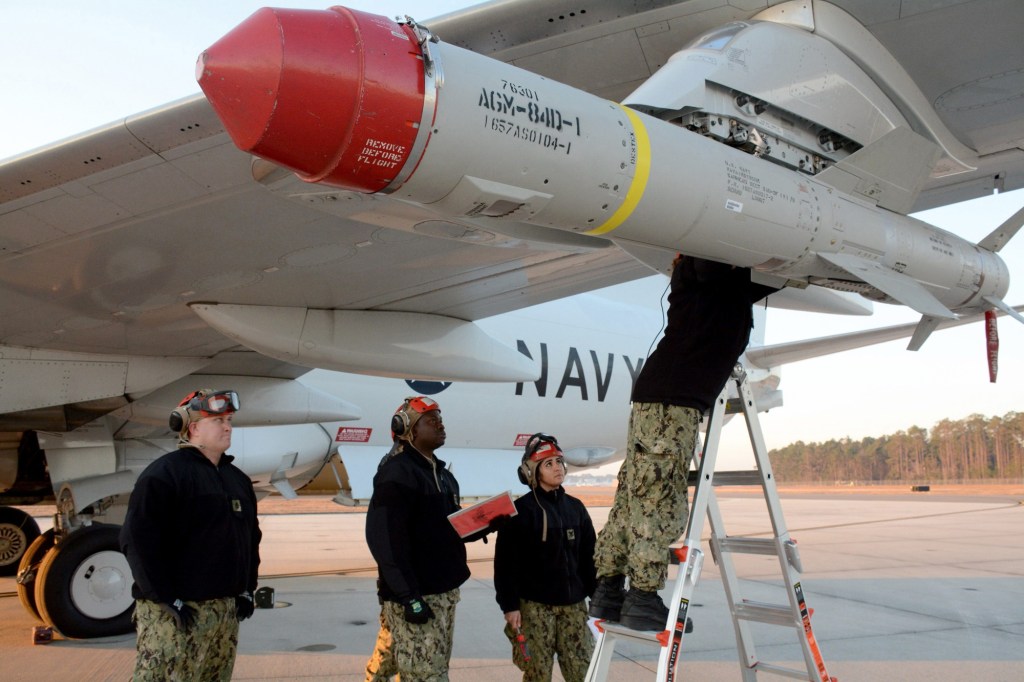
U.S. navy P-8 Poseidon shown with the AGM-158 LRASM. United States Navy P-8A Poseidon with a AGM-84D-1 Harpoon missile. The 84D-1 is an upgraded an extended range version of the Harpoon.
While the Harpoon’s almost 5 decades of service and extensive use in combat shows it is still a very capable weapon, it is outmatched in range by the air defense systems of some of the U.S. adversaries, especially the older models which are mostly if not all being phased out in favor of the II and II +.
The original Harpoon Block 1 missile has a range of around 80-100 miles.
The Block II has less range improvements at around 81 miles but was made me for combat around littoral waters so not as much range was needed.
Block II+ER, the newest generation of the Harpoon in use has a range of around 190-200 miles.
The Block II and Block II+ER have advanced capabilities added in like improved GPS guidance, and protection from Electronic interference. It’s possible that the Harpoon will still be used in some cases where the range and stealth of the LRASM isn’t needed.
While the harpoon isnt the United States only anti-ship missile it is the one that was specifically designed for that role. Some other choices include the AGM-84H/K SLAM ER which is kind of a sibling offshoot of the Harpoon and is an air launched land attack missile that can be used to target maritime targets. It has a range of 170 miles.
Enter the Lockheed Martin’s AGM-158C LRASM.
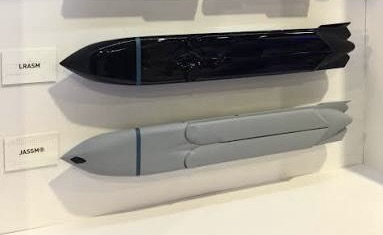
A display showing a LRASM and a JASSM
The AGM-158C is a derivative of the AGM-158B JASSM ER (Joint Air-To-Surface Standoff Missile Extended Range), a low detection air launched cruise missile designed by Lockheed Martin. The JASSM first entered combat striking Syrian government alleged chemical weapons targets in 2018 and more recently striking targets in Yemen.
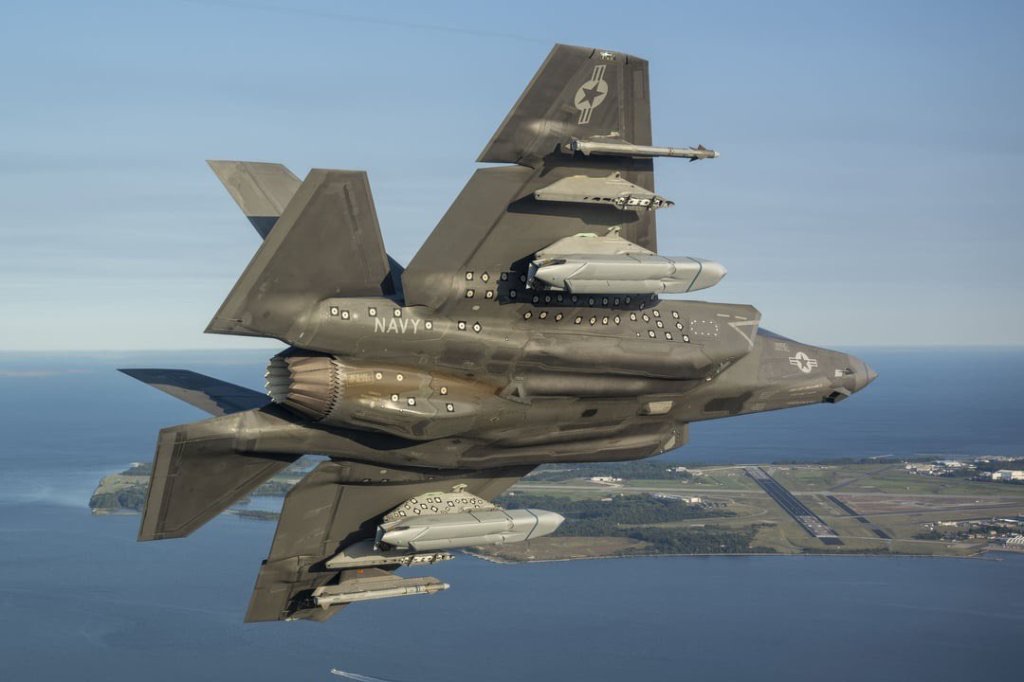
The AGM-158C LRASM is a stealth launched anti-ship cruise missile. This integration has been planned for several years now and is giving the P-8 an effective surface weapon that better keeps the aircraft and crew out of harms way. The LRASM can also be used on the B-1 Bomber, the Navy F/A-18’s, and on any non internal pylons on the F-35.
F-35 test flight with the LRASM. Note, Neither LRASM Or JASSM can be carried internally by the F-35, it has to go on an outside pylon, which takes away some of the stealth of the jet. The Rockwell B-1 Lancer carries out an integrated test with the LRASM. Capable of carrying 24 internally, an announced pylon could add 6 more externally.
The LRASM has an incredibly advanced targeting and navigations suite and even more so for planned upgrades for this missile. The range of the LRASM depends on the block number. These numbers are also mostly estimates and going off of what public data is available, which is limited. The C-1 variant is listed as having a range of greater than around 200 nautical miles, the C-2 is said to be in the +500 miles range and the new C-3 they are working on is rumored to be in the 1000 mile range but is still in development. The C-3 of the future is supposed to be being developed with Artificial Intelligence integration which will allow data links between the missiles and allow them, according to John Keller from Military Aerospace Electronic, `advanced autonomous mission planning, target discrimination, and attack coordination, adjust flight paths based on real-time data, identify and track moving targets, and adapt to changing conditions like jamming and interference.
Adding this capability to the P-8 allows them to not only detect the enemy but to also engage them with the safety that range gives you.


 Global Conflict Reporting
You must be logged in to post a comment.