On the 25th of December 2025 US forces launched a wave of strikes on ISIS-West Africa (ISIS-WA) targets in Sokoto State in Northwestern Nigeria. The White House cited attacks on members of the African country’s Christian population as the reason for the strikes.
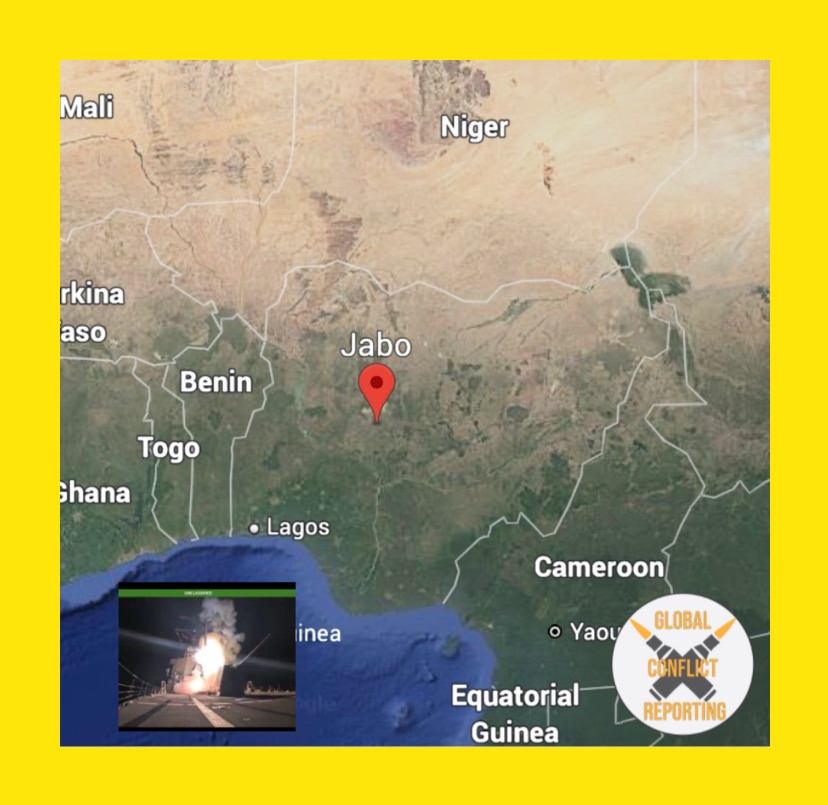
The attacks were carried with reportedly more than a dozen BGM-109 Tomahawk Land Attack Cruise Missiles (TLAM) launched from the Arleigh Burke-class guided-missile destroyer, USS Paul Ignatius (DDG-117), which its believed the ship was in the Gulf of Guinea at the time. Video was released by AFRICOM on Christmas Day showing the launch of a single TLAM.
Locals reported explosions in the small town of Jabo about 10 miles from the state’s capital.
The attack was carried out with the support of the Nigerian government who in a statement mentioned exchanging intelligence with the U.S.
While the White House says the strikes are because ISIS-WA are targeting and killing Christians, we lack a specific recent incident that shows this group is specificly killing based on religion. ISIS-WA often targets government and civil defense forces as well as their rival in the region Boko Haram. Religion isn’t usually a factor or at least not the main factor as ISIS-WA, more often than not, kills Muslim and other religions as well as Christians. All that being said Nigeria has had a rash of kidnappings lately and in one instance gunmen abducted hundreds of schoolchildren from a Catholic school woth the aim to get ransom money
These strikes signal an increased interest in the country by the U.S. who have largely withdrawn from Africa during this administration. Earlier this year US president Donald Trump declared Nigeria a “country of concern” which could be a precursor to stronger involvement by the U.S. like sanctions.
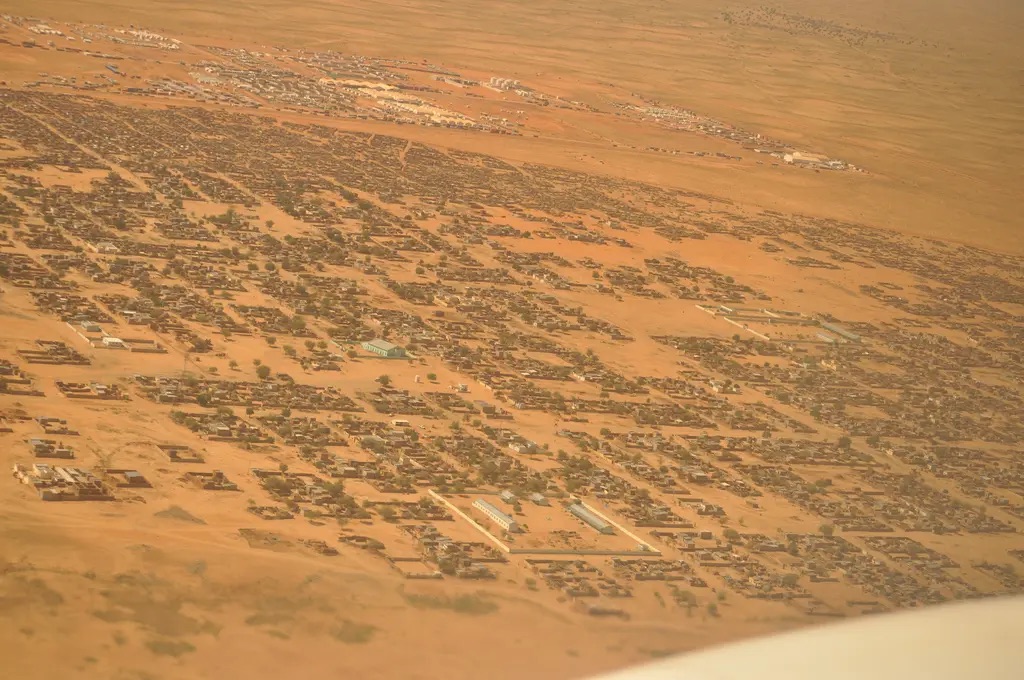
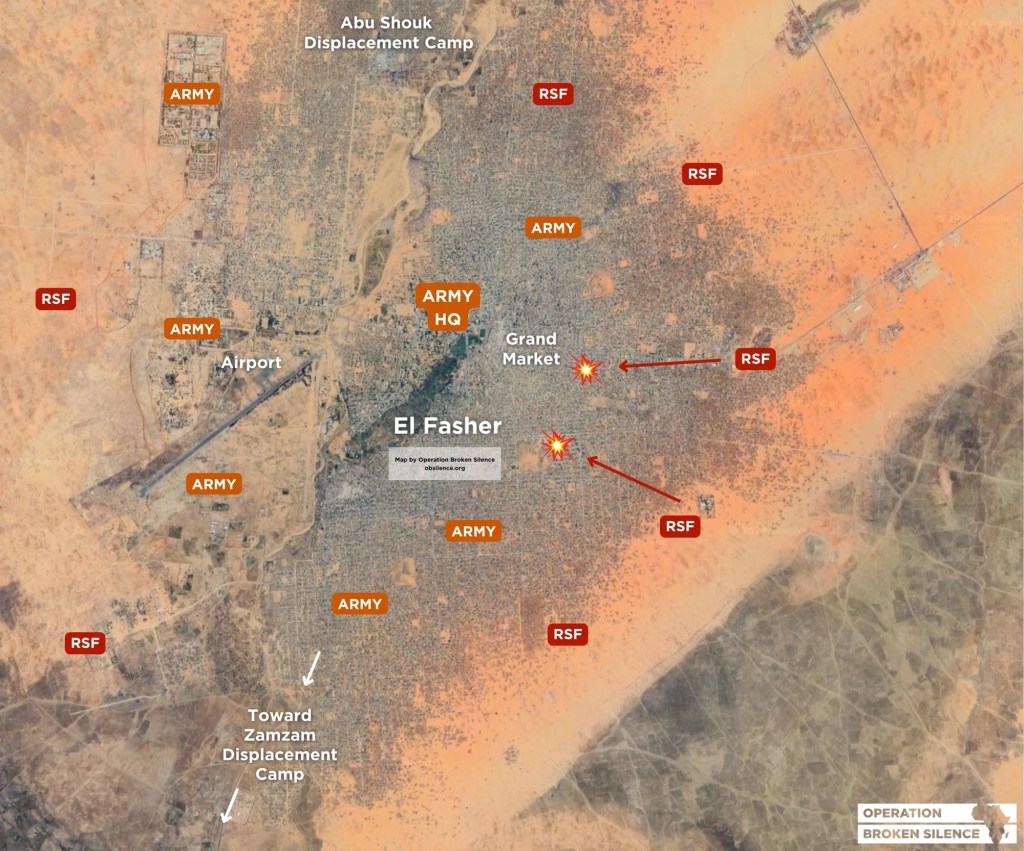
The city of El-Fashar is in the Darfur province in the western region of Sudan. For the past eighteen months the city has been under a constant siege by members of the Rapid Support Force, or RSF.
The people of Sudan, for the last two years have found themselves trapped between a rock and a hard place. Since April in 2023 two rival factions of the Sudanese military have fought a bloody war for control of the country. Sudan is one of the most bloodied countries in the modern day with millions dead over the course of 20 something military coups and at least 3 civil wars since the 1950’s.
This article looks at the background of that war, some of the players, and recent events.
Background
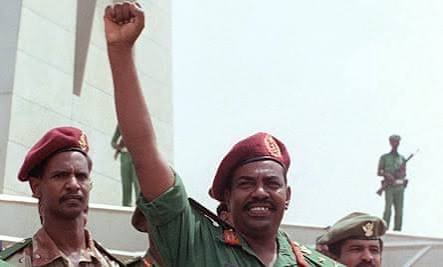
Omar al-Bashir who ruled as president of Sudan before being overthrown by two of his Generals.
Tensions arose in 2019 between the Sudanese Armed Forces (SAF) led by the country’s current de facto leader General Abdel Fattah Al-Burhan, and Mohamed Hamdan Dagalo, better known as his Hemedti, the leader of the RSF, couldn’t agree on who should lead the country after they came together to overthrow the President, Omar al-Bashir, who came to power in a coup in 1989.
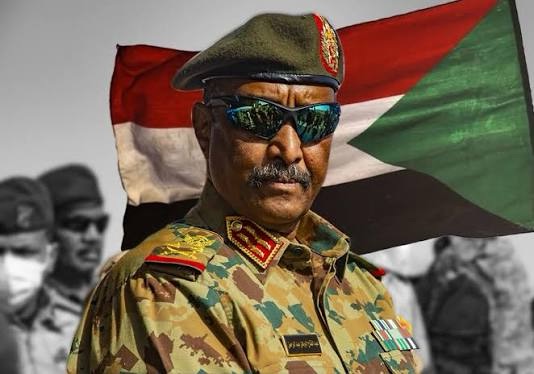
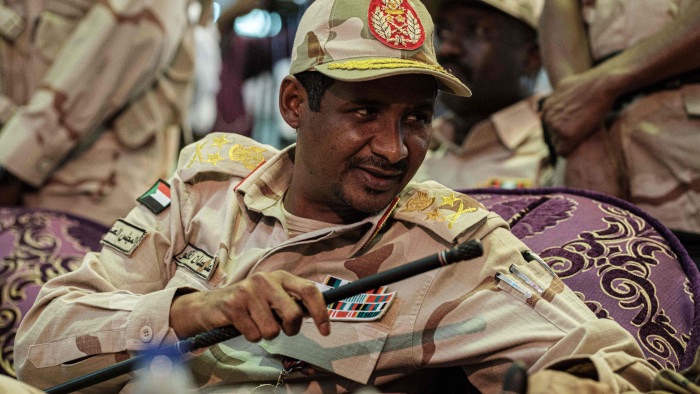
General Abdel Fattah Al-Burhan, De facto leader of Sudan and leader of the SAF. Mohamed Hamdan Dagalo, better known as his Hemedti, the leader of the RSF.
After the overthrow of Bashir the people called for more democracy. They have been through military rule before and weren’t thrilled with the idea of doing it again so an agreement was made to establish a joint civilian/military government. It was short-lived and overthrown in 2021 by General Abdel Fattah Al-Burhan and Hemedti. At the time Al-Burhan was the leader of the country and Hemedti was Al-Burhan’s deputy. This is when the disagreements between the two men started with the tipping point being the attempt to fold the 100,000 man strong Rapid Support Force into the Sudanese army and who would lead that army.
There is some dispute to what side shot first, but the shooting started in April lf 2023 when RSF forces were being redeployed to various different locations around the country. The SAF saw this movement as a threat and from there thr battle for control of the capital city Sudan, Khartoum began. The RSF quickly took most of the city and was only just in March of 2025 pushed back out.
The Siege of El-Fashar.
The siege of El-Fashar (also called Al-Fasair) started 18 months ago in may of 2024. From the very start RSF forces halted the flow of humanitarian aid trucks from reaching the city causing mass starvation and an overall worsening condition for those inside the city. The city is important to the SAF as it is their last remaining stronghold in the Darfur region.
During the siege the RSF would regularly shell the city with artillery, causing widespread destruction and deaths. In the first month of the siege the Médecine Sans Frontières (Doctors without Borders) reported widespread injury and death, over 140 had been injured and brought to their facilities in El-Fashir with the majority of the number being civilians. By April 21st they reported 44 killed and 279 wounded. The conditions in the city led to widespread looting, including the hospital. The destruction of the Abu Shouk refugee camp, home to over 100,000 displaced people was burnt to the ground in late April.
A brief ceasefire was held in late April and held until May 12th. During the ceasefire SAF and RSF held positions to the East and West of the city, respectively. During this time civilian life almost returned to normal. One of three markets opened back up – even though by this time the banks had closed and inflation was a major problem in the city. At this time the prisoners in the cities prisons were released due to a lack of food and water.
It seems at this point gangs of roving gunmen formed in an attempt to secure food and supplies for their own, began to roam the street. These men seemed to have no loyalty to either RSF or SAF. Apart from this , general banditry ran rampant in the city. By June 2023 most of the city had no water.
The siege went through various phases of ceasefire and open conflict. The city would be shelled and whitenesses endless gun battles in and around the city. Towards the later stages of the fighting in 2025 a berm was constructed around the city- presumedly by the RSF, to be used to keep people from fleeing(Noticed by researchers from Yale.
Jumping to 2025 larger battles were taking place around the city, and thousands of civilians had been killed. Both the SAF and RSF were taking hundreds of casualties in some of the larger battles. It was in 2025 when the RSF started launching drone attacks against SAF in the city. They had also continued to block aid shipments to the city in a major blockade that the Sudanese army just couldn’t break.
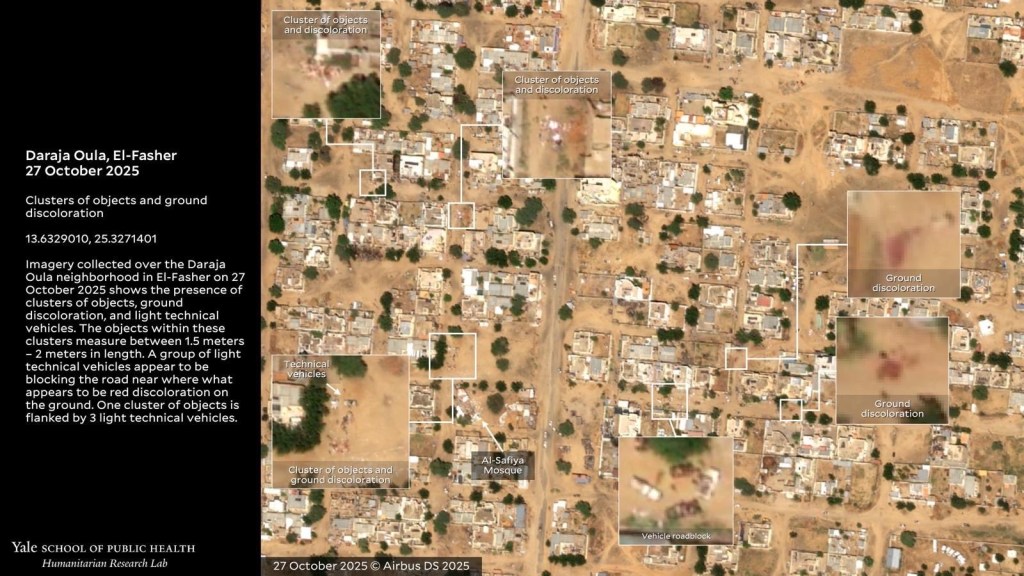
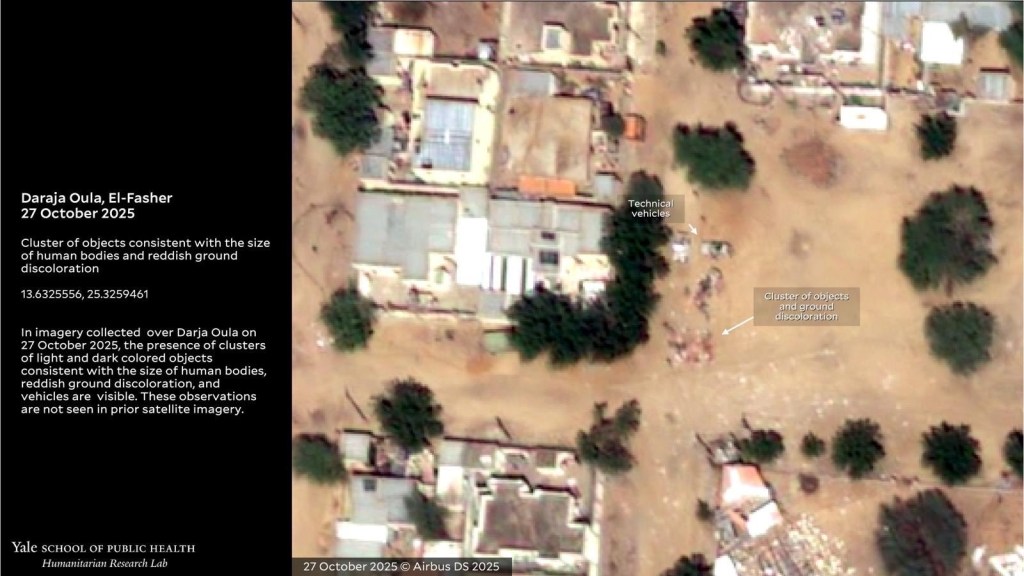
Bodies left where they fell.
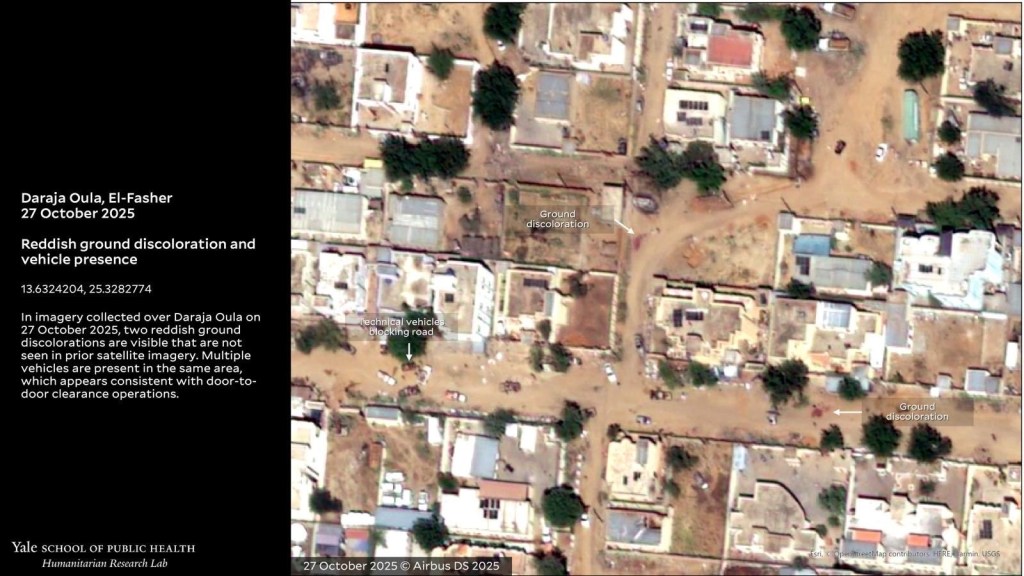
Images released by the Yale School of Public Health showing evidence of widespread killings. Comparing images after the fall of the city with images from before.
In the end the RAF forced the Sudanese army almost all the way out of the city and people in mass attempted to flee. The SAF began arresting people for running but eventually started moving their forces out of the city. As the RSF moved in they began rounding up civilians who remained and those attempting to flee. Those prisoners were interrogated and executed. Videos show dozens if not hundreds of executions took place,carried out in large part by a man whose name is believed to be Abu Lulu which is verified by BBC verify. Videos have surfaced on 10.31.2025 of that man being arrested by the RSF and thrown into prison.
Side by side photo shows a known photo of Abu Lulu beside the man seen on many of the videos of people being killed.
These videos show men casually shooting men and women as they run away or as they are sitting on the ground after being captured. At one point Abu tells a group to run only as he guns them down after they run for a moment.
Satellite images which were studied and released by the Yale School for Public Health show the city and imply that the RSF went house to house interrogating and killing civilians. Red blotches can be seen in the sand which seem to indicate large pools of blood had been spilled there, some clusters of objects are believed to show where the bodies have been left on the ground, in the groups they were killed with.
Mass ethnic cleansing is taking place in El-Fasher, Darfur. There is every kind of evidence videos, photos, and other visual proof. For example, RSF militiamen are seen chasing and shooting at people. In the video, the phrase “Kill the Nuba” is clearly heard. It is being used as… pic.twitter.com/Egx4IHVfgS
The RSF was formed in 2013 by presidential decree by Omar al-Bashir which mobilized Arab herders to fight against black African insurgents in Darfur who were rebelling against al-Bashir’s leadership. They formed from the “Janjaweed” militia who were already active and militarized. The decree mostly just gave them better weapons and a more unified leadership.
The Janjaweed were made up of mainly the camel-herding nomads from the Mahamid and Mahariya branches of the Rizeigat ethnic group that ranged around northern Darfur and adjoining areas of Chad. This group has been active in the area long before the borders in the area were drawn. Their most infamous leader during the 2003-2005 Darfur war and massacres was Musa Hilal, chief of the Mahamid.
These tribesmen and fighters proved their worth to the President who further formalized their service calling them Border Intelligence Units.
Among these fighters in southern Drafur was one who proved effective time and time again. Mohamed Dagalo, known as “Hemedti” because of his baby-faced looks – Hemedti being a mother’s term for “Little Mohamed”. The name has stuck ever since. He first served in the Sudanese army but left at some point. He joined the Janjaweed and rose through the ranks to become a commander.
In 2007 a critical event happened in Hemedti’s career. He and his soldiers under his command rebelled from President Al-Bashir’s. He and his men felt they had been exploited by being sent to fight on the frontlines and being accused of some atrocities and then left with no support. When Hemedti and his soldiers left they vowed to fight Khartoum “until judgement day”, and tried to cut a deal with the Darfur rebels.
This ended when Hemedti was offered a sweet deal. Back pay for his troops and ranks for his officers and even a promotion himself-to brigadier general. This promotion angered a lot of officers who went to staff college and felt he had done little to earn the title. He and his men accepted this and were folded back into the military of Sudan being put under a branch called the National Intelligence and Security Service (NISS), who were at the time planning a proxy war with the bordering country Chad.
It’s at this time it’s reported that Hemedti had a falling out with the chief mentioned earlier, Musa Hilal. The Generals of Sudan felt Hilal was untrustworthy for his multiple mutinies. Al-Bashir’s generals wanted to deal with Hemedti. It was then in 2013 that the RFS was founded with Hemedti at the head. At the time Bashir thought of Hemedti as a friend and even had a nickname for him- “Himayti”, meaning “My Protector”. This nickname lasted until about the time gold was discovered in Darfur and Brigade General Hemedti decided he wanted to be one of the richest men in Sudan.
Today the RSF is almost a whole different entity, funded heavily by outside state actors. They have received a lot of support from the UAE and Russia (through the Wagner group). The U.N. confirmed reports from sources in Sudan saying that the RSF was receiving weapons and ammo weapons shipments from the UAE several times a week. The UAE has aggressively sought to stop the expansion of Islamic influence across the Middle East. Hemedti has presented himself as a shield against the Islamist-leaning factions that established deep roots in the army and other institutions under Bashir.
On the other hand General Burhan’s closest ally has been Egypt. The two countries share a border and both are currently led by military commanders who overthrew “democracy” elected leaders. The Sudanese government forces have also received support from Iran, using their drones in several major engagements.
Analysis
Sudan is a country where the civil war permeates much of the daily life of many of the country’s inhabitants. Refugees leave ome war torn area only to get caught in the next one.It would be a feat to even count the sheer amount of human rights violations taking place daily. The immense suffering, carried out on the Durfar population by the RSF is not helping them beat the allegations of an attempted genocide. 12 million people have been displaced ans more than half of the country is in need of humanitarian aid.
The country’s economy has collapsed causing widespread shortages of goods and increase in prices on goods that can be provided. Poverty in the country is closing in on 60%.
The complex relationship of all the players involved makes mediation of any kind difficult. Foreign powers being involved has only intensified and stretched out the length of the conflict, again, worsening the humanitarian issues. So far an estimated 150,000 have been killed since the conflict began in 2023.
Violence has broken out across urban areas of the Central African country of Cameroon after a constitutional court decision giving president Paul Biya another 7 years term.The country’s opposition parties claim the election was rigged citing high numbers of people who voted in a region where armed separatist conflict is currently ongoing.
This election will see Paul Biya, who first won the presidency in 1982, saying in office till 2032. Biya will be nearing 100 at that time. He is the oldest world leader currently serving anywhere. This is his 8th consecutive term as President of the country of 30 million people.
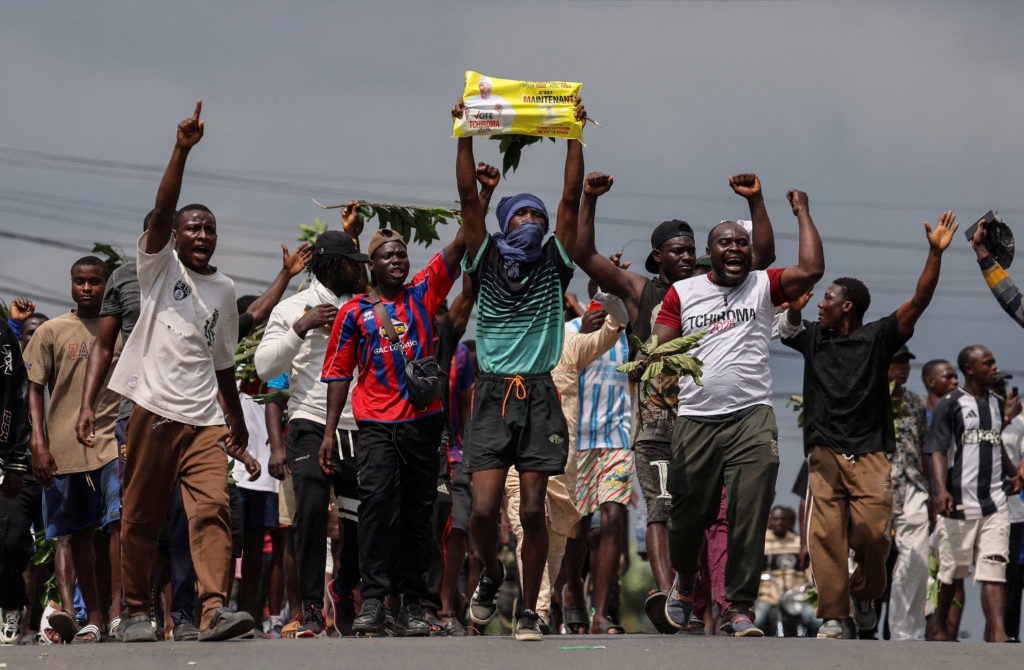
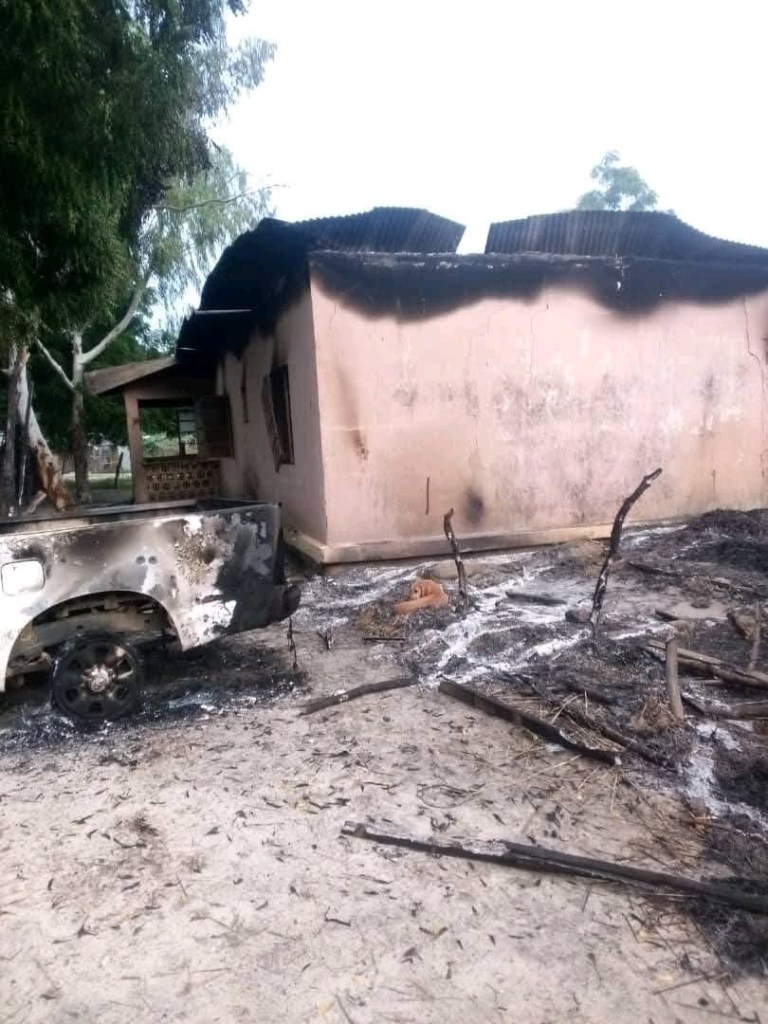
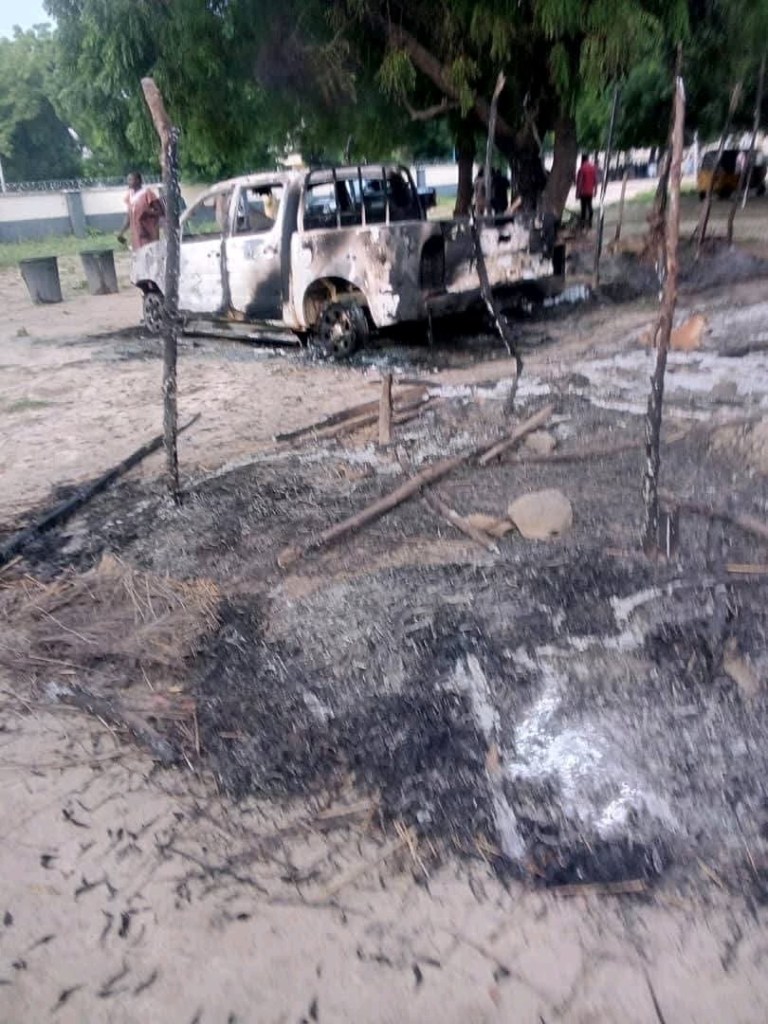
The results of the election and the vote of the constitutional court has sparked a number of large uprisings and protests which the government has responded to with force. Opposition supporters have defied a countrywide ban on protesting and have taken to the streets, lighting police cars on fire, burning car tires in the street and barricading roads. Before the results from the constitutional court were annonced a number of supporters had come out for opposition leader,Issa Tchiroma Bakary the leader of the Front for the National Salvation of Cameroon party, those supporters were dispersed with police water cannons and tear gas.
Tchiroma claims he won the election with 55% of the vote which is not the official number which sits at 35.19%. Biya on the other hand ,officially, according to the constitutional court has 35.19%.
Tchiroma is the candidate put forward by the political coalition “union for change” a group that brought together dozens of political parties and civil groups in an effort to oust Biya from power. Tchiroma has been a politician in the country for a long time and served as the government spokesperson during the years of fighting with Boko Haram. Considered by some to be a member of the “old guard”, he has promised change to come to Cameroon.
One candidate, Tomaïno Ndam Njoya who came out fifth in the election, said that the outcome of the election didn’t fairly represent the “sovereign will” of the country or its people.
“They reflect a weakened electoral system, undermined by irregularities, manipulation and repeated violations of the law,”Tomaïno Ndam Njoya
The governor of the Wouri River Estuary, Samuel Dieudonne Ivaha Diboua, told the AFP news agency that protesters had attacked and burned police stations in several districts across the city of Douala, the economic capital of Cameroon.
As of yesterday four people had already been killed with dozens wounded. Videos being released online show riot police opening up with what seems to be live ammunition.
(Video wouldn’t let me embed so here is the link.)
The United Nations Secretary-General echoed concerns shared by the European Union regarding violence against the population. Both urge restraint and to not let hate speech and violence take over. Some human rights groups, like Amnesty International have launched investigations into the civilian deaths and “excessive use of force” against protesters.
Last night, the Jihadist group, Boko Haram killed more than 70 people in an overnight attack in the village of Darul Jamal on the border of Nigeria and Cameroon in the Borno State.
Dozens of armed men arrived on motorcycles around 8:30pm on Friday night and started firing indiscriminately. Residents say the gunmen went house to house killing the men and leaving the women behind.
The leader of the village, who asked to remain anonymous told Reuters “They went house to house, killing men and leaving women behind. Almost every household is affected,”
He said that they have recovered 70 bodies on Saturday morning but thag more were still missing .
Malam Bukar fled with his wife and three kids, he said “They came shouting, shooting everyone in sight.”
The governor of the Borno state, Babagana Zulum, visited the village on Saturday, the day after the attack and spoke to AFP news agency.
“It’s very sad, this community was resettled some months ago and they went about their normal business,”
He also said
“The numerical strength of the Nigerian army is not enough to contain the situation,”
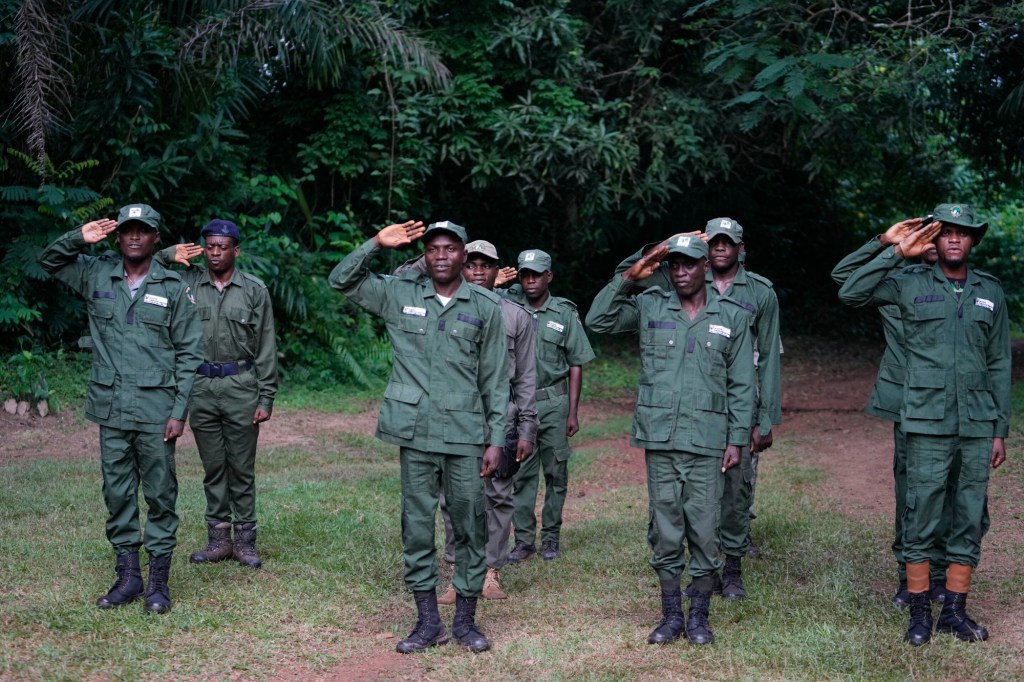
Zulum added that a newly established force called the Forest Guards was set to bolster security personnel in the embattled region.
Images of Nigerian Forest Guard. Each region is expect to recruit anywhere from 2,000-5,000 to help deal with ongoing security concerns. They will fight poachers and hopefully help deal with the threat of terrorist.
This attack comes as Islamic Jihadist have been making a resurgence in the area with Boko Haram and their rivals, the west African branch of the Islamic State (ISWAP) both stepping up attacks.
“Western education is forbidden” a quick history of Boko Haram.
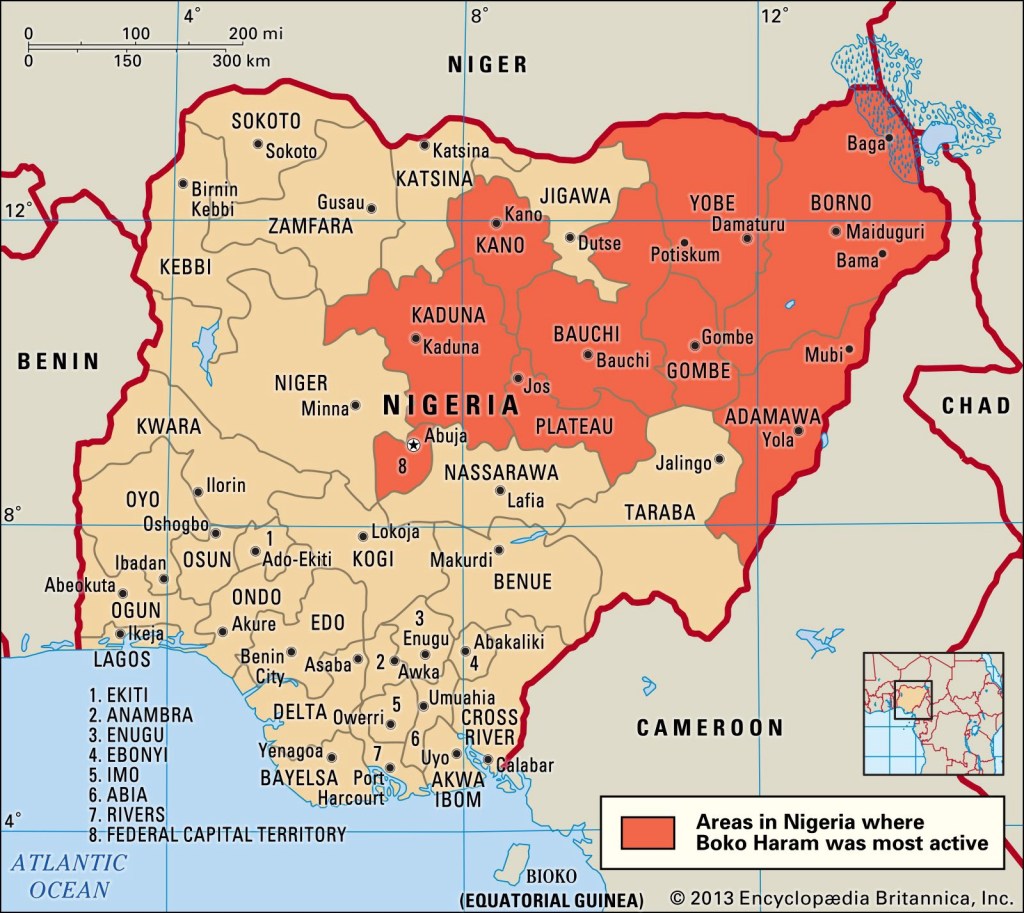
Map showing the area of activity from Boko Haram.
Boko Haram has existed in Nigeria, in one form or another since the early 90’s. The group calls itself Jama‘atu Ahl as-Sunnah li-Da‘awati wal-Jihad” (JASDJ; Group of the Sunni People for the Calling and Jihad) and “Nigerian Taliban”.
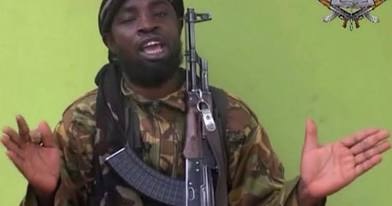
The group looks to overthrow the current goverment in Nigeria and replace it with a regime based on Islamic law. Boko Haram stands for “Western education is forbidden”. Boko being a holdover word for book from the time of English colonialism. In 2009 thr group suffered a major setback when clashes with Nigerian security forces left hundred of their members dead. They have been rebuilding ever since and have become much more dangerous under the leadership of their former second-in-command, Abubakar Shekau who claimed leadership of the group in 2010. Since that time the group has displayed more effective operational terror capabilities, utilizing improvised explosive device (IED), vehicle-borne IED (VBIED), and female suicide attacks against a wide range of targets. In 2011 the group bombed the UN headquarters in Abuja killing over 20.
Abubakar Shekau
In 2014 Boko Haram was carrying out near daily attacks against Christian people or Nigerian goverment forces, schools, the media, politicians and even other Muslims they viewed as collaborators.
Hundreds of thousands are currently fleeing the city of Goma and the surrounding area as M23 militia have reportedly commenced a large-scale assault on the area. The United Nations has said that M23 control the airport but that some pro-government militia and the Congolese army are still holding out.
Rwanda backed M23 Rebels take over a UN post in Goma.
Learning the past to better understand the present.
M23 or the March 23rd Movement and also known as the Congolese Revolutionary Army, is a Congolese majority Tutsi rebel army backed by Rwanda. They mainly operate out of North Kivu province which borders Rwanda and Uganda in the eastern Democratic Republic of the Congo. A United Nations report in 2013 found that M23 was essentially created and led by the Rwandan government, headed by President and former revolutionary leader Paul Kagame since after the 1994 Rwandan Genocide.
To understand this current conflict we have to go all the way back to the genocide which was kicked off in ‘94 when the plane carrying President Juvénal Habyarimana, an ethnic Hutu, was mysteriously shot down on its approach to the capital, of which the plane was Kigali. This sparked the 100 day murder spree that became known as the Rwandan genocide. An estimated 800,000 people, mostly of the Tutsi minority, were killed in that time frame by the instigation of Hutu extremists. At the end of the hundred days Kagame’s army had control of the country, and hundreds of thousands of Hutu extremists as well as normal people fled to the neighboring country of the Democratic Republic of the Congo (called Zaire until it was changed during the first Congo war in 1997).




 Global Conflict Reporting
You must be logged in to post a comment.