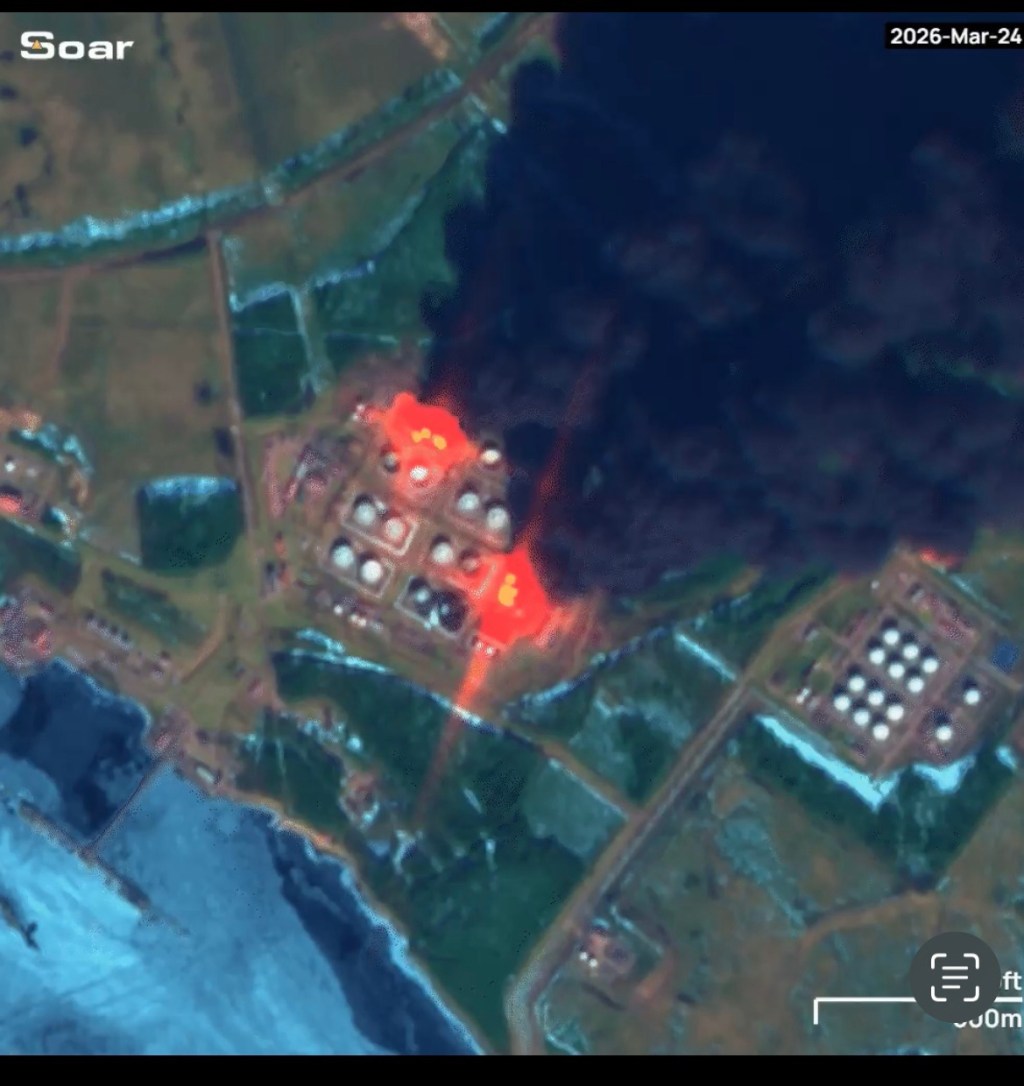
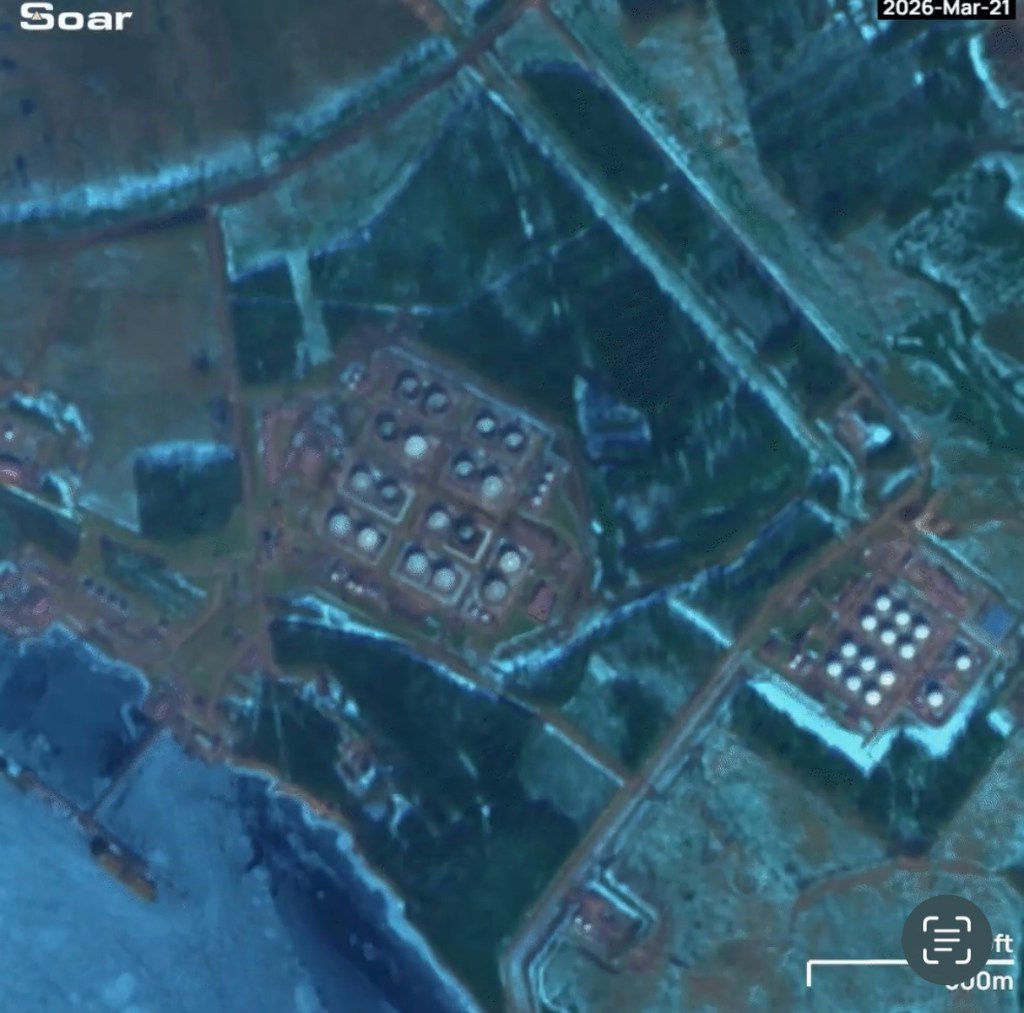
On March 22nd going into the 23rd Ukraine launched a large-scale drone attack on the Primorsk Oil Port in the Leningrad region, in the coast of the Gulf of Finland.
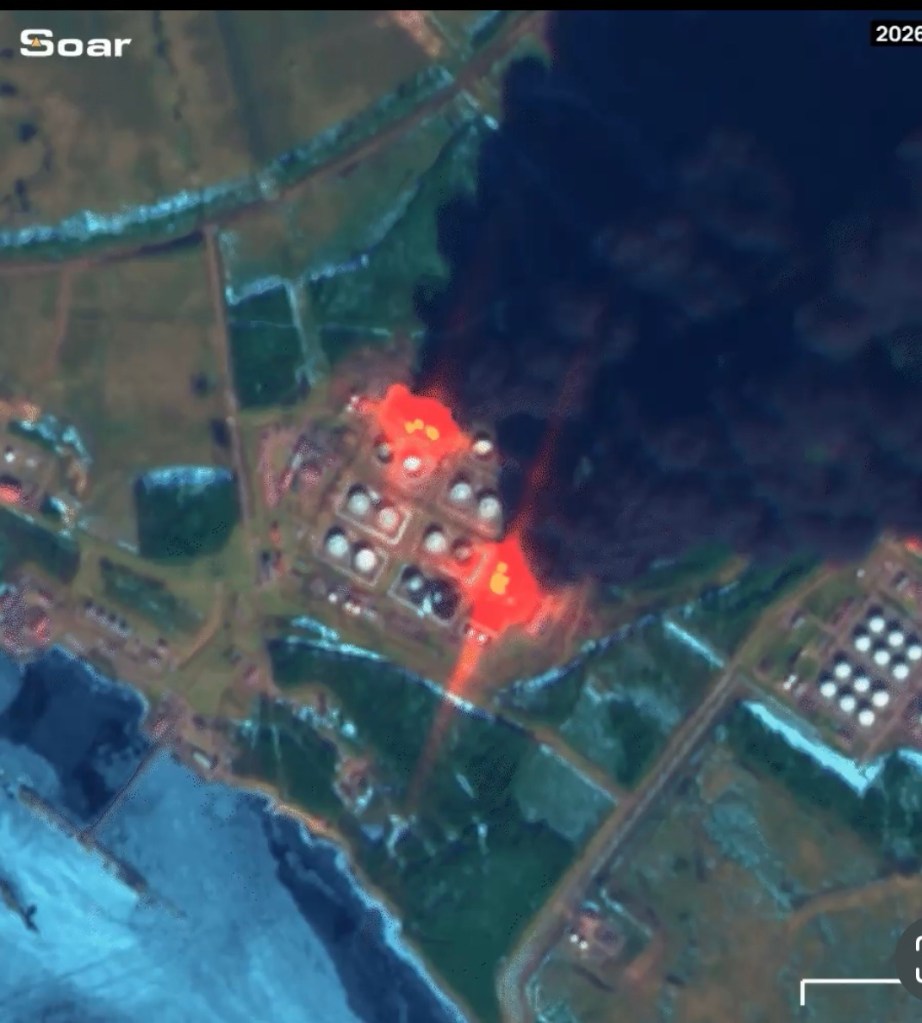
Image taken March 21st 2026 of the Primorsk Oil Port shows the terminal before the strike. Satellite image released by Soar and taken March 24th, 2026 shows the result of the attack with multiple destroyed and damaged oil storage tanks.
Ukrainian forces launched a long-range coordinated attack using multiple Kamikaze drones which traveled through hundreds of miles of Russian air defense and struck the facility, damaging multiple fuel storage tanks in the compound. Leningrad Governor Alexander Drozdenko publicly confirmed fires in “several fuel reservoirs” and said emergency crews had been fighting the blaze while workers were evacuated.
The fires were still burning 48 hours after.
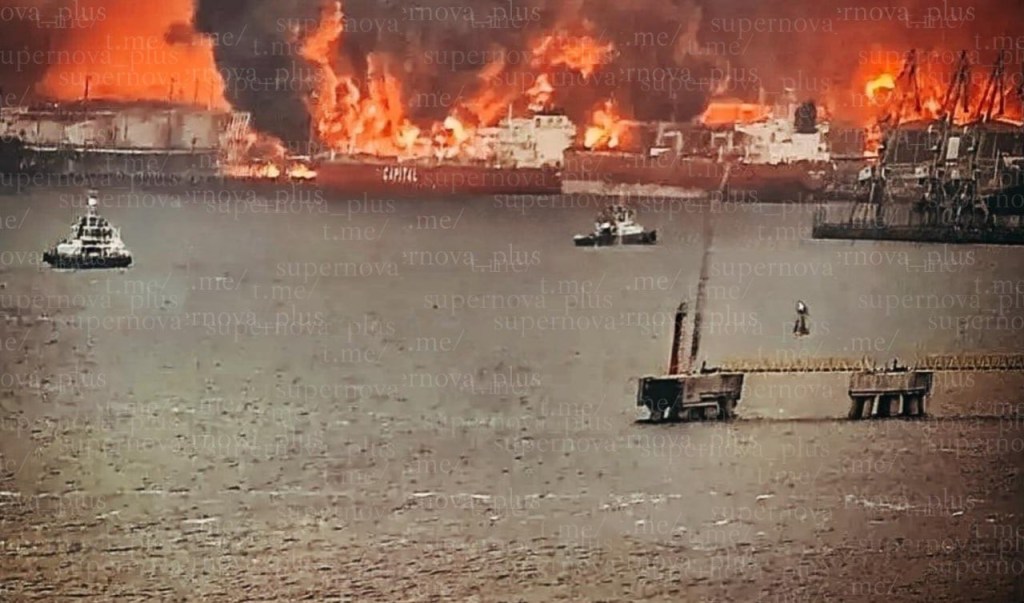
An image taken after the attack on Ust-Luga.
On the next night night a similar attack was carried out directly across the Gulf of Finland on the Ust-Luga terminal, along with many other oil production facilities in that general area in what Ukraine is calling the single largest night of drone attacks in the war.
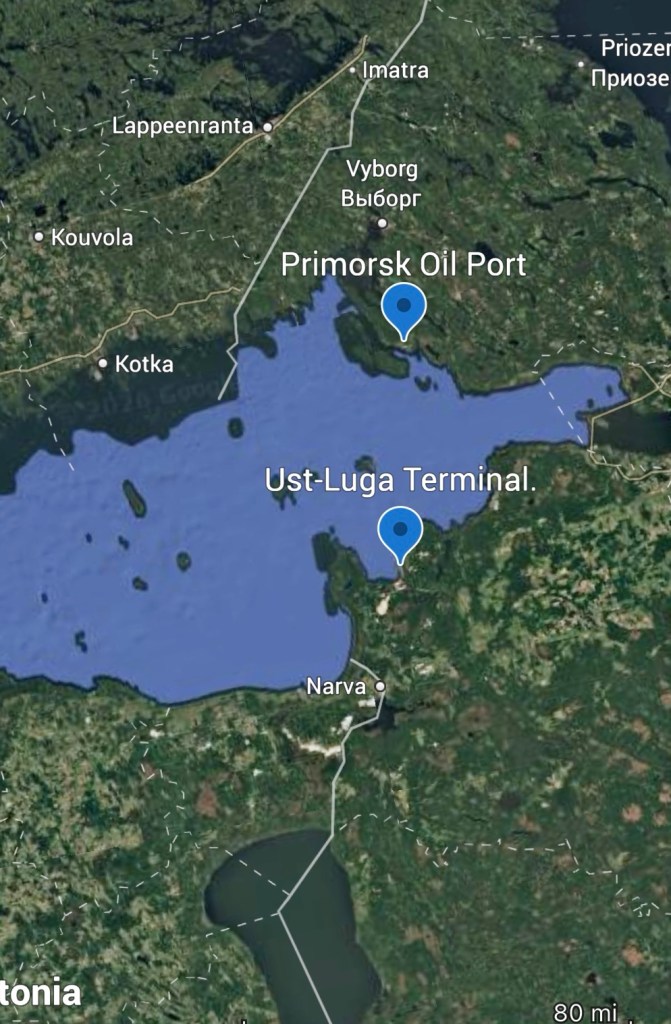
No satellite images have been released yet but we’ve plotted out both locations on Google Earth to show the proximity of the terminals to each other.
As of this month the attacks in Russia’s oil industry has caused a drop in exports by 40%. Ukraine is attempting to disrupt any Russian infrastructure that finances the ongoing war. Both sites halted production on Wednesday.
Around the time the Ust-Luga site was hit, one Ukrainian drone landed in Latvia and one crashed at an Estonian power station without causing damage.
A source that spoke to Reuters told them that the reserves had been lit on fire and that Ust-Luga had been sealed off.
The attack damaged oil loading stands as well as the tanks. The tanks are a fairly easy thing to replace but the equipment to transfer the oil to the ships is more expensive and harder to get making these strikes more devastating than just hitting the oil.
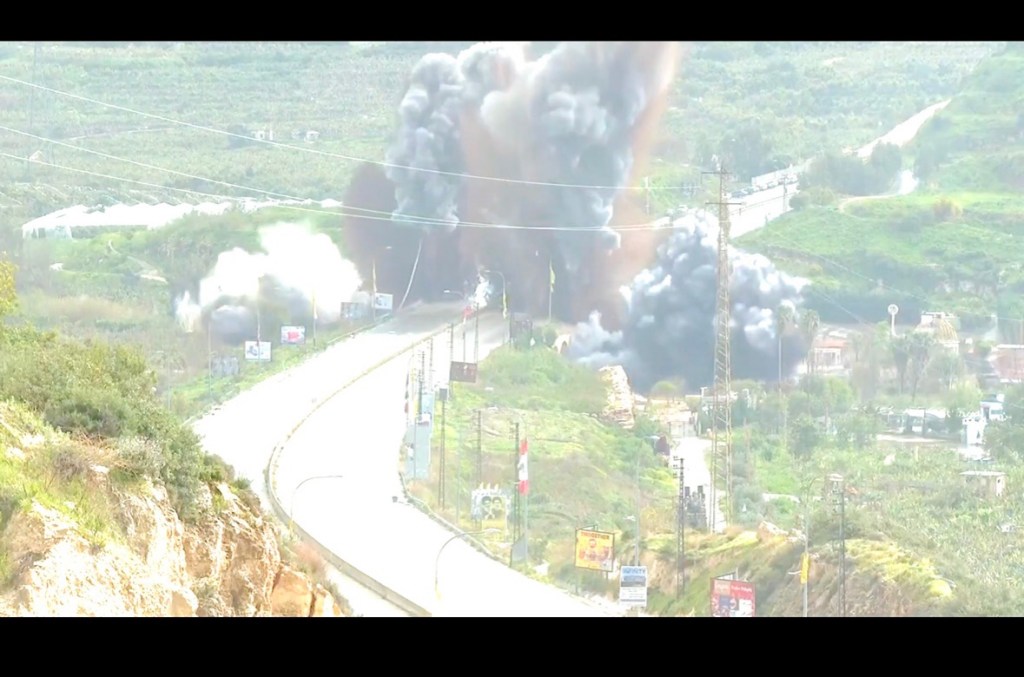
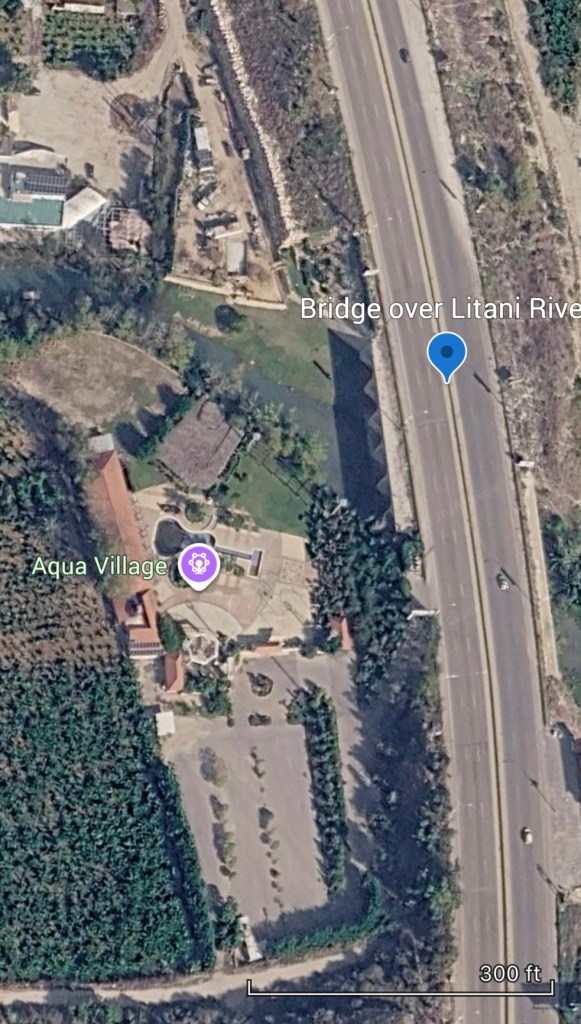
On Sunday(March 22, 2026) , Israel launched strikes on several bridges in southern Lebanon including the main Qasmiyeh Bridge over the Litani River with the aim of cutting off Hezbollah supply routes from the north coming to the areas Israel will be pushing into.
The area from the strikes shown in Google Earth (33.323951°N 35.264620°E)
The strikes come as Israel continues limited ground operations in southern Lebanon, launched earlier this month, aimed at pushing Hezbollah away from the border following months of rocket fire across the border.
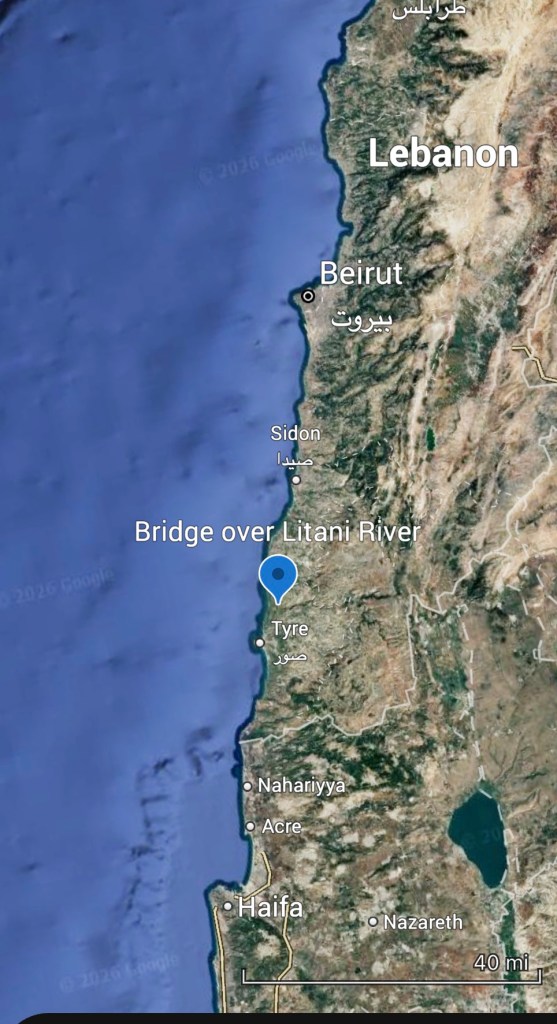
Image showing wider view of the area. The site is less than 15 miles from the Israeli border.
The Litani River lies roughly 30 km north of the Israeli border and has long been a strategic line under UN Security Council Resolution 1701 (2006), which requires the area south of it to be free of armed groups other than the Lebanese army and UN peacekeepers—something Israel says Hezbollah has repeatedly violated. That’s claim is proven by videos of Hezbollah fighters launching shoulder fired rockets into Northern Israeli border post that were circulating in social media around the time of the start of the operation into Gaza.
According to the Israeli military, Hezbollah uses these crossings over the Litani River (especially the Qasmiyeh Bridge) to transport fighters, weapons, rockets, and launchers southward. “The Hezbollah terrorist organization uses these crossings to transfer thousands of weapons, rockets and rocket launchers, which it uses to carry out terror attacks from the area south of the Litani River against IDF troops and Israeli civilians,” the IDF stated. The strikes are intended to disrupt what Israel describes as Hezbollah’s exploitation of civilian infrastructure for military resupply from northern Lebanon into the southern border zone.
Southern Lebanon has had an evacuation order in place as Israel has said they will be going forward with a planned invasion into southern Lebanon. The Israeli Defence Minister Israel Katz has said that they ordered the IDF to speed up the destruction of houses and villages in southern Lebanon calling them “a threat to Israel”. Katz also said prime minister Benjamin Netanyahu instructed the IDF to take out the bridges, and giving the order “to immediately destroy all the bridges over the Litani River that are used for terrorist activity” to “prevent Hezbollah terrorists and weapons from moving south”.Katz described the moves as part of a broader effort to accelerate home demolitions in ‘frontline villages’ using models from Gaza’s Beit Hanoun and Rafah, while warning Lebanon’s government that failure to disarm Hezbollah would lead to ‘damage to infrastructure and loss of territory.
Lebanese President Joseph Aoun condemned the strikes as a ‘dangerous escalation’ and ‘flagrant violation of Lebanon’s sovereignty,’ describing them as ‘a prelude to a ground invasion.’ Hezbollah has not issued an m statement on today’s bridge attacks, but the group has previously vowed to respond to any Israeli operations in the south.
The conflict between Israel and Lebanon has displaced more than one million people across Lebanon, around 20% of the population, with southern villages being the most affected. Aid groups warn that destroying key bridges could further isolate communities and hinder humanitarian access to those who cannot evacuate.
The strikes have raised international concerns over further escalation, though no immediate response has come from any of the major powers, regional or beyond.
March 13th it was announced that a Marine Expeditionary Unit and its supporting warships would be deploying to the Middle East region at the request of the U.S. Central Command, to help with the current operation in Iran.
This move was originally reported by the Wall Street journal and is seen as a response to the ongoing attempted closure of the Strait of Hormuz, a thin stretch of ocean that Iran has threatened to close for years, cutting off much of the oil coming from the region. The closure has had a direct effect on oil prices and the price at the pump in America and beyond.
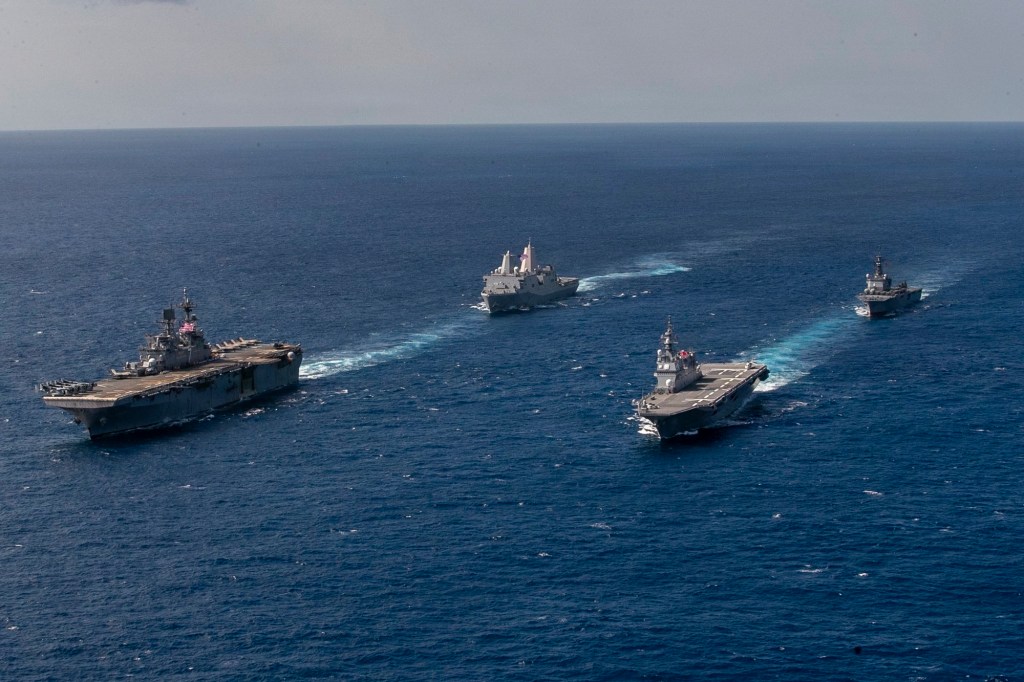
The Wall Street journal reported that the U.S. Secretary of Defense Pete Hegseth has approved a request from CENTCOM for an element of an Amphibious Ready Group as well as the attached Marine Expeditionary Unit, according to three US officials who spoke with the WSJ. The amphibious ready group or ARG is usually made up of an assault ship, two (SAN ANTONIO-Class) transport docks, and a support vessel that carries an embarked Marine Expeditionary Unit (MEU) of at least 2,200 Marines. In this case the sources who spoke to the WSJ said the USS Tripoli(LHA-7) is being sent from its usual base in Japan along with the USS San Diego (LPD-22) and USS New Orleans (LPD-18). These ships make up the 31st Marine Expeditionary Unit (31st MEU).
If needed, other MEU’s are also available for operations in the Middle East.
The Marine Expeditionary Unit was developed as a highly versatile, somewhat self-contained fighting force that can be called upon to quickly respond to situations. They were put together and usually kept in areas where the U.S. expects to need marines quickly, such as the pacific or often in the Middle East.
As stated by the Marines website the four elements of the MEU are as follows.
Command Element – Serves as the headquarters for the entire unit and allows a single command to exercise control over all ground, aviation, and combat service support forces.
Ground Combat Element – Provides the MEU with its main combat punch. Built around a Marine infantry battalion, the GCE is reinforced with tanks, artillery, amphibious vehicles, engineers, and reconnaissance assets.
Aviation Combat Element – The ACE consists of a composite medium helicopter squadron containing transport helicopters of various models and capabilities, attack helicopters and jets, air defense teams, and all necessary ground support assets.
Logistics Combat Element – Providing the MEU with mission-essential support such as medical/dental assistance, motor transport, supply, equipment maintenance, and landing is the mission of the LCE.
The marine website also list some of the missions that the MEU trains for.
– Peacekeeping/Enforcement
-Humanitarian/Disaster Relief
– Security Operations
– Noncombatant Evacuation Operations
– Reinforcement Operations
– Amphibious Raids/Assaults/Demonstrations
– Tactical Deception Operations
– Airfield/Port Seizures
– Show-of-Force Operations
– Reconnaissance and Surveillance
– Seizure/Recovery of Offshore Energy Facilities
Having the MEU available in the region does not necessarily mean that they will be used for ground combat roles. Iran still has a large fighting force made up of Iranian Revolutionary Guards Corp as well as the regular army meaning any ground operation will likely involve considerably more troops than come with the MEU. However the MEU provides a wide range of options for commanders to use towards completing their goals.
Let’s look at some of what the MEU brings to the fight.
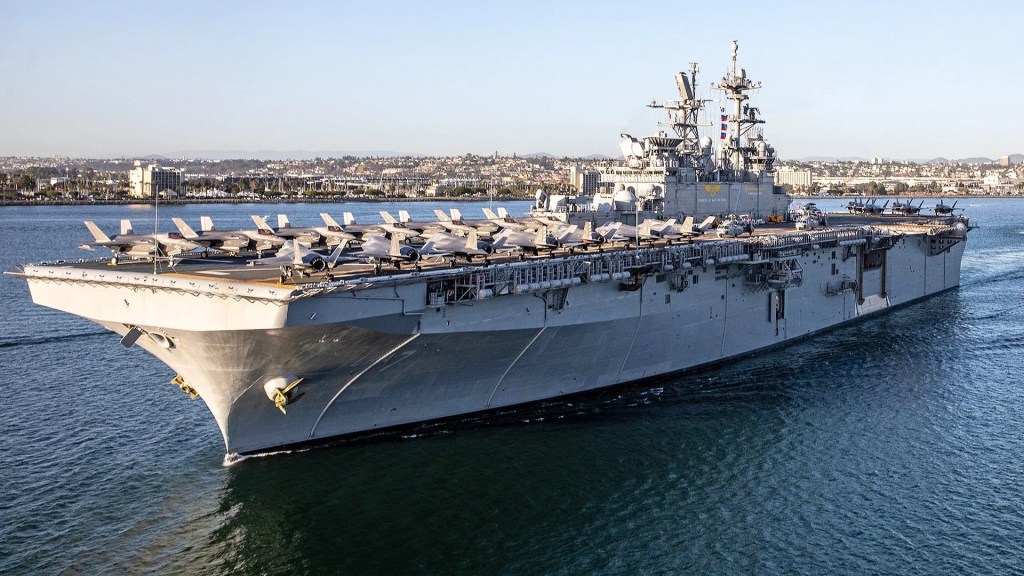
The USS Tripoli (LHA-7) is the second of the America-class amphibious assault ships, which is itself an upgrade on the Wasp-Class amphibious assault ship. This class removed the well deck usually used for landing ships, giving the Tripoli, and the America much more hanger space as well as extra aviation repair and armament storage.
USS Tripoli with its F-35B’s on deck.
The ship is protected by RIM-116 Rolling airframe missiles for protection primarily against anti-ship missiles.
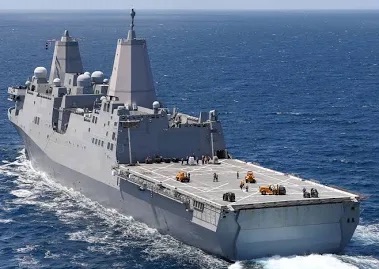
USS San Diego and USS New Orleans are both San Antonio-Class Amphibious Transport Docks. These ships mostly focus on carrying Marines and using their large CH-53 Sea Knight and MV-22 Osprey’s and landing ships to put a good sized marine fighting force anywhere nearby in a short amount of time, useful for seizing a landing zone for example.
USS San Diego
The ability of the 31st MEU to to strike targets using the F-35B’s as well as AH-1Z Viper and UH-1Y Venom helicopters it’s important in supporting the marine fighters and would be especially useful for hunting down the slow flying Shahed drones as well as the smaller craft used by the Iranian navy.
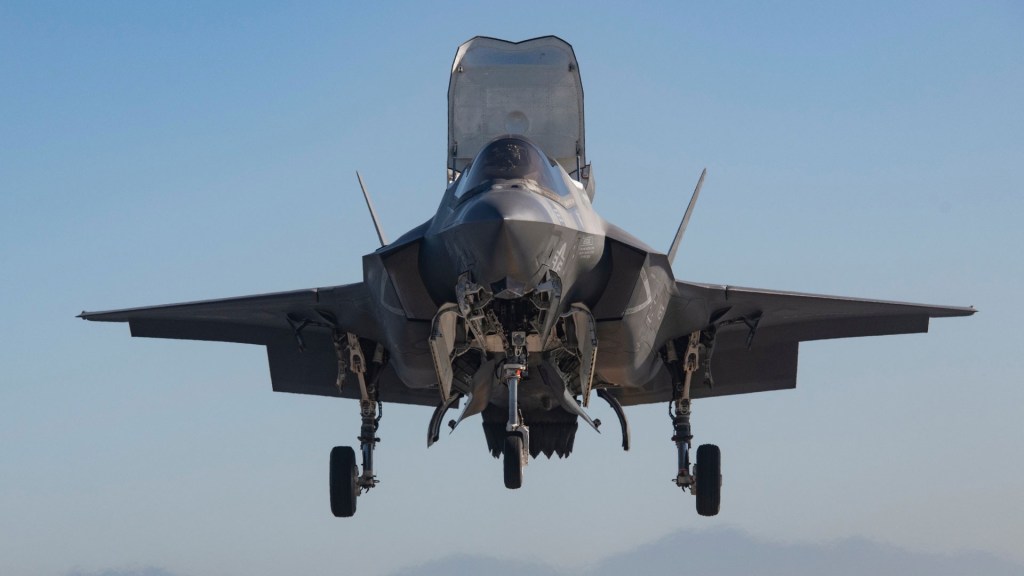
F-35B in its vertical lift mode.
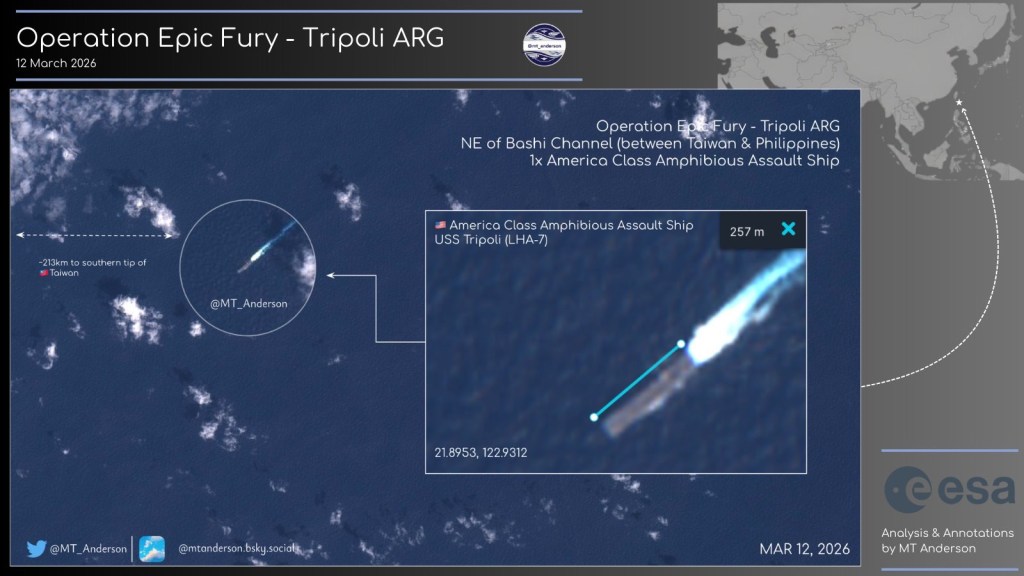
The 31st MEU should arrive in the Middle East in about two weeks.the Tripoli was spotted on satellite imagery heading south from its Okinawa home port.
Shows the USS Tripoli heading south west as it makes its journey to the Middle East.
The other Marine expeditionary units could be called to the region if needed.
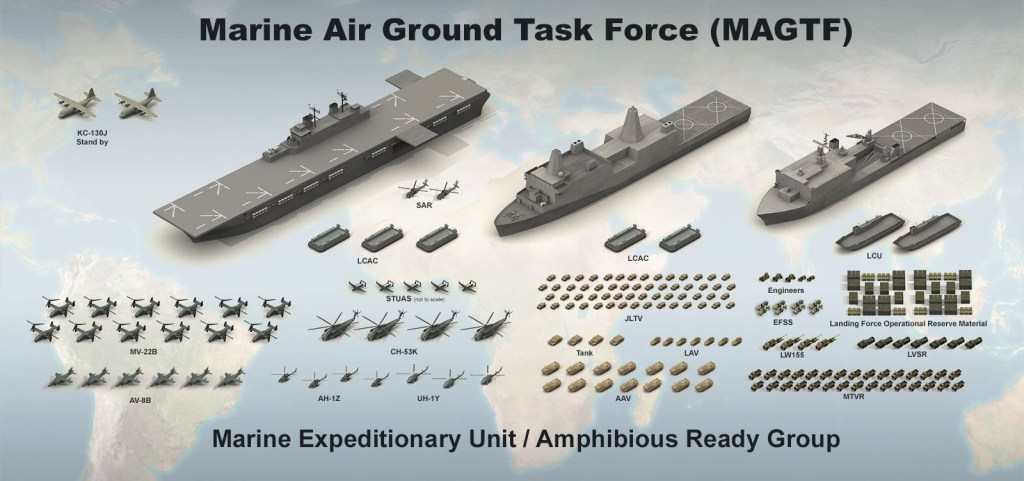
An older image but minus the AV-88B’s represents what a lot of the MEU’s are working with as far as equipment and numbers. The plan is to switch out the AV-88B’s for F-35B’s.
On February 22nd, troops from the Mexican Secretariat of National Defense (SEDENA), the government organization responsible for managing the army and Air Force and reporting directly to the country’s President, targeted Nemesio Oseguera Cervantes for arrest. The target, better known as El Mencho, the 59 year old drug lord and leader of the Jalisco New Generation Cartel (CJNG).
Reward poster for El Mencho.
Upon arriving at the scene in the town of Tapalpa in the western state of Jalisco the soldiers came under fire from CJNG gunmen resulting in a gunfight between the two groups. The soldiers killed 4 cartel gunmen during the course of the operation as well as the target himself, El Mencho. The cartel leader died along with one gunman as they were being transported via aircraft for medical attention.During the raid three soldiers were injured.
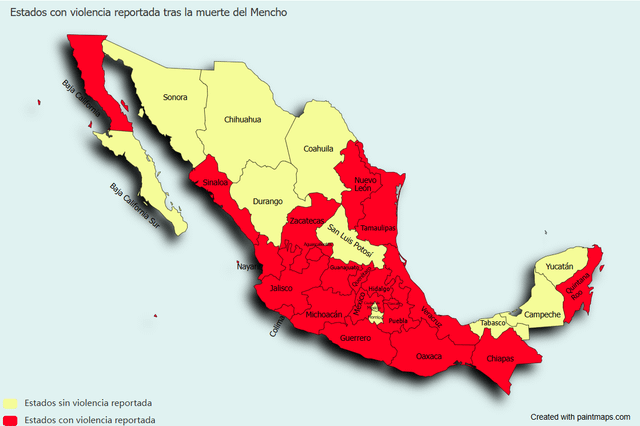
The raid itself set off a series of violent clashes across Jalisco as the cartel learned of the death of their leader. Cartel members set fire to buses and blocked roads and clashed with the police. There are some signs that the violence spread across multiple states although right now the situation is still somewhat localized to the Jalisco area.
US tourists are advised to shelter in place as the authorities attempt to regain control however right now things are still pretty rough. Video evidence has been circulated of multiple incidents showing the Mexican Guardia Nacional being ambushed by cartels in drive-by shootings and ambushes.
A UH-60 Black Hawk with the Mexican Air Force uses its mounted minigun to target gunmen with the CJNG Cartel near the prison in Puerto Vallarta, Mexico. pic.twitter.com/g0SMCD7GP7
This operation was a joint effort between the US and Mexico with the U.S. providing intelligence assistance for the operation. Mexican President Claudia Sheinbaum Pardo has shown a reluctance to target decapitation style operations on the cartels saying she believed taking out the leaders of the various cartels would just cause the groups to fracture, causing more issues down the line as more groups rise from the ashes. It’s likely that recent pressure from the United States and President Donold Trump to address the issue of drugs flowing into the US. CJNG is cited as being one of the main sources of fentanyl coming into the U.S.
This is the first article since redesigning some of the website. Please let me know if you have any issues. For now old articles aren’t going to have images on the Home Screen until I go through and correct an error but it will take a while because I have to go through all of them one by one, the new articles however will be fine and you also won’t have to scroll through full articles just to read one you missed like it used to do. The Home Screen now correctly displays the most recent post with an excerpt, as well as the most recent 5-6 articles before that, shown on the sidebar. From there, at the bottom it shows related post.
I’ll also be implementing an archive where all my old post can be easily searched as well as a corrections screen to list any mistakes over time however those are still a work in progress. I’m also revamping my about me page and the contact page just to liven things up a bit.
The United States military is continuing a buildup of forces which are signaling that an attack on Iran could be imminent. While recent movements have brought offensive might to the region, some of the important elements that one would expect to see, weren’t there. That changed today when a number of aircraft moved from US based in the continental US and Europe moved towards the Middle East and the CENTCOM area off Responsibility (AOR).
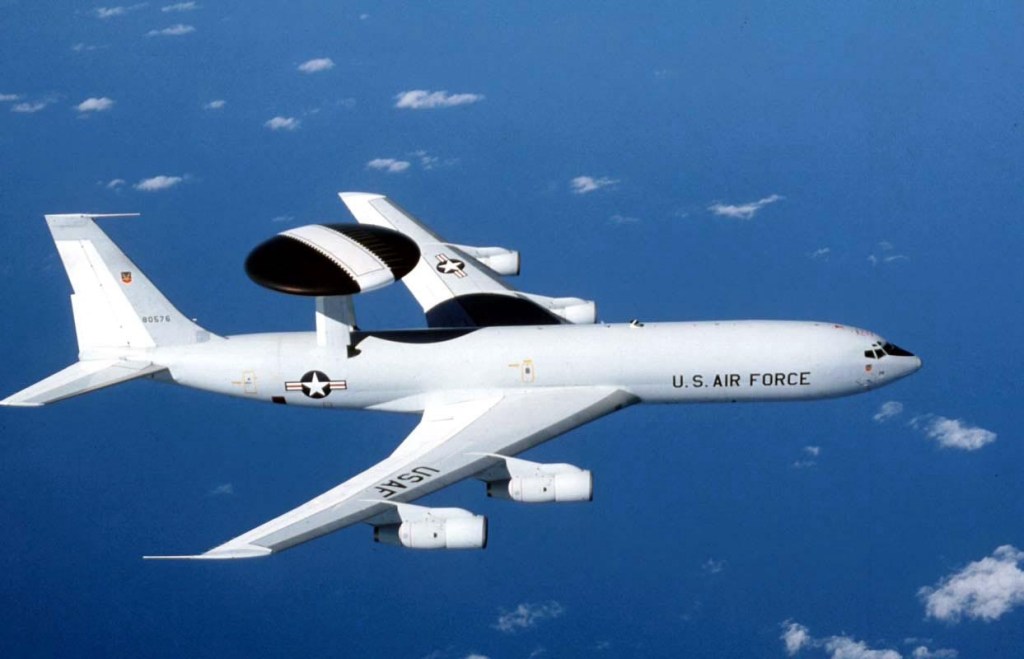
First off we have two E-3G Sentry Airborne Early Warning and Control (AEW&C) Aircraft that were seen departing Elmendorf Air Force Base in Alaska on Monday (Feb.16), DENALI01/02, arrived at RAF Mildenhall early on Tuesday at about 5:30AM Eastern (Feb.17). We expect them to continue on towards the Middle East however this could just be a routine rotation. Still something to watch. These planes are the eyes, ears and command of the US forces, coordinating air and ground forces and using their long range radar to look at the big picture.
Wow! Amazing to see 2 USAF E-3s arrive at Mildenhall this morning. DENALI01/02. 82-0007 of note especially still having markings of 961st AACS (Kadena AB) #aviation#avgeekpic.twitter.com/IJG1pE9L6T
RAF Lakenheath in Suffolk, at about 5AM Eastern time UK showed the arrival of 12 F-22 Raptors Stealth Fighters from the1st Fighter Wing supported by KC-46A Pegasus and KC-135 Stratotanker aerial refuelling tankers. They were flying out of Langley, Virginia. The F-22 Raptor is America’s most dominant air-to air platform and is usually tasked with air defense and air superiority but can also carry a number of ground attack weapons internally in its weapons bay. It was used in Syria to strike a number of ground targets, (usually with 1000lb JDAMS and GBu-39 SDB’s) and is useful for hitting high value targets in a hostile airspace using its stealth to open up air corridors for other strikers. I’d like to note that several days before Operation Midnight Hammer, when US B-2 Spirit bombers attacked Iran’s nuclear facilities, a similar crossing of F-22’s took place.
A large number of F-16′ “Vipers” have also been reported on the move as well, according to open source flight tracking. At least 36 from various bases including Aviano Air Base in Italy, Spangdahlem Air Base in Germany and McEntire Joint National Guard Base (JNGB) in South Carolina. F-16’s are one of the ultimate multi-role aircraft of their time and can be used for almost anything. Air defense, ground attack, SEAD/DEAD, CAS, anything you ask of it, the F-16 can do, making it the true workhorse of the US Air Force. These will add to the limited number of F-16’s already in the region.
Large USAF fighter deployment underway toward Middle East: 36× F-16 (12 Aviano, 12 Spangdahlem, 12 McEntire JNGB) and 12× F-22 TREND51 from Langley, supported by multiple tanker waves staging via Europe and the Atlantic toward regional bases.
The last aviation asset on the move is a U-2 Dragon Lady spy plane on its way to the region, the U-2 conducts high altitude surveillance but can also serve as a communications link between some assets that cannot communicate with each other such as the F-22 and F-35.
The US navy is reporting to some outlets that an additional Arleigh Burke-class guided missile destroyer, USS Pinckney (DDG-91) has been deployed to the region.The Pinckney departed Singapore about a week ago after some maintenance and repairs.
What was already sent.
GCR has covered the buildup since the first signs that Trump could decide to launch strikes on Iran. A link to the previous post can be found here.
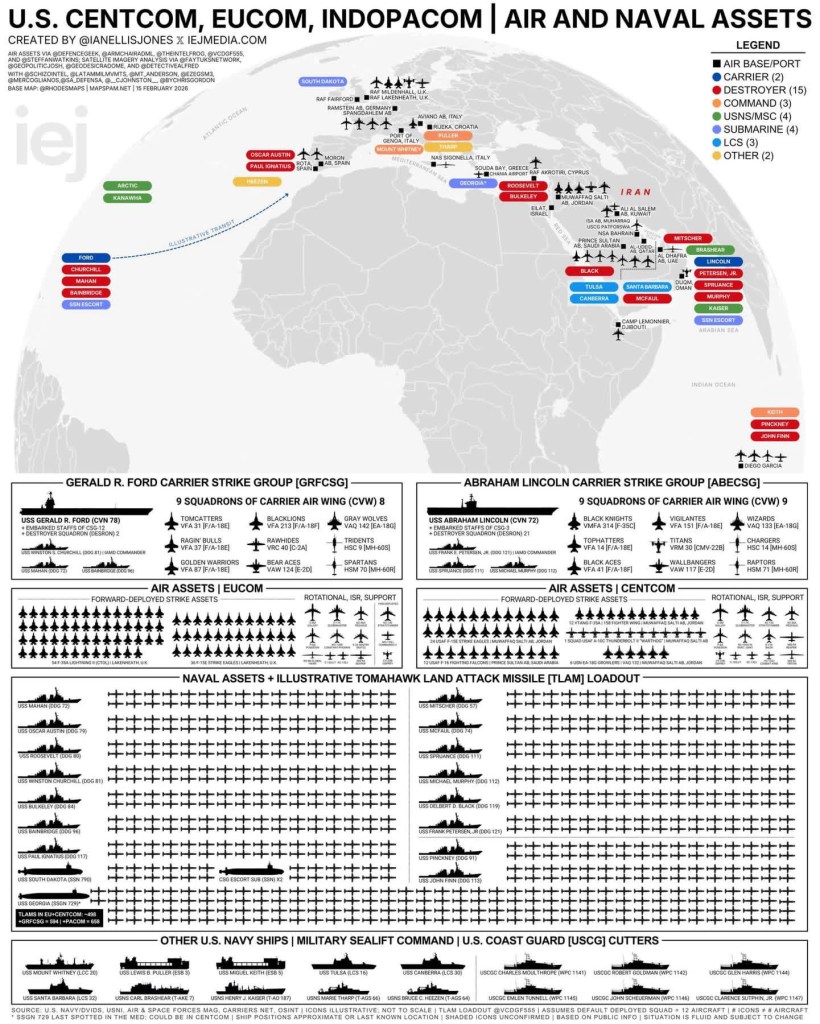
Another useful map can be found here, created by analysts and writer Ian Ellis which shows a visual representation of what has been moved and where.
These U.S. forces will almost undoubtedly be supported and assisted by the forces of the Israeli IDF who have a sizable Air Force as well, all of which they will no doubt make available.
Another unseen element not mentioned is the U.S. bomber fleet which can be called to strike targets anywhere in the U.S. with minimal notice in less than 24 hours.
The U.S. and Iran concluded their most recent set of negotiation talks early on Tuesday, Supreme leader Khamenei, talking about the arrival of the U.S. aircraft carriers to the region warned in Iranian media that that Iran’s weaponry could “sink them to the bottom of the sea.”
“Our missile program is none of America’s business,”
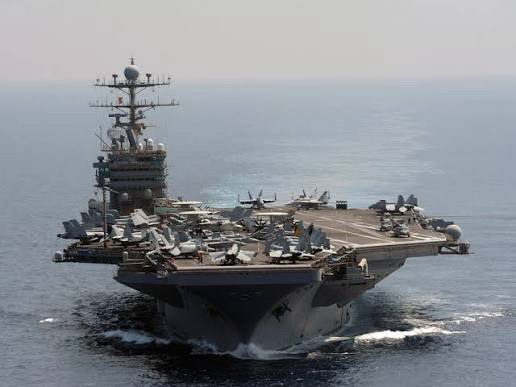
The New York Times has reported that the USS Gerald R. Ford Carrier Strike Group (CSG) will join the Abraham Lincoln CSG which arrived in the Arabian Sea earlier this month. This addition of another aircraft carrier, its escorts, and the air wing, will bolster the offensive and defensive capabilities of the forces in the region. The Ford left the Middle East late in 2025 and arrived in the Caribbean at the end of January 2026 for Operation Southern Spear, now it’s been ordered back, extending its current deployment past the normal 7 month rotation.
Both carriers, as well as the other forces in the region, including several squadrons of F-15E Strike Eagles and F-35, are a part of a military buildup to put pressure on the Iranian regime. US president Donald Trump, had threatened military strikes if Iran refused to stop its violent crackdown on anti-regime protesters. The crackdown and murder carried out by soldiers of the state was well recorded and spread through social media, even through a complete internet blackout in Iran.
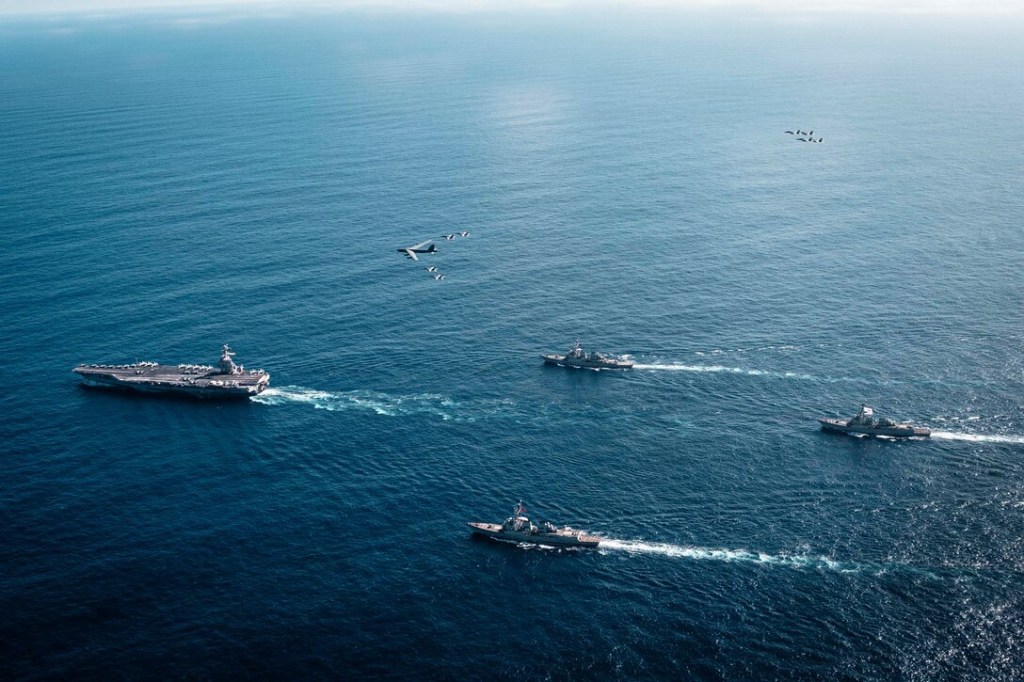
The USS Gerald R Ford CSG
Recent image of the USS Ford CSG during its operations in the Caribbean. (Bonus B-52 flyover).
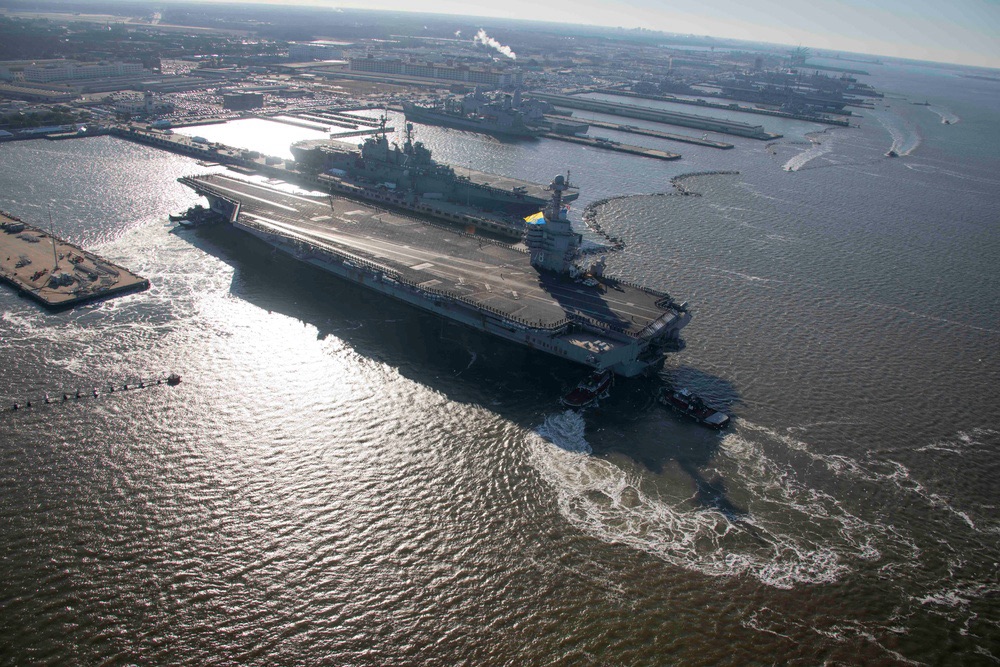
The Gerald R. Ford-Class Carrier, USS Gerald R. Ford (CVN-78) homeported at Naval Station Norfolk in Virginia.
USS Ford returns to naval station Norfolk.
Arleigh Burke-Class Guided Missile Destroyers USS Bainbridge (DDG-96) and USS Mahan (DDG-72), both homeported at Naval Station Norfolk in Virginia. Also included is the Air Defense commander USS Winston S. Churchill (DDG-81) which is homeported at Naval Station Mayport, Florida.
On the Ford is Carrier Air wing 8, details listed below.
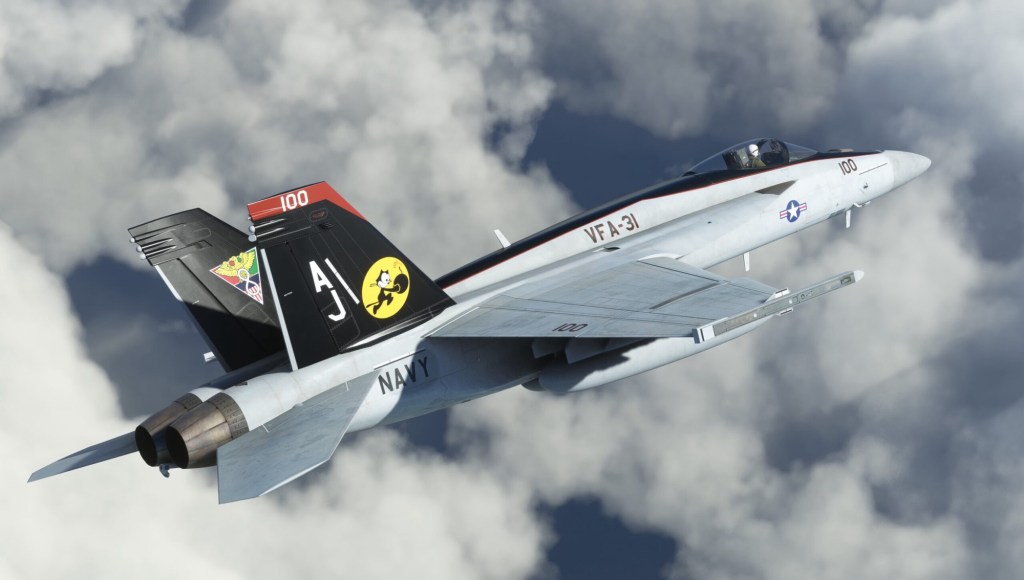
The “Tomcatters” of Strike Fighter Squadron (VFA) 31. Flying F/A-18E Super Hornets from Naval Air Station Oceana, Virginia
VFA-31 Super Hornet
The “Ragin Bulls” of VFA 37,also flying F/A-18E Super Hornets from Naval Air Station Oceana.
The “Golden Warriors” of VFA 87 flying F/A-18E superhornets from Naval Air Station Oceana.
The “Black Lions” of VFA 213, F/A-18F superhornets from Naval Air Station Oceana.
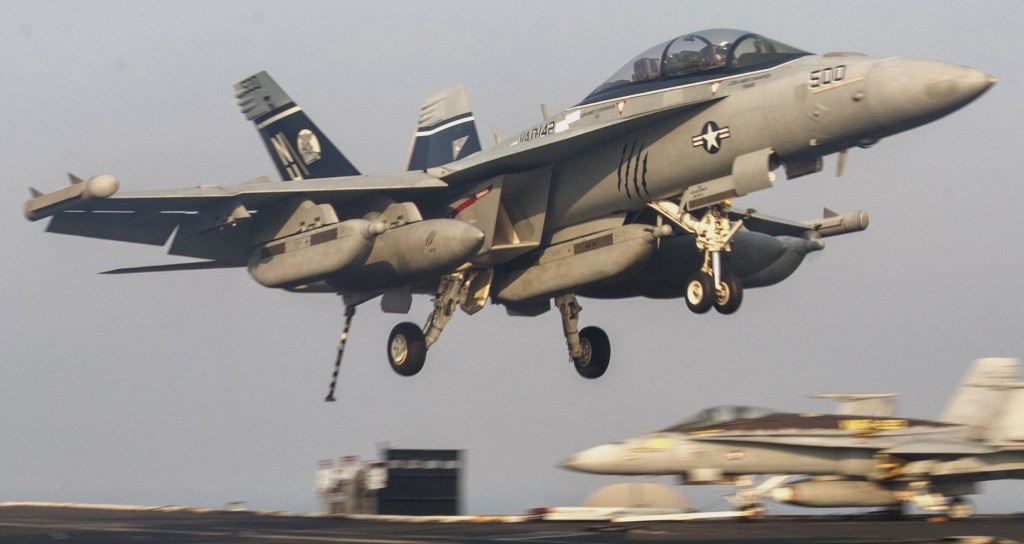
The “Gray Wolves” of Electronic Attack Squadron (VAQ) 142 flying EA-18G Growlers from Naval Air Station Whidbey Island, Washington.
VAQ-142 Growler
The “Bear Aces” of Airborne Command and Control Squadron (VAW) 124 Flying E-2D Hawkeye from Naval Air Station Norfolk,Virginia.
The “Rawhides” of Fleet Logistics Squadron (VRC) 40 Det. Flying C-2A Greyhounds from Naval Air Station Norfolk.
The “Spartans” of Helicopter Maritime Strike Squadron (HSM) 70 flying MH-60R Seahawks from Naval Air Station Jacksonville, Fla.
The “Tridents” of Helicopter Sea Combat Squadron (HSC) 9 flying MH-60S Seahawks from Naval Air Station Norfolk.
The CSG will also be accompanied by at least one unnamed attack submarine which is standard procedure.
Low missiles production a constant problem.
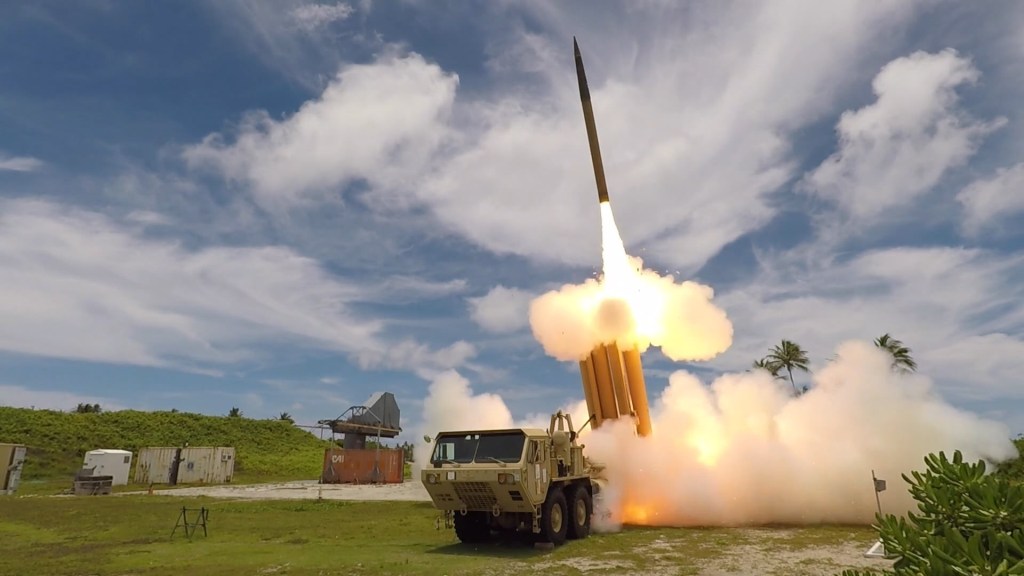
According to a recent article by the New York Times, when Trump made his threats to Iran in January the Pentagon begged him to slow down because the usual mass of US assets and forces in the region had been either redeployed or used up in the recent engagements. The U.S. burned through several months If not years worth of production of its Patriot missile stock during the Iranian ballistic missile attacks on Israel. Not to mention the even more valuable THAAD interceptor missiles,used specificly for long range theater air defense, and recently reported to have been deployed to an airbase in Jordan, had at least 25% of total stocks in 2025 engagements. A large number of Sea and air-launched air defense missiles (SM-2, SM-6) were also expended, especially in the Red Sea, during Operation Prosperity Guardian, firing hundreds of missiles defending the sea lanes against Houthi anti-ship ballistic missiles and drones.
US THAAD (Terminal High Altitude Area Defense)
While missile production has pretty much gone up across all of the defense companies, there hasn’t been a long enough time for the military to benefit from these production increases. Take the Patriot missiles for example, an important asset for any future war, Lockheed Martin only makes around 600 of them a year.
Bottom line and some opinions.
With the addition of the second CSG in the region, the potential for strikes on Iran in the near future has increased in my opinion. The Ford has been on deployment since June of 2025, being redirected multiple times to respond to the changing geopolitical landscape around the world. Moving the ford to the Middle East instead of waiting for another carrier to be available shows that the leadership believes it is important to have an another carrier there, right now.
I also believe that the U.S. should do whatever it can to avoid a long drawn out engagement in the Middle East at this time. The best option would be another “Midnight Hammer” style raid where they target several high value targets with anything other than TLAM cruise missiles, another asset the US (and CENTCOM especially) likes to deploy like it’s going out of style. My thinking here is that while the U.S. should do whatever it can for the people of Iran they also need to follow their own recommendation of focusing on the Pacific and countering China. Not to get too far off the original article but China is growing into a major threat in the Pacific and has the range with its weapons to make any engagement against them a nightmare without a surplus of land and and sea based advanced air defense weapons. The U.S. should have a base line, this is how many missiles that planners think we need for defending against China’s missiles in the Pacific and then not letting CENTCOM fire off 40-50 PAC-2 and 3 missiles in a weekend.
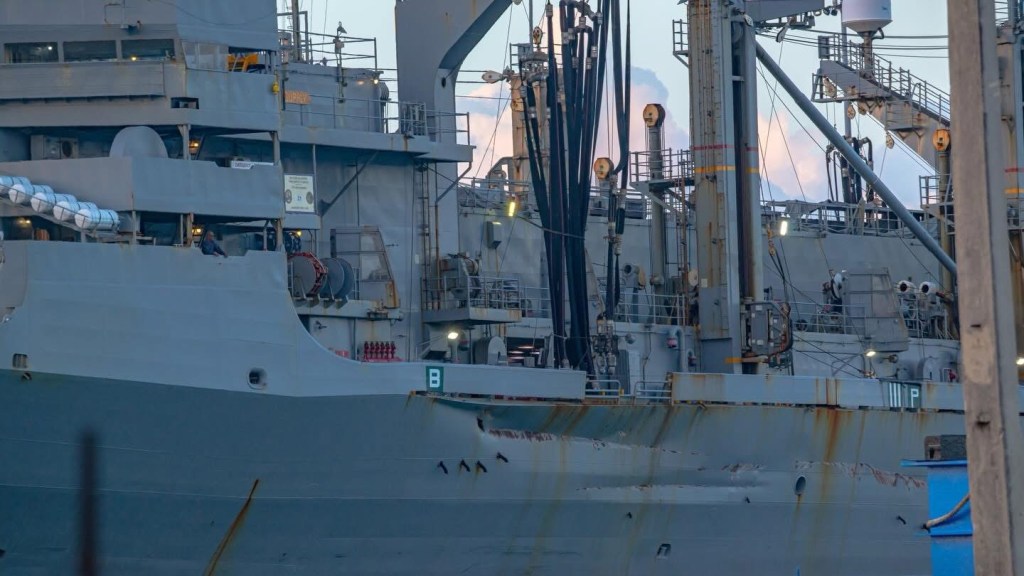
On Wednesday, February 9th, the USS Truxtun (DDG-103), an Arleigh Burke Class Guided-Missile Destroyer, collided with the USNS Supply (T-AOE-6), a Supply-Class Fast Combat Support ship during underway replenishment (UNREP) operations somewhere in the Caribbean. At the time of the incident, the USS Gettysburg (CG-64) is believed to be the ship to the port side of the USNS Supply, it can be seen for a brief second in the video.
Both known videos of the incident can be viewed below.
🚨 BREAKING: Video shows the moment the USS Truxtun and the USNS Supply collide in the Caribbean Sea.
“Yesterday afternoon, the Arleigh Burke-class guided missile destroyer USS Truxtun (DDG103) and the Supply-class fast combat support ship USNS Supply (T-AOE-6) collided during a replenishment-at-sea. Two personnel reported minor injuries and are in stable condition. Both ships have reported sailing safely. The incident is currently under investigation.”
UNREP allows ships to stay at sea and on task for much longer. Instead of finding a friendly port every time they need supplies, the supplies are brought straight to them. However, The Navy, and some sailors, consider UNREP one of the most dangerous things you can do while at sea. It’s a very hazardous operation that has the potential to go wrong in a very short amount of time even if the crews are doing everything they are supposed to do. “Seemingly minor mistakes can turn into potential severe mishaps in seconds.” Says a 2024 dispatch from the Naval Safety Center.
Mechanical malfunctions have caused a number of accidents in the past and often accounts for why these collisions take place. Problems with the rudder or even a malfunction with one of the propellers could be the cause. Certain human issues have also played a role, like stress or tiredness at the end of a long shift.
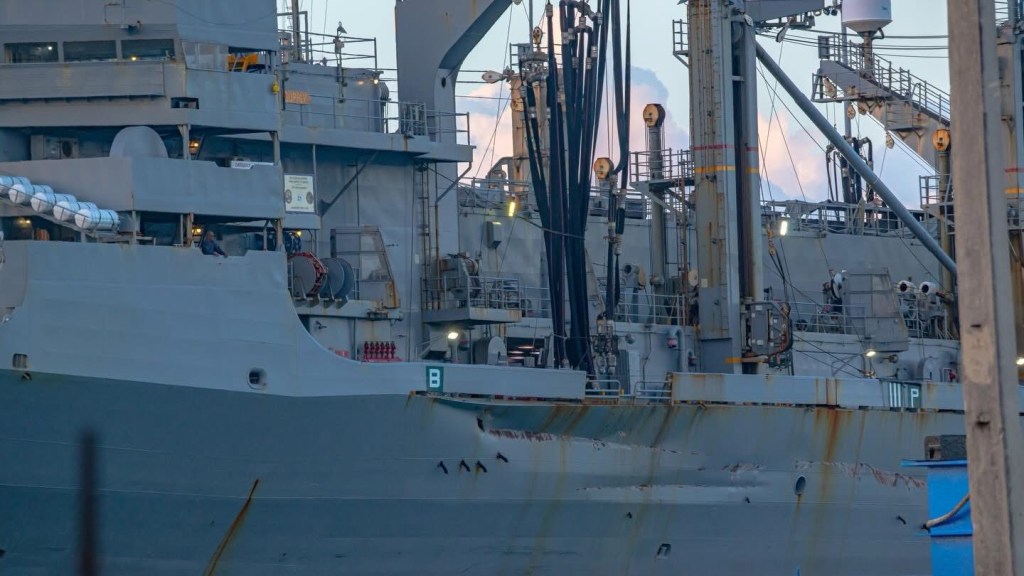
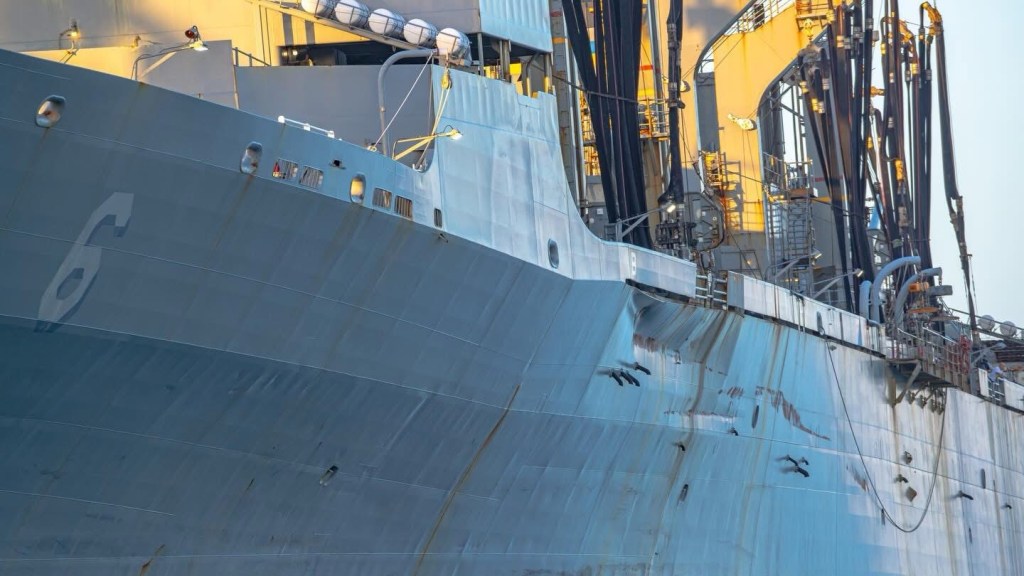
Image of the USNS Supply, taken after the ships returned to Puerto Rico.
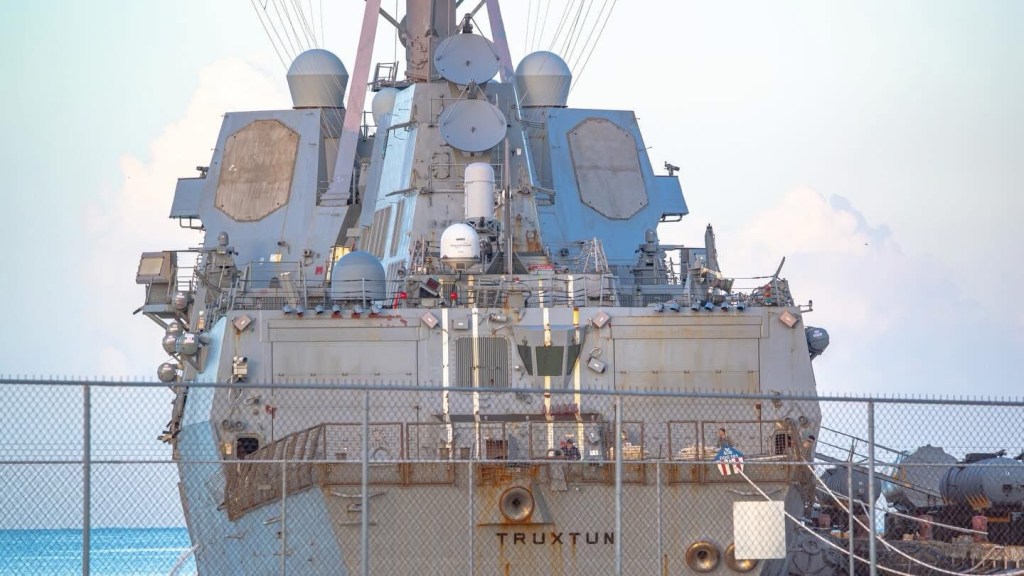
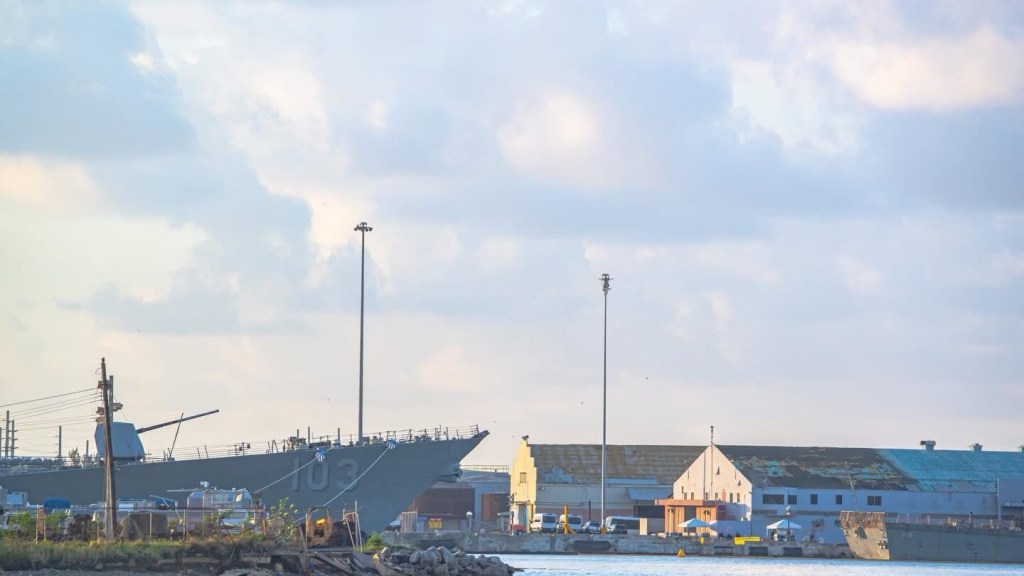
Images taken after both ships returned to Both ships were photographed at Ponce, Puerto Rico where the ships were last spotted since the incident occurred. It’s unclear how this will affect the future for the USS Truxtun’s current deployment.

 Global Conflict Reporting
You must be logged in to post a comment.